Air Pump Blood Pressure Watch vs. PPG Blood Pressure: Accuracy Comparison for Medical Applications
By
/ 2026 年 6 月 21 日
Blood pressure monitoring in wearable devices has advanced significantly, but not all technologies are created equal. This guide compares the two primary approaches — air pump (cuff-based) and PPG (optical estimation) — to help B2B buyers make informed decisions for clinical, telehealth, and corporate wellness applications.
The Two Technologies Explained
Air Pump Blood Pressure Watch (Oscillometric)
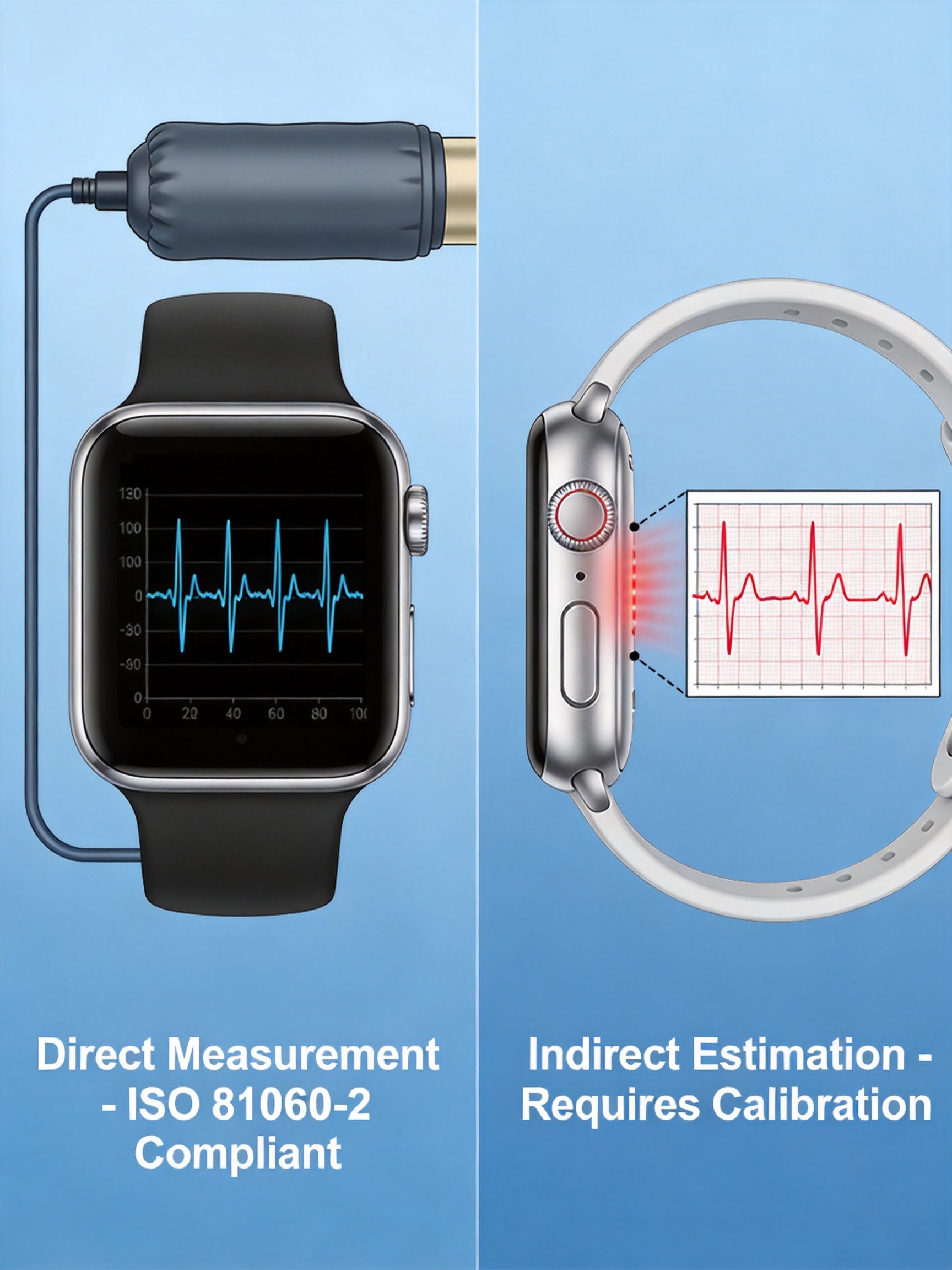
Air pump BP watches contain a miniature inflatable cuff that wraps around the wrist or arm. When a measurement is triggered, the cuff inflates to occlude blood flow, then slowly deflates while a pressure sensor detects oscillations in the arterial wall — the same oscillometric principle used in clinical blood pressure monitors.
This is a direct measurement of blood pressure, not an estimation.
PPG Blood Pressure Estimation
PPG-based BP estimation uses optical sensors to analyze pulse wave characteristics (pulse transit time, pulse wave analysis) and applies machine learning algorithms to estimate systolic and diastolic values. No cuff inflation is involved.
This is an indirect estimation derived from pulse waveform analysis, calibrated against a reference cuff measurement.
Accuracy: The Critical Distinction
Clinical Accuracy Standards
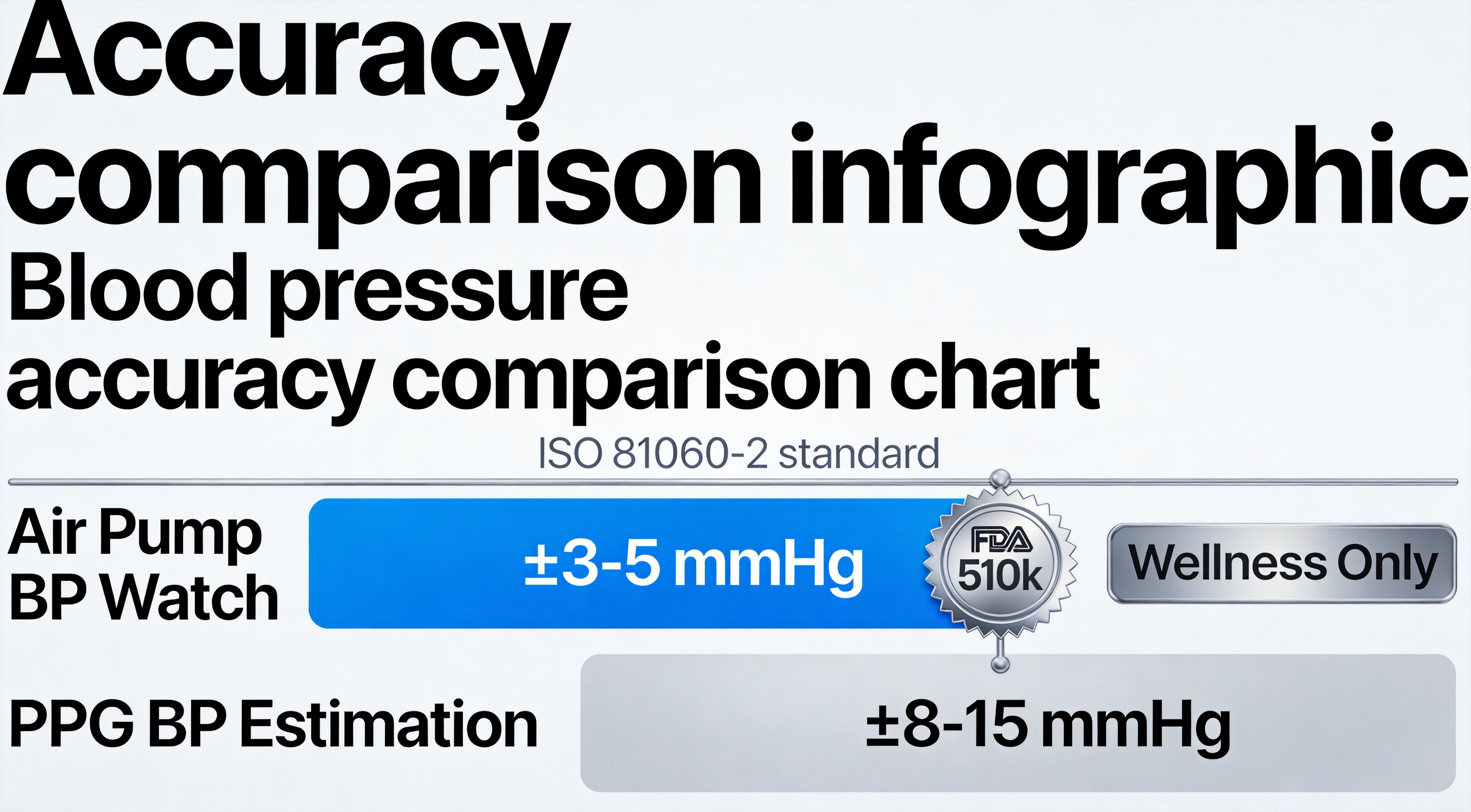
The international standard for blood pressure monitoring accuracy is ISO 81060-2, which requires: Mean difference ≤ ±5 mmHg, Standard deviation ≤ 8 mmHg, Validated against a clinical reference device.
Comparative Accuracy Data
Metric
Air Pump BP Watch
PPG BP Estimation
Measurement method
Oscillometric (direct)
Pulse wave analysis (indirect)
ISO 81060-2 compliance
Yes (medical-grade models)
No (most consumer devices)
Systolic accuracy (vs. clinical)
±3-5 mmHg
±8-15 mmHg
Diastolic accuracy (vs. clinical)
±3-5 mmHg
±8-12 mmHg
Calibration required
No
Yes (periodic recalibration)
Drift over time
Minimal
Significant (requires recalibration)
FDA clearance
Yes (Class II, 510(k))
Limited (most are wellness-only)
CE medical certification
Yes (Class IIa)
Varies (often consumer-only)
Why PPG BP Estimation Is Less Accurate
Indirect measurement: PPG measures optical pulse characteristics, not actual pressure. The algorithm must infer BP from pulse waveform shape and timing.
Calibration dependency: PPG BP requires initial calibration with a cuff device. Over time, vascular tone changes and accuracy drifts.
Individual variability: Pulse wave velocity varies significantly between individuals based on age, vascular health, and skin characteristics.
Motion sensitivity: Any movement during measurement introduces artifacts that can significantly affect the estimated values.
Regulatory limitations: Most PPG BP devices are FDA-cleared only as “general wellness” products, not for medical diagnosis.
Feature Comparison
Feature
Air Pump BP Watch
PPG BP Estimation
Cuff inflation
Yes (miniature cuff)
No
Measurement time
30-40 seconds
15-20 seconds
Continuous monitoring
No (interval only)
Possible (but lower accuracy)
FDA 510(k) clearance
Yes
Rare
Reimbursable (CMS/RPM)
Yes
No
Suitable for diagnosis
Yes (validated models)
No
Suitable for hypertension screening
Yes
Not recommended
When to Choose Air Pump BP Watch
Essential (Non-Negotiable)
Clinical hypertension diagnosis: Requires ISO 81060-2 validated device
Telehealth RPM programs: CMS reimbursement requires FDA-cleared BP device
Hospital outpatient monitoring: Clinical-grade accuracy is safety-critical
Medication titration: Treatment decisions based on BP readings require validated accuracy
Clinical trials: Regulatory submissions require validated BP data
Recommended Xdun Medical Air Pump Models
Model
Key Features
Best For
TK67 Air Pump BP Watch
Cuff + ECG + PPG + SpO2
Clinical telehealth RPM
S101 Air Pump BP Watch
Cuff + PPG
Hospital outpatient
S200 Air Pump BP Watch
Cuff + PPG + large display
Elderly care
BP100E 4G Air Pump BP Watch
Cuff + 4G connectivity
Remote standalone monitoring
S10 Pro BP Watch
Cuff + compact design
Corporate wellness screening
D16 Wrist BP Band
Mini-cuff + band form
Discreet continuous monitoring
When PPG BP Estimation Is Acceptable
General wellness trend tracking: Non-clinical awareness of BP trends over time
Consumer fitness devices: Where FDA medical clearance is not required
Screening triage: Identifying who needs clinical follow-up (with confirmation via cuff device)
Most devices classified as “general wellness” (FDA exempt)
Cannot make medical claims
Not eligible for RPM reimbursement
Cost-Benefit Analysis for B2B Programs
Factor
Air Pump BP Watch
PPG BP Watch
Unit cost (1,000+ qty)
$45-80
$25-40
Certification investment
Higher (clinical validation)
Lower
RPM reimbursement eligibility
Yes ($50-100/patient/month)
No
Liability exposure
Lower (validated device)
Higher (estimation)
Patient trust
Higher (familiar cuff method)
Lower (new technology)
Conclusion
For any application where blood pressure accuracy matters — clinical, telehealth, or regulatory — air pump (cuff-based) blood pressure watches are the only defensible choice. PPG BP estimation remains a wellness-grade technology unsuitable for medical decision-making.
Contact Xdun Medical at jine@xdunmedical.com or +86-13544254314 to discuss your blood pressure monitoring program needs.
📋 Editorial Note This content was produced with AI assistance and reviewed by human editors for factual accuracy. All medical and health claims are verified against authoritative sources (WHO, CDC, FDA, peer-reviewed journals). Learn more about our content standards →