**Meta Title:** Sports Medicine Wearables 2026 | Performance & Recovery OEM Guide
**Meta Description:** Explore how wearable technology is revolutionizing sports medicine and rehabilitation. Learn about ECG/PPG biosensing, injury prevention, recovery tracking, and OEM customization options.
—
Athletes don’t just train harder—they train smarter. And the smartest training programs now run on data.
Wearable technology has moved far beyond step counting. Today’s sports medicine wearables track biometrics with clinical precision, predict injury risk, guide rehabilitation protocols, and optimize recovery in ways that were impossible just five years ago.
For brands entering this space, the opportunity is enormous. But so is the complexity. This guide breaks down the current state of sports medicine wearables, the technologies driving them, and what OEM partners need to know to build products that actually deliver on their promises.
## The Market: Why Sports Medicine Wearables Are Booming
The numbers tell a clear story: this market is expanding rapidly on a global scale.
The global sports medicine devices market is projected to reach **$8.34 billion in 2026**, growing to **$14.29 billion by 2033** at a CAGR of 8.0%, according to Coherent Market Insights. Within this broader category, wearable sports technology is growing even faster—estimated at **$44.86 billion in 2026** and projected to hit **$98.94 billion by 2035** (CAGR 9.19%).
More importantly for medical-focused brands, the wearable medical equipment market is exploding at a **16.1% CAGR**, expected to reach **$112.3 billion by 2035**. This convergence of sports performance and clinical monitoring is where the biggest opportunities lie.
Adoption tells the same story:
– Over **39% of professional sports teams** now integrate wearable performance monitoring systems
– **71% of elite athletes** use wearables specifically for training optimization
– **58%** leverage wearables for recovery management and physiological monitoring
– **61% of sports performance centers** have adopted wearable analytics platforms
– In the U.S. alone, **67+ million Americans** use fitness wearables regularly
What’s driving this? Three forces:
1. **Clinical validation**—sensors have improved to the point where data is reliable enough for medical professionals to trust
2. **Preventive shift**—teams and athletes prioritize injury prevention over reactive treatment
3. **Remote care demand**—post-operative and rehabilitation care increasingly happens at home, with wearables as the monitoring bridge
## Key Applications in Sports Medicine
### Real-Time Physiological Monitoring
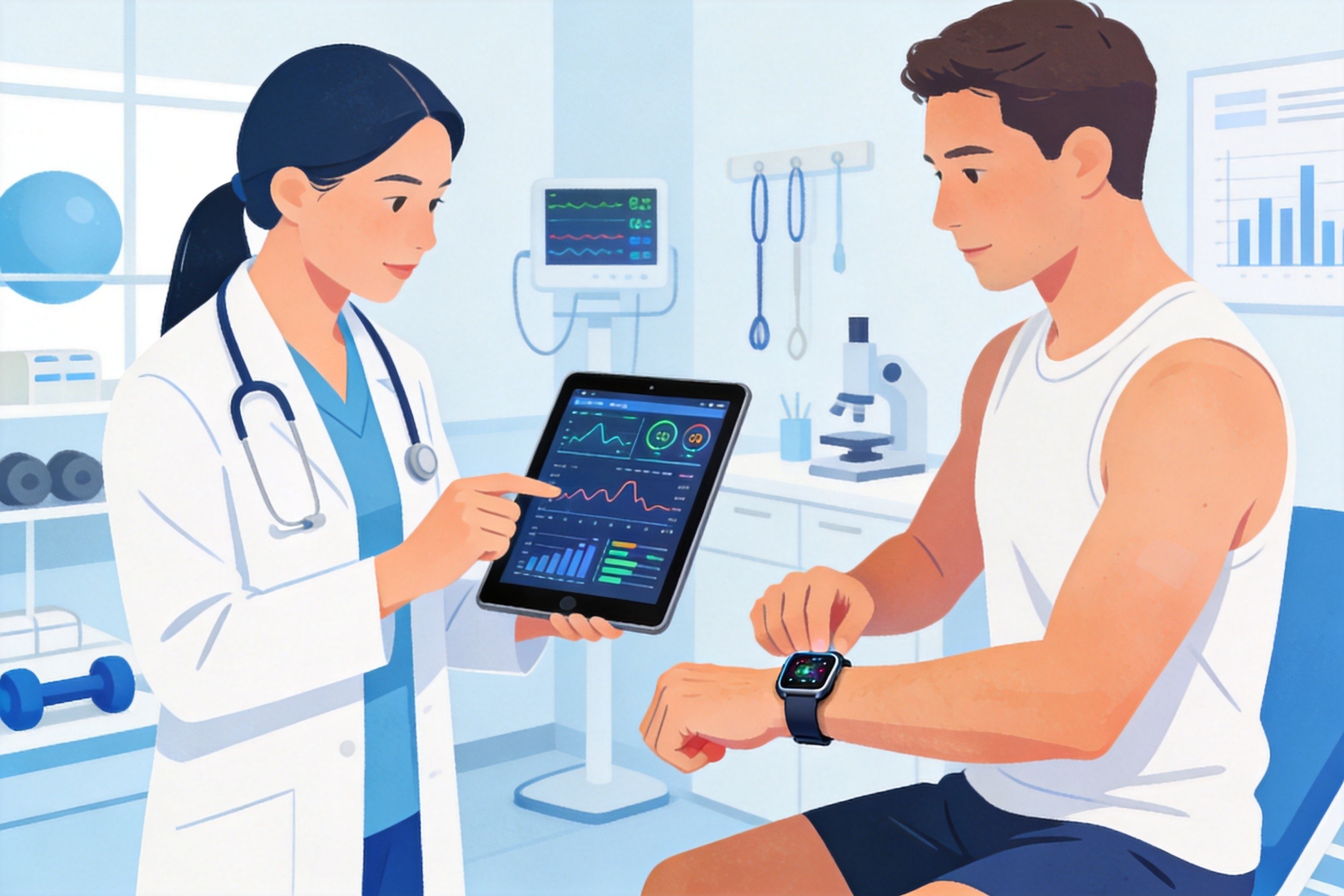
Gone are the days when “hard work” was measured by sweat and soreness. Modern wearables track core vitals continuously during training and competition:
– **Heart rate & HRV**—the foundation of load monitoring and recovery assessment
– **Blood oxygen (SpO₂)**—critical for endurance training and altitude adaptation
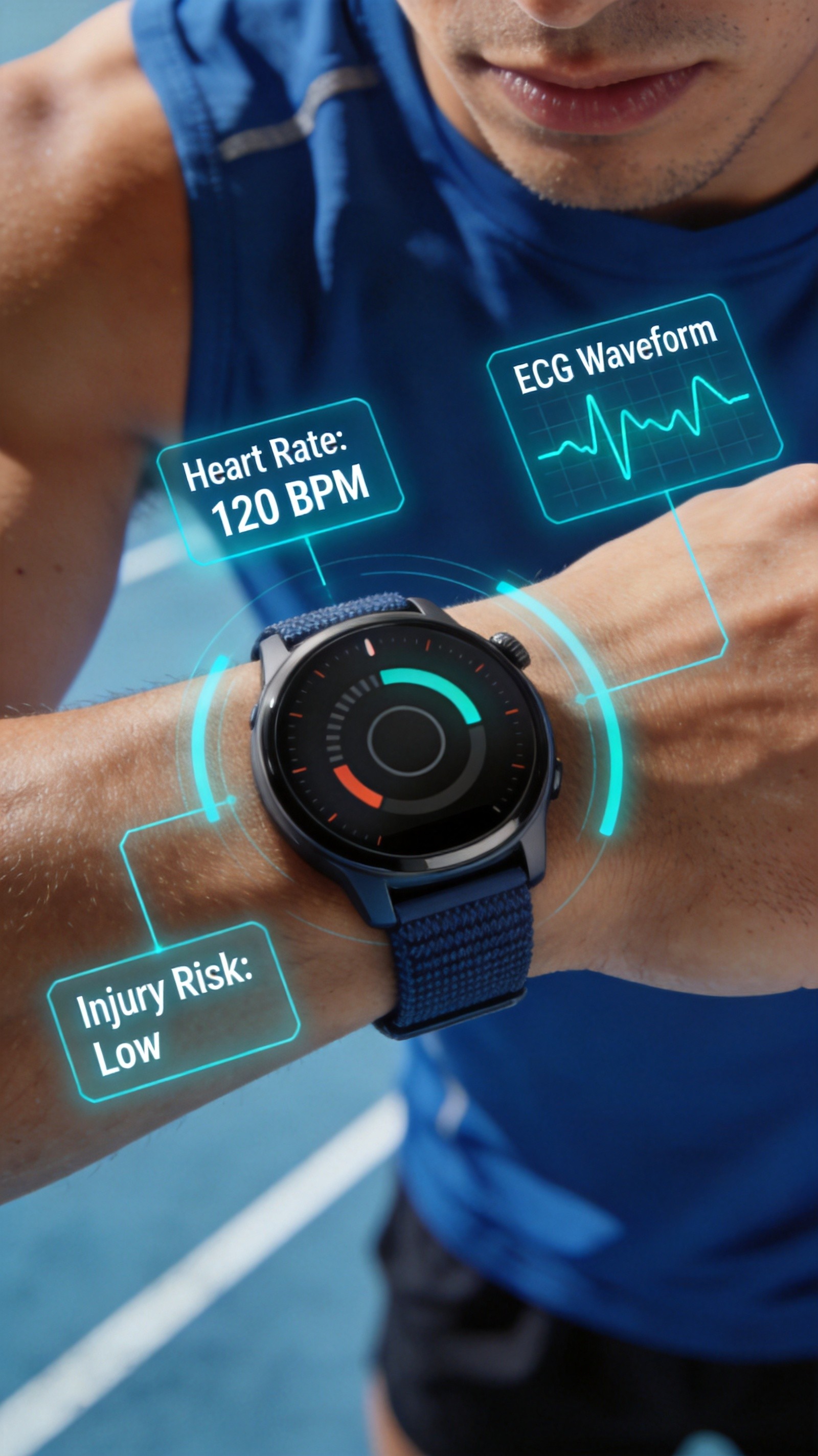
– **ECG**—detects arrhythmias and cardiac stress patterns that would otherwise go unnoticed
– **Skin temperature**—early warning signal for overtraining or impending illness
For teams and clinicians, this means decisions are based on data, not intuition. A 2024 study of professional soccer teams found that clubs using continuous biometric monitoring reduced soft tissue injuries by **28%** compared to control groups.
### Injury Prevention and Risk Assessment
This is where wearables deliver the highest ROI in professional sports.
By combining motion sensors (accelerometers, gyroscopes) with biometric data, modern systems can identify movement patterns associated with increased injury risk. For example:
– Asymmetric gait patterns linked to ACL injury risk
– Decreased HRV combined with declining power output signaling overtraining
– Impact force monitoring in contact sports to manage concussion risk
Over **29% of professional training programs** now use wearable-based injury prevention monitoring. The business case is straightforward—a single star player’s season-ending injury can cost a franchise millions in revenue and ticket sales.
### Post-Injury Rehabilitation Tracking
Rehabilitation used to rely on weekly clinic visits and patient self-reporting. Wearables change this entirely by providing **continuous, objective data** throughout the recovery process.
For physical therapists and sports medicine clinicians, wearable data enables:
– Objective tracking of recovery progress vs. subjective pain reports
– Early identification of setbacks before they become reinjuries
– Remote monitoring between clinic visits
– Personalized rehab program adjustment based on actual workload data
This is especially valuable for post-surgical recovery—like ACL reconstruction or rotator cuff repair—where returning to activity too soon causes **30% of reinjuries**.
### Recovery Optimization
Recovery isn’t passive anymore. Wearables quantify what used to be subjective:
– **Sleep analysis**—deep sleep, REM, and sleep stages directly impact muscle recovery and cognitive performance
– **HRV trends**—autonomic nervous system recovery is one of the best predictors of readiness to train
– **Stress monitoring**—chronic stress elevates cortisol, impeding recovery and increasing injury risk
Teams using wearable-guided recovery protocols report **26% fewer recurring injuries** and faster return-to-play timelines, according to data from the 360 Research Reports wearable medical equipment analysis.
## Core Technologies Powering Medical-Grade Sports Wearables
Not all wearables are created equal. Medical and professional sports applications require engineering that consumer-grade devices skip. Here are the technologies that matter.
### PPG Biosensing
Photoplethysmography (PPG) uses light to measure blood volume changes through the skin. It’s the technology behind heart rate, blood oxygen, and even blood pressure estimation in wearables.
For sports medicine applications, key specifications include:
– **Sampling rate**: 100–500 Hz for accurate HRV measurement during movement
– **Sensor quality**: Multi-channel PPG with noise cancellation for motion artifact reduction
– **Wavelength optimization**: Green for heart rate, red/IR for SpO₂
The KR96PRO screenless smart bracelet, for example, uses a **PD2325 + GH3228T PPG chip** running at 500Hz sampling—specifications usually found in medical devices, not consumer wearables.
### ECG Monitoring
Electrocardiography in wearable form is one of the most significant advancements in sports medicine tech. Unlike PPG-based heart rate monitoring, ECG measures the heart’s electrical activity directly, enabling:
– Arrhythmia detection (AFib, PVCs)
– More precise HRV analysis
– Cardiac stress assessment during exercise
For endurance athletes—who face elevated cardiac risk from long-term intense training—wearable ECG can be genuinely life-saving.
### IMU Motion Analysis
Inertial Measurement Units combine accelerometers, gyroscopes, and sometimes magnetometers to capture movement data. In sports medicine, they enable:
– Gait analysis and asymmetry detection
– Jump height and power measurement
– Running form metrics (cadence, ground contact time, vertical oscillation)
– Impact force tracking in contact sports
The accuracy of these sensors—when paired with good algorithms—is now sufficient to replace expensive motion capture labs for many field applications.
### Multi-Sensor Data Fusion
The real power of modern wearables isn’t any single sensor—it’s what happens when you combine them.
Data fusion algorithms integrate inputs from PPG, ECG, IMU, and temperature sensors to generate insights that no sensor could produce alone. For example, combining motion data with heart rate data allows systems to distinguish between actual cardiac stress and sensor noise caused by arm movement during running.
This is where OEM partners with strong algorithm capabilities create real differentiation.
## Product Portfolio for Sports Medicine Applications
Not every wearable fits every use case. Here’s how different form factors map to sports medicine applications:
| Product Type | Best For | Key Features | Battery Life | Target Setting |
|————–|———-|————–|————–|—————-|
| **Fitness Tracker (W01)** | Entry-level health monitoring, corporate wellness programs | Heart rate, SpO₂, sleep tracking, 11+ sports modes | 5–7 days use, 25–30 days standby | Gyms, corporate wellness, consumer fitness |
| **Screenless ECG Bracelet (KR96PRO)** | 24/7 health monitoring, remote patient care | ECG, HRV, blood pressure, body composition, 120+ sports modes, screenless design | 5–30 days use | Rehabilitation clinics, elderly care, long-term monitoring |
| **GPS Sports Watch** | Outdoor training, endurance sports, team sports | Multi-satellite GPS, route tracking, barometer, advanced sports metrics | 10–24 hours GPS | Running clubs, triathlon, professional teams |
| **EMS Massage Watch** | Muscle recovery, pain relief, post-workout relaxation | 6 massage modes (acupressure, kneading, cupping), health monitoring | 5–7 days | Recovery centers, physical therapy, wellness brands |
| **Smart Ring** | Sleep tracking, 24/7 biometrics, premium positioning | Lightweight, sleep monitoring, HRV, activity tracking | 5–7 days | Premium wellness, sleep optimization, elite athlete recovery |
## OEM/ODM Considerations for Sports Medicine Brands
Building a sports medicine wearable is different from building a consumer fitness tracker. Here’s what brands need to consider when selecting an OEM partner.
### Sensor Quality Directly Impacts Clinical Credibility
You can’t build a medical-grade product with consumer-grade sensors. Look for partners who specify **actual sensor part numbers** and can provide performance data, not just marketing claims.
For example, Xdun Technology’s health wearables use named components like the JL 7013A main chip, Maxim-series PPG sensors, and STMicro motion sensors—transparency that matters when you’re building a brand around accuracy.
### Algorithm Expertise Matters More Than Hardware Specs
Two devices with identical sensor hardware can deliver wildly different accuracy levels depending on the algorithms processing the data.
Your OEM partner should have:
– Proprietary signal processing for motion artifact reduction
– Validated detection algorithms with published accuracy data
– Ability to customize algorithms for specific use cases (e.g., sports-specific heart rate zones)
### Regulatory Strategy Starts Early
If you’re marketing your wearable for medical or clinical applications, regulatory compliance isn’t an afterthought—it shapes the entire product development process.
Key certifications for sports medicine wearables:
– **CE (RED/EMC/LVD)**—required for EU market entry
– **FCC**—mandatory for the U.S.
– **ISO 13485**—quality management for medical devices
– **MDR compliance**—if making medical claims in the EU
Experienced OEM partners like Xdun can guide you through these pathways and help you determine which functions can be marketed as wellness features vs. requiring full medical device certification.
### Battery Life Is a Non-Negotiable Feature
In sports medicine, the best wearable is the one the athlete actually wears consistently. Battery life directly impacts adherence.
A device that needs daily charging will get left behind on road trips, forgotten on chargers, and eventually abandoned. Look for **5+ days of battery life** for general health wearables, and **10+ hours of GPS tracking** for sports-specific models.
The KR96PRO achieves 30+ days of use on a single charge precisely because it eliminates the power-hungry display—an interesting design tradeoff for 24/7 monitoring applications.
## The Future: Where Sports Medicine Wearables Are Headed
The next 3–5 years will bring capabilities that sound like science fiction today:
**AI-powered injury prediction**—systems that don’t just report data but predict when an athlete is approaching injury risk thresholds, with increasing accuracy as they learn individual patterns.
**Smart fabric integration**—biometric sensors woven directly into clothing, eliminating the need for wrist-worn devices entirely. Currently used by **18% of elite sports organizations**, this category is growing fast.
**Hydration and electrolyte tracking**—non-invasive monitoring of hydration status through skin impedance or sweat analysis, a game-changer for endurance sports.
**Clinical-grade blood pressure estimation**—cuff-free BP monitoring validated for clinical use, bringing a vital health metric to continuous wearable tracking.
For brands, the window to establish position in this expanding market is open now—but it won’t stay open forever.
## Frequently Asked Questions
**Q: What’s the difference between consumer fitness wearables and medical-grade sports medicine wearables?**
A: Three key differences: sensor quality and sampling rate, algorithm validation for medical accuracy, and regulatory compliance. Consumer wearables prioritize battery life and aesthetics over clinical precision. Medical-grade devices use higher-quality sensors at faster sampling rates, with algorithms validated against clinical gold standards.
**Q: How accurate are wearable ECG devices for athletes?**
A: Modern single-lead ECG wearables are accurate enough to detect major arrhythmias like atrial fibrillation with **95%+ sensitivity** when used correctly. However, motion artifact during intense exercise can reduce accuracy, which is why quality signal processing algorithms are critical for sports applications.
**Q: What certification do I need for a sports medicine wearable in the U.S. and EU?**
A: For general wellness claims, FCC (U.S.) and CE (EU) are required. If you make medical or diagnostic claims, you’ll need FDA clearance (U.S.) or MDR compliance (EU). Many brands start with wellness positioning and pursue medical certifications later as they build clinical evidence. ISO 13485 is also valuable for quality system credibility.
**Q: Can smart rings really be used for sports medicine applications?**
A: Smart rings excel at 24/7 health monitoring and sleep tracking—both critical for recovery management in sports. They’re less suited for real-time performance tracking during workouts (no display, less motion-resistant sensor positioning). The ideal setup is often a ring for all-day recovery monitoring paired with a watch for training sessions.
**Q: What’s the typical MOQ for custom sports medicine wearables?**
A: Entry-level fitness trackers can have MOQs as low as 500–1,000 units for logo customization. Full custom designs with unique features typically require 3,000–5,000 unit MOQs. Medical-grade devices with specialized sensors may have higher minimums due to component sourcing and certification costs.
## Build Your Sports Medicine Wearable With Confidence
The sports medicine wearable market is growing fast, and brands that establish credibility now will capture the most value as the market matures. But building a device that actually delivers on performance and accuracy claims requires more than just a good idea—it takes an OEM partner with real engineering depth.
Xdun Technology has over **14 years of smart wearable OEM/ODM experience**, with in-house capabilities spanning PCB design, firmware development, algorithm optimization, and app development. Our portfolio includes everything from entry-level fitness trackers to ECG-enabled medical wearables, all built in our **ISO 9001-certified 24,000 m² manufacturing facility** with a daily capacity of 50,000 units.
Whether you’re launching a sports recovery brand, outfitting a rehabilitation clinic, or building a team monitoring solution, we can help you select the right form factor, sensors, and features for your specific use case.
**Ready to discuss your sports medicine wearable project?** Reach out to our team for a consultation—we’ll walk you through the options, provide transparent pricing, and help you bring a product to market that athletes and clinicians can actually trust.
*Email: jine@gysmartwatch.com | WhatsApp: +86 186 8227 4360*
—
**Internal links to add:**
– [Smartwatch OEM Cost Breakdown](https://xdunmedical.com/smartwatch-bom-cost-explained/)
– [Medical Wearable Certification Guide](https://xdunmedical.com/smartwatch-certification-guide/)
– [Smart Ring vs Watch Comparison](https://xdunmedical.com/smart-ring-vs-smartwatch-best-wearable/)
**Tags:** sports medicine wearables, wearable technology, athletic performance, injury prevention, rehabilitation tech, ECG smartwatch, fitness tracker OEM, sports recovery devices, medical wearables, wearable biosensing