#The World Health Organization’s 2025 World Mental Health Today report delivers a sobering statistic: roughly one in eight people on the planet — approaching one billion individuals — lives with a diagnosable mental disorder. Depression alone affects an estimated 332 million people globally, while anxiety disorders touch approximately 359 million. The National Institute of Mental Health (NIMH) reports that in the United States, more than one in five adults experienced a mental illness in the past year, with anxiety disorders representing the single largest category at 19.1% prevalence.
Behind these numbers sits an economic reality that corporate decision-makers and health system administrators can no longer bracket as a “soft” concern. Depression and anxiety, by the WHO’s own accounting, strip roughly US$1 trillion from the global economy each year through lost productivity. For an enterprise running a 5,000-employee workforce, the math translates into millions in absenteeism, presenteeism, and turnover costs that land directly on the P&L.
Yet the clinical infrastructure built to address this crisis remains stubbornly episodic. A patient completes a PHQ-9 or GAD-7 questionnaire during a quarterly psychiatry visit. The clinician makes treatment decisions based on a 15-minute snapshot of self-reported symptoms. Between appointments, weeks pass with no objective data. This is the gap that wearable technology is beginning to close — not by replacing clinicians, but by giving them a physiological data stream that runs continuously between encounters.
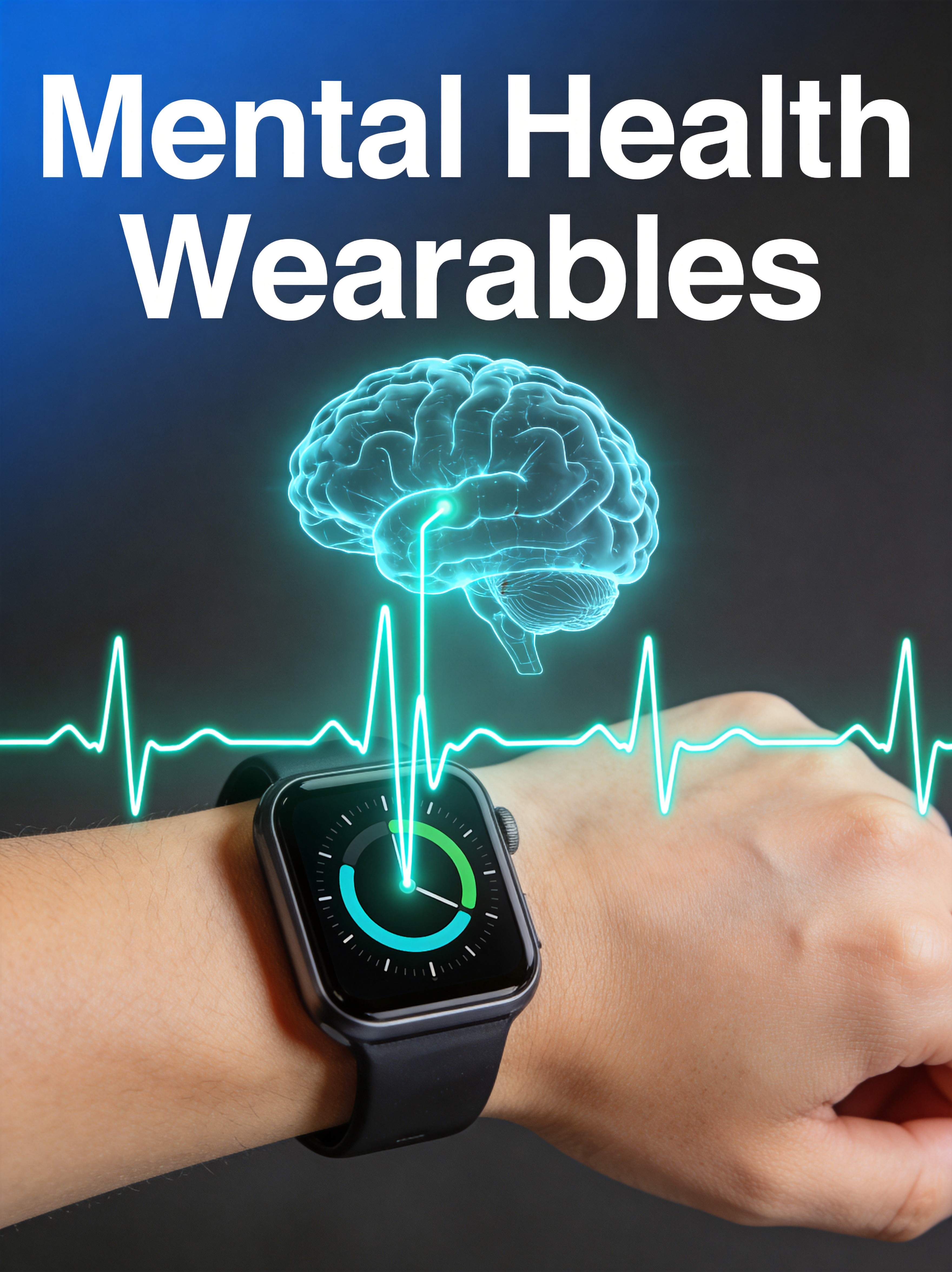
Medical-grade wearable devices with continuous HRV, EDA, and respiratory monitoring are transforming behavioral health screening.
The Autonomic Nervous System as a Mental Health Dashboard
Consumer wearables spent a decade chasing step counts and calorie burns. Those metrics are orthogonal to mental health. A person can log 10,000 steps while weathering a panic attack. The biometric signals that correlate with psychological states live in a different domain entirely: the autonomic nervous system (ANS). As covered in our B2B OEM guide on medical wearables for allergy and immunology and anaphylaxis prevention, capturing highly specific, context-dependent physiological and environmental data is equally critical for managing acute immune reactions.
The ANS regulates the balance between sympathetic arousal — fight-or-flight — and parasympathetic recovery. When that balance tilts chronically toward sympathetic dominance, the body registers the shift in measurable ways long before the person can articulate that something is wrong. Three signals carry the bulk of the clinical evidence:
Heart Rate Variability (HRV)
HRV — the millisecond-level variation between consecutive heartbeats — is the most exhaustively studied biomarker of autonomic function. A high HRV typically signals a flexible, resilient nervous system. Chronically suppressed HRV has been linked to major depressive disorder, generalized anxiety disorder, PTSD, and even schizophrenia in a growing body of peer-reviewed literature.
The diagnostic power of HRV lies not in spot readings but in longitudinal drift. A wearable measuring HRV across every sleep cycle can detect a two-week gradual decline that precedes a depressive episode — a pattern invisible to any clinician relying on periodic office visits. Research published in the Journal of Medical Internet Research has shown that machine learning models trained on wearable HRV data can predict depressive episodes with over 90% accuracy up to ten days before onset.
Modern PPG-based sensors, when built to medical-grade specifications, now achieve correlation coefficients between 0.91 and 0.999 against ECG-derived HRV during resting and sleep conditions. The differentiator between a clinical tool and a wellness gadget is sensor quality, sampling rate, and the signal processing pipeline that cleans motion artifacts from raw data.
Electrodermal Activity (EDA)
EDA — also known as galvanic skin response — measures the electrical conductivity of skin, which shifts as eccrine sweat glands activate. These glands, concentrated in the palms and soles, are innervated exclusively by sympathetic nerve fibers. Unlike heart rate, which responds to physical exertion and emotional arousal alike, EDA offers a relatively pure window into sympathetic activation.
When a stressor hits, sweat gland activity rises within one to three seconds, producing a measurable spike in skin conductance. The signal is fast, it is unconscious, and it does not require the wearer to self-report. The engineering challenge is signal fidelity: motion artifacts, ambient temperature shifts, and electrode-skin contact all inject noise. The best implementations use adaptive filtering and machine learning-based artifact rejection trained on large-scale ambulatory datasets.
Respiratory Rate
Respiratory rate tends to be overlooked in mental health discussions, but it is among the most direct reflections of autonomic state. Anxiety produces characteristic breathing changes: higher rate, shallower depth, and a shift from diaphragmatic to thoracic breathing. PPG-derived respiratory rate estimation now captures these patterns without a chest strap. Advanced platforms like the 4G LTE health monitoring watch utilize medical-grade sensors to support this continuous tracking, while standalone cellular connectivity ensures real-time data transmission to clinical teams without relying on a paired smartphone.
Equally important, respiratory rate contextualizes other signals. Low HRV paired with rapid, shallow breathing suggests a different physiological state than low HRV with slow, deep breathing. Multimodal analysis — pulling HRV, EDA, and respiratory rate into a single analytical frame — produces insight that no single channel can deliver.
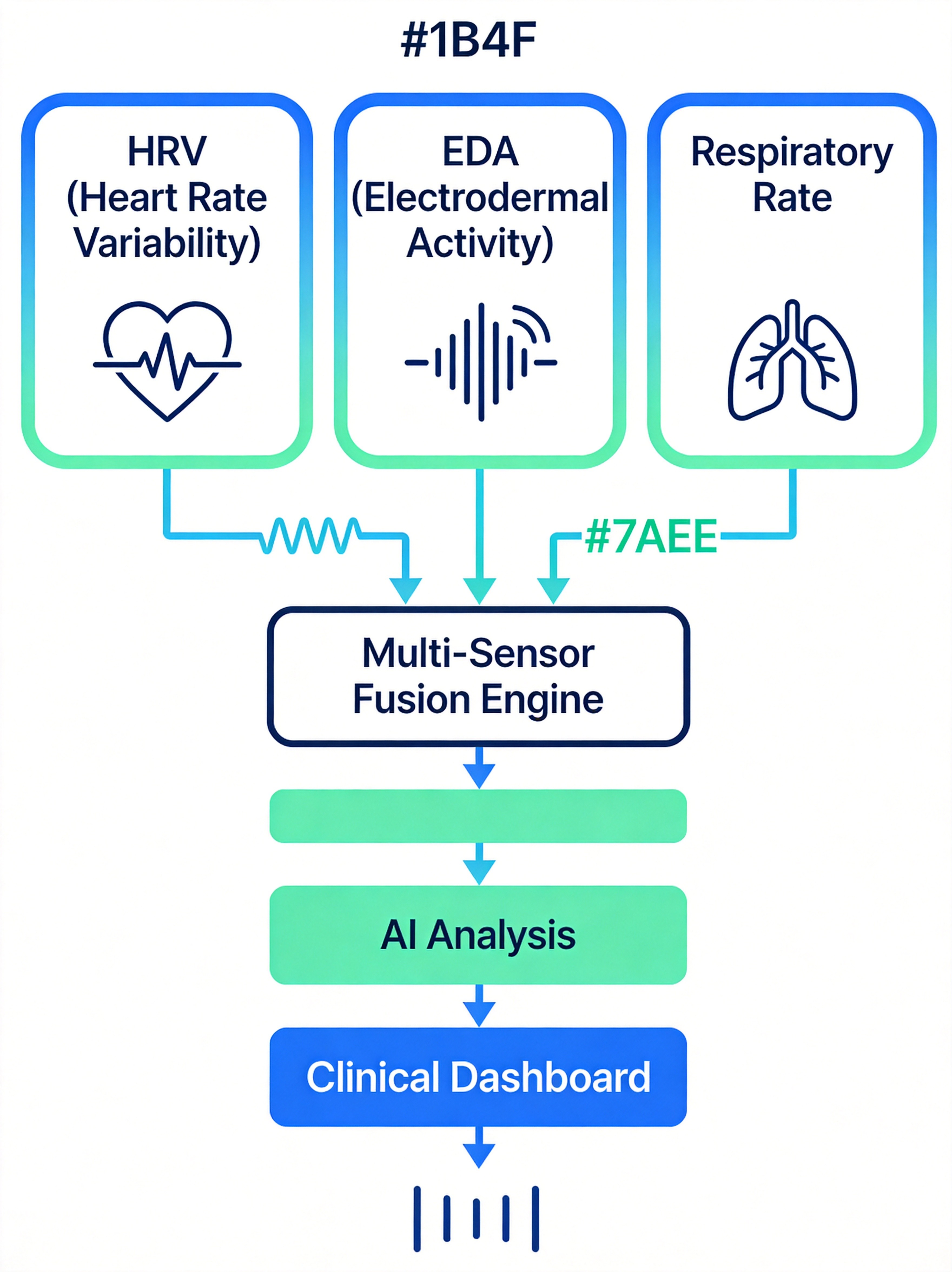
Multi-sensor fusion architecture combining HRV, EDA, and respiratory rate data streams for comprehensive mental health assessment.
Sensor Fusion: Why One Channel Fails
No individual biometric is specific to a particular mental state. HRV can drop due to depression, overtraining, an oncoming viral infection, or a poor night of sleep. EDA can spike from anxiety, excitement, or a warm conference room. Single-signal approaches generate false positives that erode clinical trust.
Multi-sensor fusion addresses this through simultaneous analysis of multiple data streams. A pattern of low HRV, elevated EDA, rapid shallow breathing, and nocturnal movement is far more specific to an anxiety state than any single marker. The mathematics involves Bayesian state estimation: each sensor contributes a probability distribution, and the system dynamically weights each input based on estimated signal quality. When accelerometer data indicates heavy motion, EDA is down-weighted; when the wearer is still, EDA confidence rises.
This adaptive weighting is what separates a research prototype from a deployable clinical tool. Xdun Medical’s platform architecture captures ECG/PPG (for HRV), EDA, skin temperature, and multi-axis accelerometer data through a single wearable device. The fusion engine runs on a hybrid edge-cloud model: real-time anomaly detection operates on-device with sub-second latency, while longitudinal trend analysis, population health analytics, and structured clinical reporting execute in the cloud.
AI Emotion Recognition: From Raw Signal to Clinical Decision Support
Raw sensor data becomes clinically actionable only after transformation by artificial intelligence. The pipeline involves several stages:
Signal Preprocessing: Raw PPG, EDA, and accelerometer data pass through deep neural networks trained to identify and remove motion artifacts, ambient light interference, and physiological noise. These networks increasingly outperform traditional signal processing heuristics, particularly in free-living conditions where artifacts are abundant.
Feature Extraction: Time-domain features (SDNN, RMSSD for HRV), frequency-domain features (LF/HF ratio, high-frequency power), and non-linear features (entropy measures, detrended fluctuation analysis) are computed from cleaned signals. For EDA, tonic skin conductance level and phasic skin conductance responses are decomposed through convex optimization. For respiratory rate, waveform morphology features are extracted from the PPG-derived breathing signal.
Classification and Prediction: Models ranging from gradient-boosted trees to LSTM recurrent neural networks and transformer architectures classify physiological patterns into clinically meaningful categories. Critically, these models learn individual baselines rather than applying population-level thresholds — a distinction that dramatically reduces false alarms for individuals with naturally high or low resting HRV.
Clinical Translation: The output is not a raw “stress score” but a structured clinical report: trend visualizations, flagged anomalies, and treatment response trajectories. These reports integrate into existing clinical workflows through HL7 FHIR-compliant APIs, appearing in the same EHR interface clinicians already use for labs, medications, and clinical notes.
The evidence base is expanding rapidly. A 2024 systematic review in BMJ Digital Health documented that wearable-based monitoring achieved 80–84% accuracy for anxiety detection and over 90% for predicting depressive episodes in bipolar disorder — findings drawn from studies involving hundreds of patients monitored over months in uncontrolled, real-world conditions.
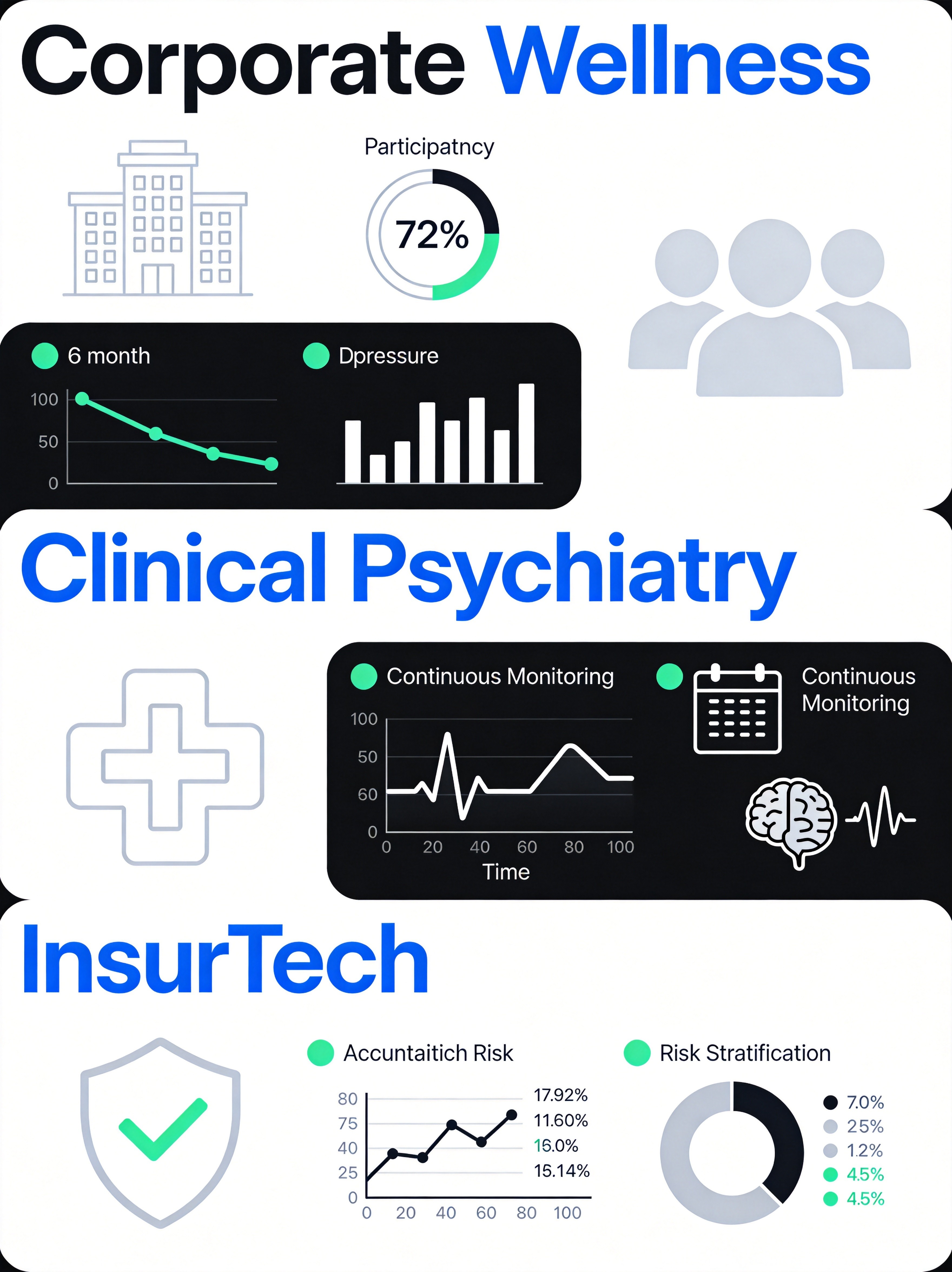
Three key B2B application domains for mental health wearable technology: corporate wellness programs, clinical behavioral health platforms, and insurance technology.
Enterprise-Scale Applications
The most consequential applications of mental health wearables are institutional, not individual. Three sectors are driving adoption:
Corporate Wellness and Employee Mental Health Screening
The WHO estimates that depression alone accounts for 12 billion lost working days annually. For enterprises, mental health is no longer a peripheral HR concern — it is a business continuity variable. Companies are adopting wearable-based mental health screening programs that operate on principles fundamentally different from consumer apps: voluntary opt-in with explicit consent frameworks, aggregate and anonymized reporting at the team or department level, integration with existing Employee Assistance Programs, and evidence-based escalation pathways when concerning patterns are detected.
The architecture is designed to screen for population-level risk while protecting individual privacy. A department-level dashboard might show that stress indicators are trending upward across a specific team, triggering a wellness intervention — flexible scheduling, manager training, or stress management resources — without identifying which individuals drove the trend. Forward-thinking organizations have reported measurable reductions in absenteeism, lower healthcare claims, and improved retention metrics.
Clinical Psychiatry and Behavioral Health Platforms
For psychiatrists, psychologists, and behavioral health providers, wearable data bridges the gap between sessions. A patient starting a new SSRI can be monitored for physiological changes — HRV improvement, sleep architecture normalization, reduced EDA reactivity — that often precede subjective improvement by weeks. This gives clinicians objective feedback on treatment efficacy far earlier than traditional follow-up schedules allow.
Telepsychiatry platforms are increasingly integrating wearable data streams into their clinical dashboards. A therapist conducting a virtual session can review the patient’s physiological trends from the past month, identify correlations between life events and stress responses, and adjust therapeutic strategies accordingly. The data does not replace clinical judgment; it enriches it with information no clinical interview could capture.
Insurance Technology (InsurTech)
Insurers are exploring mental health wearables for two purposes: risk stratification and outcomes-based care. Population-level risk assessment derived from aggregated, anonymized wearable data can inform underwriting — though this application raises genuine ethical questions that the industry is navigating through regulatory frameworks and consent protocols.
A more immediately actionable use case is value-based care, where insurers reimburse behavioral health providers based on outcomes rather than visit volume. Wearable data supplies an objective measure of treatment response — something that has historically been nearly impossible to capture reliably in mental health. When a depressive episode resolves, the physiological data corroborates the clinical observation, strengthening the actuarial case for continued investment in behavioral health programs.
Xdun Medical: Integrated Hardware and Cloud Analytics for Behavioral Health
Xdun Medical brings over 15 years of OEM/ODM manufacturing expertise — serving healthcare brands across more than 30 countries — to the mental health wearable space. The company’s platform is built on three architectural pillars:
Multi-Sensor Hardware Portfolio: Devices spanning smart watches (including the TK40 EDA Stress Watch), smart rings (R6 Health Ring), and chest/arm band form factors integrate ECG/PPG for HRV, EDA sensors for stress response monitoring, skin temperature sensing, and multi-axis accelerometers. This sensor suite captures the full spectrum of physiological signals relevant to mental health assessment, in form factors designed for 24-hour continuous wear.
Hybrid Edge-Cloud AI Engine: Real-time detection — arrhythmia alerts, stress threshold notifications, fall detection — executes on-device with latency measured in tens of milliseconds. The cloud platform handles longitudinal trend analysis, population health analytics, and structured clinical report generation. This architecture delivers clinical responsiveness at the point of care while enabling the population-level insights that health systems and insurers require.
White-Label Cloud Platform: The Xdun Cloud Platform supports HIS/EMR integration via FHIR R4 APIs, HIPAA- and GDPR-compliant data governance, role-based access controls, and full white-label customization. For behavioral health platforms, telepsychiatry providers, and corporate wellness programs, this means deploying a complete remote mental health monitoring solution under their own brand, with full control over data governance and user experience.
The platform is designed to support global certification pathways, with products carrying CE, FDA, FCC, and RoHS certifications.
What B2B Buyers Should Evaluate
Organizations assessing mental health wearable solutions should look beyond sensor specifications to several structural factors:
Regulatory Alignment: The FDA has authorized over 1,000 AI/ML-enabled medical devices. The December 2024 Predetermined Change Control Plans (PCCP) guidance establishes a framework for post-market algorithm updates. Buyers should verify whether their technology partner’s platform architecture is structured to support these regulatory pathways, particularly for use cases involving clinical decision support.
Clinical Validation: Peer-reviewed performance data on independent, diverse datasets — not vendor-conducted internal testing — should be a primary selection criterion. Claims that cannot be reproduced across populations, demographics, and real-world conditions carry limited weight.
Interoperability: The platform must integrate with existing IT infrastructure. FHIR R4 compliance, HL7 v2 compatibility for legacy systems, and well-documented REST APIs are minimum requirements for enterprise deployment at scale.
Data Governance: Mental health data sits among the most sensitive categories of personal information. Granular consent management, data minimization, and compliance with HIPAA, GDPR, and PIPL are non-negotiable. The Xdun Cloud Platform is architected with these requirements as foundational design principles.
Scalability: A pilot covering 500 employees is architecturally different from a national rollout across 50,000 lives. The platform must scale horizontally without degradation in latency, reliability, or data integrity.
Looking Forward
Mental health wearables are not a diagnostic panacea. They do not replace the therapeutic relationship that sits at the center of effective mental healthcare. They raise legitimate questions about privacy, algorithmic fairness, and the risk of over-surveillance — questions the industry must address with transparency and rigor.
What they do offer — and are already delivering — is a stream of objective, longitudinal physiological data that complements clinical judgment, surfaces warning signs before crises escalate, measures treatment response in near-real time, and enables population-level mental health screening at a scale that traditional methods cannot approach.
For enterprise buyers — corporate wellness directors, behavioral health platform operators, hospital psychiatry departments, and insurance technology executives — the question is shifting from whether physiological monitoring has a role in mental health to which technology partner can deliver a clinically credible, regulatorily sound, and operationally scalable platform.
Contact Xdun Medical to discuss your mental health wearable requirements:
📧 Email: jine@xdunmedical.com
📞 Phone: +86-13544254314
🌐 Website: xdunmedical.com
Content curated by the Xdun Medical Editorial Team. Xdun Medical is a professional B2B OEM/ODM manufacturer of medical-grade smart health wearables, serving hospitals, nursing homes, corporate wellness programs, and healthcare brands across 30+ countries.