Introduction: The Battery Barrier in Medical Wearables
Ask any procurement manager at a remote patient monitoring (RPM) platform what keeps them up at night, and the answer rarely surprises: battery life. A medical wearable that dies mid-monitoring is not merely inconvenient—it creates a data blind spot that can mask clinically significant events. For OEMs building the next generation of continuous health monitors, the power subsystem has quietly become the hardest engineering problem on the board.
The tension is straightforward. Clinical-grade wearables must collect multi-parameter data—heart rate, SpO₂, temperature, sometimes single-lead ECG—around the clock. Yet patients will not tolerate a device that demands daily charging, and clinicians will not trust a device that skips measurements to save power. Squaring this circle requires a layered strategy that spans battery chemistry, silicon selection, wireless protocol design, and display architecture. A practical application of this approach is the 4G ECG monitoring watch, which utilizes medical-grade sensors to support continuous cardiac tracking while maximizing operational uptime. For deeper analysis, see our technical overview of reflective pulse oximetry technology for smart ring SpO2 monitoring to understand how optimized sensor design mitigates these power constraints.
This article examines the battery technology landscape powering medical wearables today and maps the trajectory toward longer-lasting, safer, and more patient-friendly designs.
Part 1: From Lithium Polymer to Solid-State — The Chemistry Shift
Where We Are: Lithium Polymer Dominance
Lithium polymer (Li-Po) cells remain the default choice for most medical wearables. Their energy density—typically 250–300 Wh/kg—has proven adequate for smartwatches and fitness bands that expect daily charging. The manufacturing ecosystem is mature, with well-characterized safety profiles and established supply chains.
Yet Li-Po carries inherent constraints that matter more in medical contexts than in consumer electronics. The liquid or gel electrolyte requires rigid packaging to prevent leakage. Charging generates heat that, in a device pressed against skin for 24 hours, becomes a comfort and safety variable. And the energy density ceiling means that adding a SpO₂ sensor or ECG front-end inevitably shortens runtime—forcing designers into uncomfortable trade-offs between clinical capability and user experience.
The Transition: Semi-Solid and Solid-State
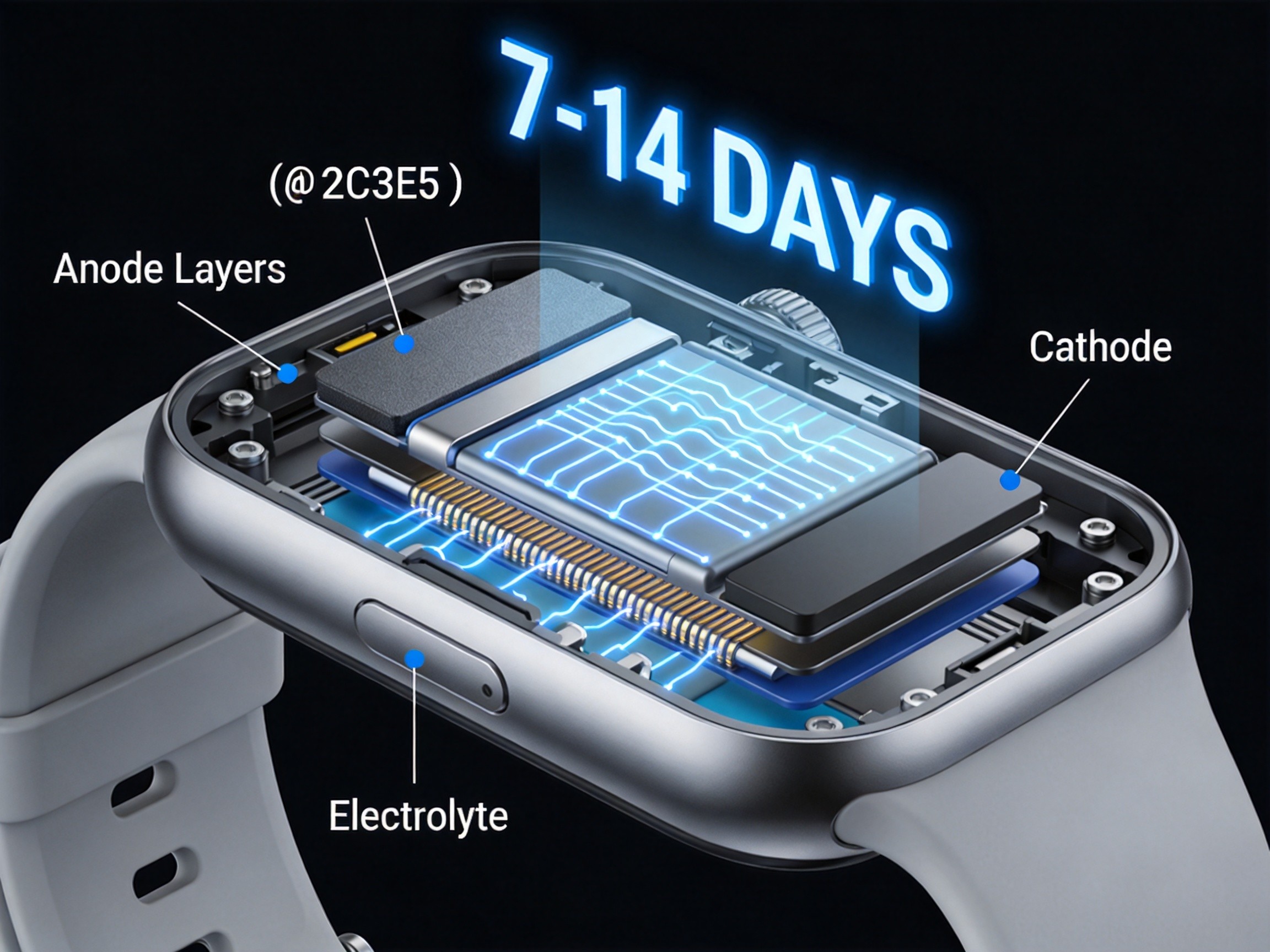
The next leap is already in motion. Semi-solid-state batteries—where a portion of the liquid electrolyte is replaced with a ceramic or polymer solid—are appearing in production wearables. These cells eliminate the swelling that plagues Li-Po packs during charge cycles and can withstand over 10,000 bending cycles at thicknesses as low as 0.45 mm. For medical patch and ring-form-factor devices, this mechanical flexibility opens design possibilities that rigid cells foreclose.
Fully solid-state batteries represent the horizon target. By replacing the flammable liquid electrolyte entirely with a solid separator—typically ceramic, glass, or dry polymer—solid-state cells eliminate thermal runaway risk. This is not a theoretical advantage; it is a regulatory one. A battery that cannot catch fire simplifies the safety case for a device worn continuously against skin, including during sleep.
The energy density gains are equally compelling. While commercial Li-Po tops out around 300 Wh/kg, solid-state architectures using lithium metal anodes target 400–600 Wh/kg. In practice, that could mean a medical-grade patch monitor running for 14 days instead of 5—or maintaining the same 7-day runtime while adding continuous SpO₂, which roughly doubles the optical sensor duty cycle.
To be clear: fully solid-state cells are not yet shipping at scale for medical wearables. The cost gap remains 3–5× versus liquid-electrolyte equivalents, and manufacturing yields are improving but not solved. Semi-solid-state cells, however, have crossed the chasm into production, and OEMs designing platforms today should architect for the transition.
Part 2: The Power Budget — Where Every Microamp Counts
Better chemistry buys headroom. But the real endurance story in medical wearables is how that headroom gets spent. A modern health monitor power budget is a zero-sum game between four main consumers: the wireless radio, the sensor array, the display, and the microcontroller.
Bluetooth Low Energy 5.3: The Connectivity Workhorse
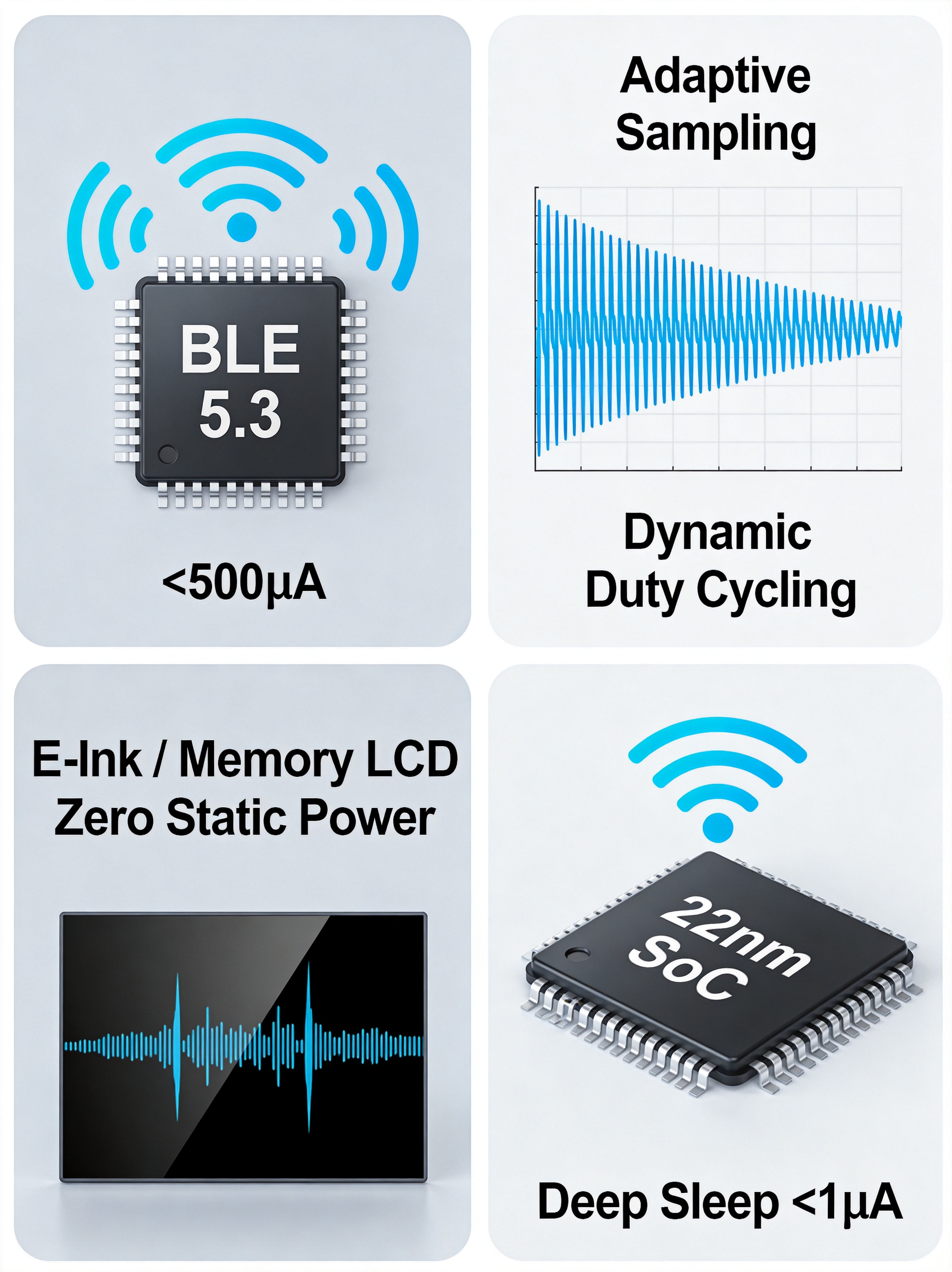
BLE 5.3 has become the near-universal wireless backbone for medical wearables, and for good reason. Compared to earlier BLE revisions, version 5.3 brings connection subrating and channel classification enhancements that directly reduce idle-time power draw. In a typical medical wearable streaming PPG and temperature data to a gateway, the BLE subsystem can account for 40–60% of total active power. Shrinking that share matters enormously.
A well-optimized BLE 5.3 implementation on a modern SoC can sustain a GATT connection at sub-500 µA average current while transmitting health data packets at 1-second intervals. By contrast, earlier BLE 4.2 designs on older process nodes routinely burn 1.2–1.8 mA for the same workload. The difference translates directly to days of additional runtime on a 200 mAh cell.
Beyond the silicon choice, protocol-level decisions compound: using extended advertising for connectionless data bursts, selecting the 2 Mbps PHY to minimize on-air time, and batching sensor readings into fewer, larger packets rather than streaming continuously. These are not exotic optimizations—they are table stakes for any medical wearable that claims multi-day battery life.
Sensor Duty Cycling: The Intermittent Sampling Advantage
Continuous monitoring rarely means constant monitoring. A heart rate sensor sampling at 100 Hz continuously will drain a 200 mAh battery in under 24 hours by itself. But clinically meaningful heart rate trends can often be captured at far lower effective sampling rates.
Adaptive duty cycling is the answer. Modern medical wearables use on-board accelerometer data to detect activity state and modulate sensor frequency accordingly. When the user is stationary or asleep, the heart rate sensor drops from continuous mode to a 1-minute intermittent sample. When motion is detected, the system ramps back to full-rate acquisition. This strategy can reduce sensor subsystem power by 60–80% without sacrificing clinical utility.
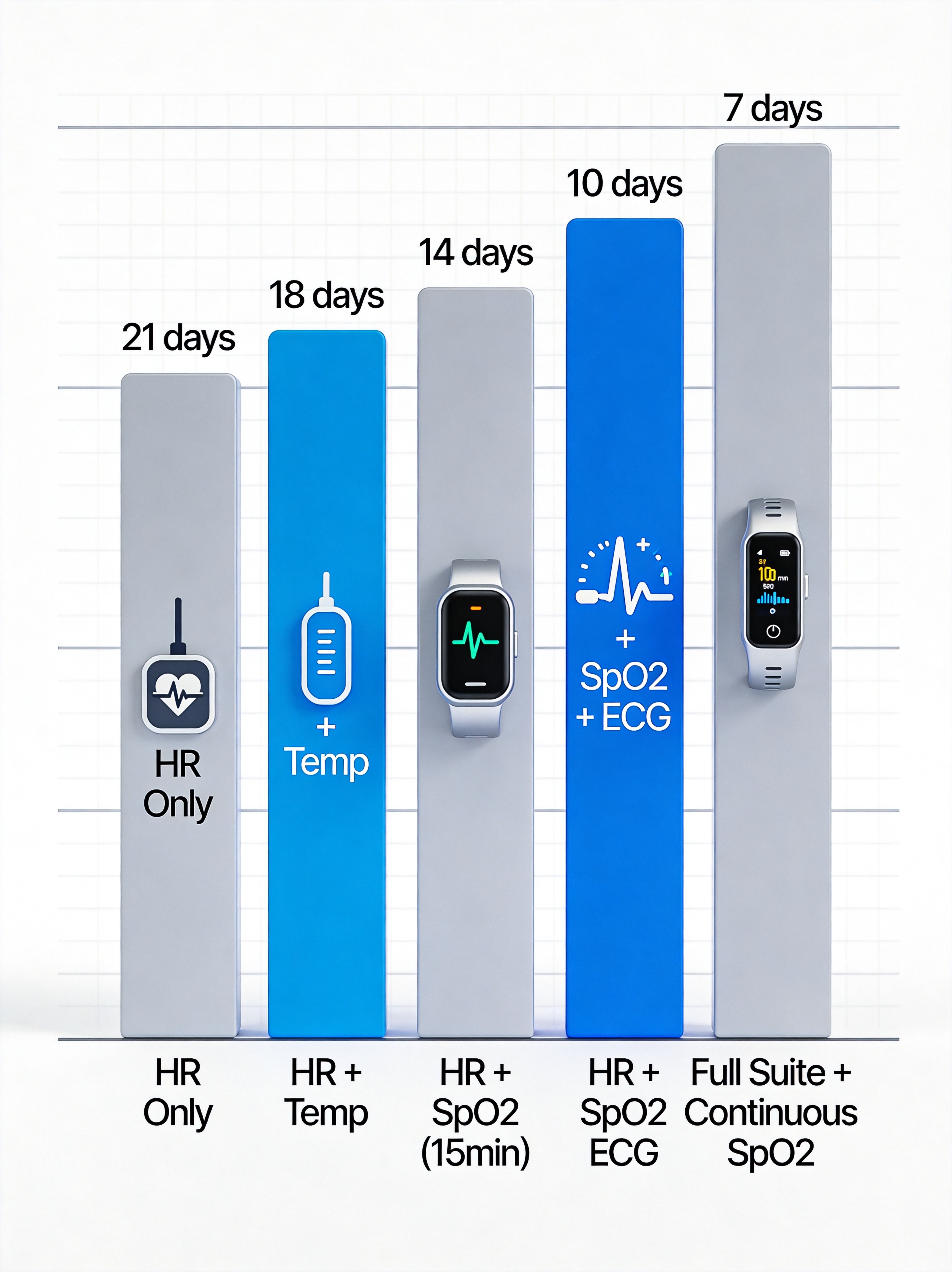
The same principle applies to SpO₂, which is particularly power-hungry because it requires driving red and infrared LEDs. A device that takes one SpO₂ reading every 15 minutes instead of continuously extends the per-charge interval dramatically while still capturing desaturation events. The key is designing the sampling strategy around clinical requirements—not around what the sensor can do, but what the use case needs.
Display Selection: E-Ink, Memory LCD, and the Case Against OLED
In medical wearables, the display is often the single largest power draw after the radio. A full-color OLED running at 200 nits can consume 20–40 mA when active—enough to halve the battery life of a compact device if the screen wakes frequently.
For devices where the primary interface is a smartphone app—which describes most medical patches and many wrist-worn monitors—the display role shifts from interactive to informational. In these scenarios, reflective displays like E-Ink or Sharp Memory LCD offer a decisive advantage: they draw zero power to hold a static image, and their refresh power is measured in microamp-seconds rather than milliamp-hours.
An E-Ink panel showing a battery indicator, connection status, and last reading timestamp can remain visible indefinitely without draining the cell. Memory LCDs offer similar bistability with faster refresh rates, making them suitable for devices that need to show real-time values. Neither can match OLED for color vibrancy or touch responsiveness—but in a medical wearable optimized for longevity, that trade-off is often the right one.
Chipset Selection: Process Node and Sleep Architecture
The microcontroller or SoC at the heart of a medical wearable defines the power floor. Modern designs targeting the medical segment increasingly adopt 22 nm or 28 nm process nodes, where deep-sleep currents below 1 µA are achievable with full RAM retention. Wake-up latency from these states is measured in microseconds, enabling event-driven architectures where the MCU spends 99%+ of its time asleep and wakes only to process a sensor interrupt or BLE event.
This architecture—sometimes called “mostly-off computing”—represents the current best practice for medical wearables. It requires careful firmware design: interrupt handlers must be lightweight, sensor FIFOs must buffer data autonomously, and the BLE stack must support connection parameter updates that minimize wake frequency. But when executed well, a device that measures vitals every 5 minutes can achieve average system currents in the single-digit microamp range, enabling months of operation from a coin cell.
Part 3: Battery Life and Patient Compliance — The Clinical Connection
The link between battery life and adherence is not speculative. Studies in hypertension management and post-surgical monitoring consistently show that patients abandon wearable monitors when charging becomes burdensome. A device that must be removed nightly for charging loses data from the very period—sleep—when many clinically significant events occur.
For RPM platforms managing thousands of enrolled patients, the math is stark. If 15% of users stop wearing their monitor because charging is inconvenient, the platform clinical value proposition erodes proportionally. Procurement managers evaluating wearable vendors increasingly treat battery life not as a spec-sheet number but as a proxy for real-world compliance.
This is why multi-day runtime—ideally 7–14 days—has become the informal benchmark for medical wearables targeting chronic disease monitoring. At 7 days, a patient can adopt a weekly charging routine (e.g., Sunday evening) that is easy to remember and minimally disruptive. At 3 days or fewer, charging becomes an unpredictable friction point.
The implication for device OEMs is clear: battery life is not a feature. It is a clinical performance parameter, as integral to the device effectiveness as sensor accuracy.
Part 4: Charging Architectures — Magnetic, Wireless, and USB-C
How a medical wearable recharges is as important as how long it lasts between charges. Three architectures dominate the market, each with distinct trade-offs for medical applications.
Magnetic Pogo-Pin Charging
Magnetic pogo-pin connectors use spring-loaded contacts and alignment magnets to create a physical electrical connection without requiring the user to insert a plug. This is the dominant approach in consumer smartwatches and is gaining traction in medical wearables.
Advantages: Reliable physical contact with low insertion force; supports moderate charge currents (100–500 mA); no alignment precision required beyond magnet engagement; pins can be sealed against ingress with simple O-ring designs.
Disadvantages: Exposed contacts are vulnerable to corrosion from sweat and cleaning agents; pins can accumulate debris; requires a proprietary cable or dock.
For medical wearables that need daily or every-other-day charging, magnetic pogo-pin is the pragmatic default. It balances ease of use with electrical reliability, and the sealing challenges are well-understood.
Qi/WPC Wireless Charging
Inductive wireless charging eliminates exposed contacts entirely, which is appealing for medical devices that must withstand frequent cleaning or immersion. The trade-off is efficiency: typical Qi implementations deliver 60–70% end-to-end efficiency versus 85–95% for direct-contact charging. The wasted energy becomes heat—a concern for a device worn against skin immediately after charging.
Wireless charging also adds thickness. The receiver coil and shielding add 0.5–1.0 mm to the stack-up, which matters in ultra-thin patch designs. And alignment sensitivity means the user must place the device correctly on the pad—a source of frustration for elderly patients who may lack fine motor precision.
USB-C Direct Charging
USB-C offers the simplest bill of materials and the fastest charging speeds. It is ubiquitous, standardized, and well-supported by PMIC vendors.
The problem is ingress protection. A USB-C port on a wearable that claims IP67 or IP68 requires a gasketed flap or sealed connector—both of which degrade over repeated use. USB-C connectors also occupy more internal volume than a set of pogo pins or a wireless coil. For medical patches designed for single-use or limited-reuse scenarios, USB-C is rarely the right answer. For clinician-worn diagnostic tools that are docked between shifts, it can work well.
Decision Framework
| Criterion | Magnetic Pogo-Pin | Qi Wireless | USB-C |
|---|---|---|---|
| Ingress Protection | Good (with seals) | Excellent (no contacts) | Poor (flap required) |
| Charge Efficiency | 85–95% | 60–70% | 90–95% |
| Thickness Impact | Minimal | +0.5–1.0 mm | Moderate |
| User Experience | Good (magnetic snap) | Moderate | Good (familiar) |
| Cable Standardization | Proprietary | Standard (Qi pad) | Standard (USB-C) |
| Heat at Device Surface | Low | Moderate | Low |
For continuous-wear medical devices, the industry is converging on magnetic pogo-pin for devices requiring daily charging and Qi wireless for devices targeting multi-day wear with occasional top-ups.
Part 5: Xdun Medical Approach to Power-Optimized Design
At Xdun Medical, the power architecture is not an afterthought bolted onto a completed industrial design—it is the design organizing principle. Our medical wearable platforms integrate several of the strategies discussed above into a cohesive system-level approach.
Battery selection. Xdun Medical works with cell suppliers offering semi-solid-state lithium polymer cells that deliver higher energy density than conventional Li-Po while eliminating the swelling behavior that degrades long-term reliability. Our platforms are architected to accept fully solid-state cells as they become commercially viable, protecting our OEM partners investment in form-factor development.
Power-optimized BLE integration. Our designs leverage BLE 5.3-capable SoCs with connection subrating and channel classification, configured for sub-500 µA average connection current during active data streaming. Firmware-level batching and adaptive advertising interval tuning further reduce radio duty cycle without compromising data delivery latency.
Adaptive sensor management. Rather than running all sensors at fixed rates, Xdun Medical platforms implement activity-aware duty cycling. PPG sampling rates adjust dynamically based on accelerometer input; SpO₂ measurements are triggered on clinically relevant schedules rather than continuously; temperature sensors sample at low frequency with threshold-triggered high-frequency bursts.
Display strategy. For wrist-worn monitors, Xdun Medical recommends reflective Memory LCD or E-Ink displays that maintain always-on status visibility with near-zero power. For display-less patch designs, a multi-color LED provides at-a-glance device status without the power penalty of a graphical screen.
Charging flexibility. Xdun Medical supports magnetic pogo-pin charging as the primary interface, with Qi wireless available as a configuration option for partners requiring contactless operation. Both architectures include JEITA-compliant thermal management that prevents charging when device temperature exceeds safe thresholds.
The result is a platform that routinely delivers 7–14 days of continuous multi-parameter monitoring on a single charge, depending on sensor configuration and sampling intensity.
Looking Forward
Medical wearable battery technology is at an inflection point. The combination of semi-solid-state cells entering production, BLE 5.3 silicon maturing, and adaptive power management firmware becoming standard practice means that the 14-day medical wearable—once aspirational—is now achievable with current-generation components. For deeper analysis of sourcing these advanced components, see our B2B OEM procurement guide for medical wearable battery technology and power management.
The devices that succeed in this market will not be the ones with the most sensors or the brightest screens. They will be the ones patients actually keep wearing. And that comes down, more than any single factor, to the battery.
Contact Xdun Medical
To discuss power-optimized wearable platforms for your remote patient monitoring program, reach our engineering team:
- Email: jine@xdunmedical.com
- Phone: +86-13544254314
Xdun Medical — Designing wearables patients keep wearing.
This article is for informational purposes only. Product specifications and capabilities are subject to change. Certifications mentioned reflect supported or compatible standards; consult Xdun Medical for current certification status.