When sourcing clinical-grade wearable health devices, certification isn’t a checkbox—it’s the difference between a product that hospitals trust and one that collects dust in a warehouse. For B2B buyers sourcing smartwatches, rings, and health bands for hospitals, eldercare facilities, or enterprise wellness programs, understanding FDA clearance, CE marking, and NMPA registration isn’t optional. It’s foundational. For deeper analysis of the physical therapy and athletic recovery sectors, see our guide on sports medicine and rehabilitation wearable technology to understand how these regulatory standards apply to clinical recovery devices.
The global wearable medical devices market is projected to reach $42.7–103 billion by 2025, with projections hitting $168–505 billion by 2030-2034 at CAGRs of 20-26%. This explosive growth is driving both opportunity and scrutiny. Regulators are tightening requirements while buyers demand more clinical-grade features from wearables.
This guide cuts through the noise: what each certification actually means, what it costs in time and money, and how to evaluate whether your supplier’s certification claims hold up.
Why Certification Matters for Your Procurement Decision
The Wellness vs. Medical Device Divide
Here’s the first thing most buyers miss: the same hardware can be either a wellness gadget or a regulated medical device, depending entirely on the marketing claims.
A wrist-worn PPG sensor that tracks “heart rate trends” might fly as a consumer wellness product. The moment the manufacturer claims it “detects atrial fibrillation” or “monitors blood pressure for clinical decision-making,” it crosses into medical device territory. For instance, the 4G ECG monitoring watch utilizes medical-grade sensors to support continuous cardiac monitoring, firmly placing it in this regulated category. That’s not marketing spin—it’s regulated by law.
The FDA’s 2026 General Wellness Policy update expanded the range of physiological parameters (blood pressure, SpO2, blood glucose, HRV) that can be measured under enforcement discretion—but only if outputs are used purely for wellness purposes. Any diagnostic or therapeutic claim triggers full medical device regulation.
For B2B buyers, this has direct implications:
- Your hospital client needs FDA-cleared ECG capability? Make sure the supplier’s 510(k) actually covers that specific claim
- Your eldercare facility wants SpO2 monitoring? Verify the clearance scope matches the clinical use case
- Your enterprise wellness program needs heart rate trends? A wellness device might suffice—but check local regulations
Consequences of Cutting Corners
Sourcing uncertified devices marketed as “clinical-grade” exposes your clients to liability. FDA warning letters are public. CE certificates can be suspended under EU MDR surveillance. A device rejected at customs for lacking NMPA registration doesn’t just delay a project—it damages relationships.
Understanding FDA Certification for Wearable Medical Devices
FDA Device Classification
The FDA classifies medical devices into three risk tiers:
| Class | Risk Level | Wearable Examples | Pathway |
|---|---|---|---|
| I | Low | General wellness trackers | Exempt or 510(k) |
| II | Moderate | ECG watches, pulse oximeters, BP monitors | 510(k) required |
| III | High | Implantable cardiac monitors | PMA required |
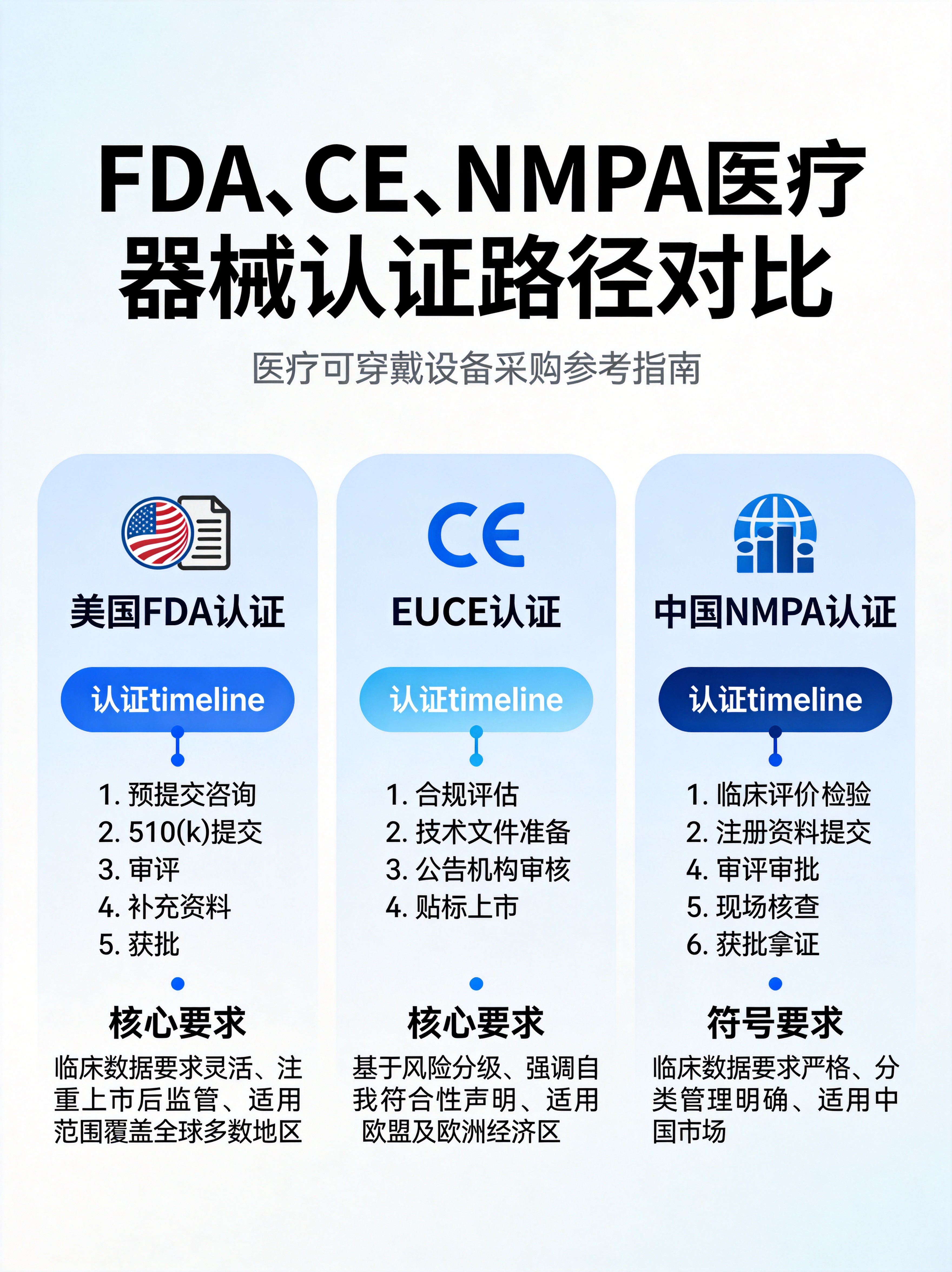 Comparison of FDA, CE, and NMPA certification pathways for wearable medical devices
Most clinical-grade wearable health devices fall into Class II, requiring 510(k) premarket notification. This means demonstrating “substantial equivalence” to a legally marketed predicate device.
Key fact: In 2023, FDA cleared over 370 510(k) submissions related to wearable health technology—a 140% increase from 2020, reflecting both market growth and regulatory maturation.
The 510(k) Process Explained
The 510(k) pathway requires demonstrating your device is substantially equivalent to a legally marketed “predicate” device. Here’s the realistic timeline:
| Phase | Duration | Activities |
|---|---|---|
| Pre-submission preparation | 4-6 months | Testing, documentation, predicate selection |
| FDA review | 3-9 months | 90 days target, longer with AI requests |
| Total to clearance | 7-15 months | Varies by submission quality |
What FDA reviewers actually want:
- Clear device description that stands on its own (don’t make them guess)
- Proactive explanations for any differences from the predicate
- Concise test summaries with pass/fail conclusions
- Complete biocompatibility, performance, and electrical safety data
The FDA aims for 90-day review, but Additional Information (AI) requests are common. A well-prepared submission might clear in 6 months; a poorly documented one could take 18+.
FDA QMSR (Quality Management System Regulation)
Critical update for 2026: Since February 2, 2026, FDA’s QMSR (21 CFR Part 82) replaced the old Quality System Regulation (QSR). QMSR incorporates ISO 13485:2016 by reference.
This means FDA now formally recognizes ISO 13485 certification as meeting QMSR requirements—a significant harmonization that streamlines compliance for manufacturers serving both US and EU markets.
What manufacturers must demonstrate:
- Design controls appropriate for device classification
- Risk management per ISO 14971
- Software lifecycle processes per IEC 62304
- Cybersecurity risk management for connected devices
- Complaint handling and MDR (Medical Device Reporting)
CE Marking Under EU MDR
EU MDR Classification for Wearables
Under EU MDR (Regulation 2017/745), wearable medical devices follow classification rules:
| Rule | Wearable Application | Typical Class |
|---|---|---|
| Rule 10 | Diagnosis/monitoring devices (ECG, SpO2) | Class IIa |
| Rule 11 | Software for monitoring physiological parameters | Class IIa or IIb |
| Rule 14 | Devices with medicinal substances | Class III |
Most wearable health monitors fall into Class IIa, requiring Notified Body involvement.
The Notified Body Bottleneck
Here’s the uncomfortable truth: EU MDR transition remains constrained. Under the old MDD, up to 80 Notified Bodies operated in Europe. Under MDR, only 52 are designated—and they face a massive backlog.
Realistic timelines:
- Standard conformity assessment: 6-18 months
- Complex devices: longer
- Application queue: can add additional months
The practical advice: Don’t wait for 2027-2028 deadline extensions. Manufacturers who submit early get reviewed faster. If you’re sourcing for EU markets, ask your supplier when they initiated their MDR transition.
Technical Documentation Requirements
Under EU MDR, manufacturers must prepare:
- Annex II Technical Documentation: Design history, risk analysis, clinical evaluation
- Annex III PMS Plan: Post-market surveillance strategy
- Clinical Evaluation Report (CER): Evidence of safety and performance
- EUDAMED Registration: Mandatory from May 2026
The CE mark itself isn’t just a logo—it’s a declaration of conformity backed by documented evidence that regulators can audit.
NMPA Registration for China Market
China’s Regulatory Framework
China’s National Medical Products Administration (NMPA) classifies devices into three classes:
| Class | Risk Level | Requirements |
|---|---|---|
| Class I | Low | Notification only |
| Class II | Moderate | Full registration with testing |
| Class III | High | Complex clinical evidence required |
Most wearable health monitoring devices fall into Class II or III, requiring formal registration.
The NMPA Process
NMPA registration typically involves:
| Phase | Duration |
|---|---|
| Local type testing | 3-6 months |
| Technical review | 6-12 months |
| Clinical evaluation | Varies by device |
| Total to registration | 12-24 months |
2025 Update: NMPA published updated “Guideline for Registration of Mobile Medical Devices” in May 2025, providing clearer pathways for software-driven medical devices. The guideline references international standards including FDA guidance and ISO 82304-2, reflecting growing regulatory harmonization.
Key Requirements
NMPA emphasizes:
- Clinical data requirements tend to be more stringent than FDA or CE equivalents
- In-country testing is typically required for Class II/III devices
- Local representative (Authorized Representative) must be established in China
- Chinese language documentation throughout
For B2B buyers sourcing for Chinese hospital or eldercare deployments, verify your supplier has completed NMPA registration—not just initiated the process.
ISO 13485—Your Quality System Baseline
ISO 13485:2016 is the international standard for medical device quality management systems. While it’s not itself a market access certification (you still need FDA clearance, CE marking, or NMPA registration), it’s the foundation everything else builds on. For deeper analysis on navigating these global regulatory pathways, see our guide on harmonizing ISO 13485 quality systems for dual FDA and EU MDR certification.
What ISO 13485 Actually Covers
The standard addresses the entire product lifecycle:
| Clause | Focus | Practical Impact |
|---|---|---|
| Clause 4 | Quality Management System | Documented procedures, traceability |
| Clause 6 | Resource Management | Competent personnel, adequate facilities |
| Clause 7 | Product Realization | Design controls, purchasing, production |
| Clause 8 | Measurement & Improvement | CAPA, audits, customer feedback |
Why ISO 13485 Matters for Buyers
When evaluating suppliers, ask for:
- ISO 13485 certificate (not just ISO 9001)
- Scope of registration—what activities are covered?
- Certificate validity—is it current and not suspended?
- Audit history—any major findings or recalls?
ISO 13485 certification from a reputable registrar (TÜV, SGS, BSI, DEKRA) indicates the manufacturer has documented processes for design, production, and post-market surveillance. It’s the baseline for regulatory compliance.
Evaluating Your Supplier’s Certification Claims
Red Flags to Watch
“We’re in the process of certification” ≠ certified. If your supplier can’t show a current certificate, they’re pre-compliance, not compliant.
“We support certification” ≠ certified. Phrases like “we can assist with FDA/CE submission” or “we have ISO 13485 experience” should raise questions. Real certification involves third-party audit.
Outdated certificates. ISO 13485 certificates are typically valid for 3 years with annual surveillance audits. FDA 510(k) clearances don’t expire, but the device description is tied to the cleared version. Verify the certificate date and scope.
Due Diligence Checklist
- [ ] Request copies of FDA 510(k) letters, CE certificates, or NMPA registration certificates
- [ ] Verify against public databases (FDA 510(k) database, EUDAMED, NMPA website)
- [ ] Confirm the specific device model is covered—not just a related product
- [ ] Check the intended use/indications for use match your client’s clinical needs
- [ ] Review ISO 13485 scope—is design and development included?
- [ ] Ask about design history file and risk management documentation
Certification Timelines and Cost Implications
Realistic Expectations
| Certification | Typical Timeline | Cost Range (USD) |
|---|---|---|
| FDA 510(k) | 7-15 months | $20,000-$150,000+ |
| EU CE (MDR Class IIa) | 9-18 months | $50,000-$200,000+ |
| NMPA Registration (Class II) | 12-24 months | $30,000-$100,000+ |
| ISO 13485 Certification | 3-6 months | $15,000-$50,000 |
These are rough ranges—actual costs depend on device complexity, testing requirements, and whether clinical data is needed.
Implication for B2B buyers: If a supplier claims to have “all certifications” but has been manufacturing for less than 18 months, be skeptical. Legitimate medical device certification takes time.
Frequently Asked Questions
Q1: Can a supplier claim “FDA compliant” without 510(k) clearance?
No. “FDA compliant” or “FDA registered” is meaningless without specific clearance or approval. Only “FDA cleared” (510(k)), “FDA approved” (PMA/HDE), or “FDA authorized” (De Novo) indicate actual market authorization. Verify claims against FDA’s 510(k) database.
Q2: What’s the difference between CE marking and EU MDR compliance?
CE marking is the result of demonstrating compliance. EU MDR is the regulation that defines the requirements. Since May 2021, all medical devices entering the EU must comply with EU MDR, not the older MDD. Ask suppliers specifically about their MDR transition status.
Q3: How long is FDA 510(k) clearance valid?
Unlike CE marking (which requires ongoing surveillance), FDA 510(k) clearance doesn’t expire. However, significant changes to the device require a new 510(k). The cleared indications for use and device description define the scope—what’s cleared is what’s cleared.
Q4: Does ISO 13485 certification mean the device is clinically validated?
No. ISO 13485 demonstrates a quality management system—it doesn’t validate clinical performance. A device can be ISO 13485 certified but lack FDA clearance or CE marking. Look for all three: quality system (ISO 13485), US market access (510(k)), and EU market access (CE/MDR).
Q5: What’s the fastest path to market for a new wearable health device?
For low-risk wellness features: market directly under FDA’s general wellness policy or EU MDR exclusion. For clinical-grade features: budget 12-18 months minimum for regulatory clearance. There’s no shortcut to legitimate medical device certification—attempting to bypass it exposes buyers and end-users to significant risk.
Partner with an OEM/ODM Manufacturer Who Understands Certification
For B2B buyers seeking clinical-grade wearable health devices, certification compliance isn’t just a legal requirement—it’s a marker of manufacturing maturity. At Xdun Medical, we specialize in medical-grade wearable design and manufacturing with:
- ISO 13485 certified quality management system
- Support for FDA 510(k), CE MDR, and NMPA registration processes
- Clinical-grade sensor integration including ECG, SpO2, blood pressure, and temperature monitoring
- 15+ years of experience serving hospitals, eldercare facilities, and enterprise health programs globally
Our product line includes clinically relevant devices like the S10 Pro wrist-worn blood pressure monitor (with ambulatory BP monitoring, 4G LTE connectivity, and IP65 rating), designed to meet rigorous medical standards while remaining practical for real-world deployment.
Ready to discuss your certification requirements? Contact our B2B team for a consultation on regulatory strategy and compliant product sourcing.