The Remote Patient Monitoring (RPM) market is experiencing unprecedented growth. Driven by healthcare digitization, expanding CMS reimbursement frameworks, and a global shift toward value-based care, healthcare systems are rapidly scaling RPM programs. For hospitals, eldercare providers, telehealth platforms, and enterprise wellness companies, sourcing the right remote cardiac monitoring device at scale is now a strategic priority. For deeper analysis, see our comprehensive breakdown of RPM economics and ROI. Once the hardware is secured, scaling these initiatives requires careful execution; as covered in our complete guide on transitioning from a pilot program to enterprise-wide deployment, this phase demands meticulous clinical and operational planning.
According to Grand View Research, the global RPM market was valued at approximately USD 1.8 billion in 2025 and is projected to reach USD 6.2 billion by 2030, reflecting a compound annual growth rate (CAGR) of 28.1%. Meanwhile, the CDC reports that over 43% of U.S. adults with two or more chronic conditions now participate in some form of remote monitoring program—up from 27% in 2019.
This guide is written for B2B procurement decision-makers seeking a trusted RPM device supplier. We cover real market data, core device specifications, product recommendations, and a supplier evaluation framework to help you make informed sourcing decisions when selecting a Remote Patient Monitoring wearable OEM partner.
Market Size and Growth Drivers
The convergence of three macro forces is accelerating RPM adoption at the health system level:
- Reimbursement expansion: CMS has progressively added CPT codes for remote physiologic monitoring (CPT 99453, 99454, 99457, 99458), creating budget line items for RPM programs across hospitals and FQHCs.
- Aging demographics: The WHO estimates that the global population aged 60+ will double by 2050, creating enormous demand for continuous cardiac and fall monitoring outside hospital walls.
- Hospital-at-home models: The Acute Hospital Care at Home waiver expansion post-COVID has driven demand for clinical-grade wearables that can transmit real-time data to care teams.
North America currently leads RPM adoption, accounting for approximately 45% of global market share (Grand View Research, 2025). However, Asia-Pacific is the fastest-growing region, driven by large-scale government telehealth initiatives in China, Japan, and South Korea—making clinical wearable OEM China sourcing a strategic consideration for cost-sensitive procurement teams.
Core Functions of RPM Wearable Devices
When evaluating RPM wearables for clinical deployment, procurement teams must understand the key monitoring functions available. These capabilities vary significantly across device classes:
Electrocardiogram (ECG / Heart Rhythm)
Single-lead ECG is now standard in most clinical-grade RPM wearables. These devices detect atrial fibrillation (AFib), bradycardia, tachycardia, and other arrhythmias. The CDC estimates that 6 million Americans currently have AFib, a figure projected to reach 12.1 million by 2030. Early detection through continuous ECG monitoring can reduce stroke risk by up to 68% when anticoagulation therapy is initiated promptly. To meet this growing clinical demand, OEMs can integrate advanced solutions like the 4G ECG monitoring watch, which utilizes medical-grade sensors to support continuous cardiac data transmission.
Blood Oxygen Saturation (SpO2)
Continuous SpO2 monitoring is critical for patients with COPD, heart failure, or post-acute recovery. Wearables with SpO2 sensors capture baseline saturation trends and alert care teams when levels drop below clinically significant thresholds (typically < 92%).
Blood Pressure
Ambulatory blood pressure monitoring via wearable devices enables hypertension management without clinic visits. Some devices feature a built-in air pump for on-demand cuff-style measurement, while emerging PPG-based approaches offer cuffless estimation—though cuff-based remains the gold standard for clinical accuracy.
Fall Detection and GPS Location
For elderly and dementia patients, fall detection combined with GPS tracking is a high-value clinical feature. According to the CDC, falls are the leading cause of injury-related death among adults aged 65+, costing the U.S. healthcare system over $50 billion annually. Wearables with 3-axis accelerometers and gyroscopes can detect falls in real time and automatically alert care teams or family members.
NFC SOS and One-Tap Emergency Calling
Near-field communication (NFC) enables one-tap SOS functionality, allowing patients to summon help without navigating complex interfaces. This is particularly important for post-surgical patients, individuals with limited mobility, and elderly users who may struggle with traditional smartwatch gestures.
Key Specifications for Hospital and RPM Service Procurement
When evaluating RPM wearable suppliers, B2B buyers should assess devices against the following dimensions. These specifications directly impact clinical workflow, patient compliance, and total cost of ownership.
| Specification | Entry-Level | Clinical-Grade | Why It Matters |
|---|---|---|---|
| Battery Life | 1-3 days | 5-14 days (continuous monitoring) | Longer battery reduces patient charging friction and data gaps |
| Waterproof Rating | IP54 (splash-resistant) | IP67 / IP68 (submersible) | IP67 required for shower-safe wear; improves compliance |
| Connectivity | Bluetooth only | 4G LTE built-in (standalone) | 4G LTE enables direct cloud transmission without smartphone pairing—essential for elderly users and CMS reimbursement compliance |
| Certification | FCC / CE | FCC + CE + FDA 510(k) (where applicable) | Clinical procurement typically requires region-specific regulatory documentation |
| API / EHR Integration | Cloud dashboard only | HL7 / FHIR APIs + major EHR connectors | Direct EHR integration reduces nursing staff manual data entry and improves clinical adoption |
| Data Transmission Frequency | On-demand sync | Real-time streaming (per measurement cycle) | Real-time alerts for critical values require sub-5-minute transmission intervals |
| SOS / Fall Alert Latency | Manual trigger only | Automatic < 30 seconds | Response time directly impacts clinical outcomes in fall scenarios |
Product Line Recommendations
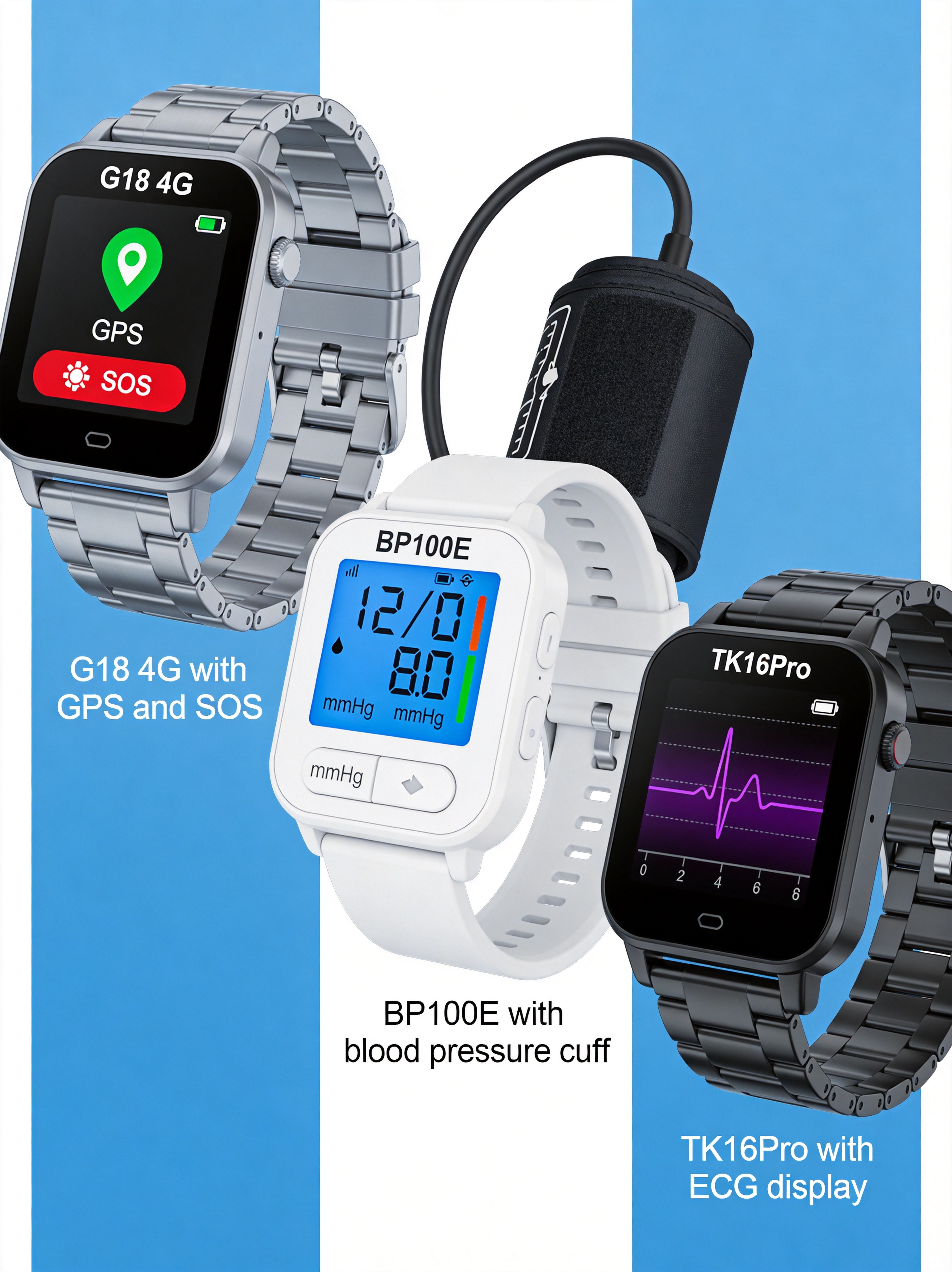
Based on our supplier evaluation framework and market feedback from healthcare system procurement teams, the following three product configurations represent the most commonly deployed RPM wearable tiers for B2B buyers working with a qualified telehealth wearable manufacturer:
G18 4G LTE Smartwatch — Active Aging and Community Care
The G18 4G LTE is a standalone wearable designed for independent living and assisted care environments. Key specifications include:
- Built-in 4G LTE (no smartphone required for data transmission)
- GPS real-time location tracking for dementia and fall patients
- One-tap NFC SOS calling
- Automatic fall detection with configurable alert thresholds
- Heart rate monitoring and step tracking
- IP67 waterproof rating
This device is particularly suited for hospital-at-home programs, senior living communities, and home health agencies managing patients across large geographic areas.
BP100E 4G Blood Pressure Smartwatch — Remote Hypertension Management
The BP100E is purpose-built for clinical blood pressure monitoring. Unlike cuffless estimation devices, the BP100E integrates a miniaturized air pump for cuff-based oscillometric BP measurement, providing accuracy suitable for hypertension management programs:
- On-demand blood pressure measurement via integrated pump and cuff
- 4G LTE standalone connectivity
- ECG + heart rate + SpO2 multi-parameter monitoring
- Multi-language display for international health system deployments
- Competitive pricing aligned with volume procurement budgets
The BP100E is recommended for cardiology departments, primary care networks, and managed care organizations running population health programs focused on hypertension control.
TK16Pro Clinical ECG Wearable — Cardiology and RPM Service Providers
The TK16Pro targets clinical-grade ECG monitoring for RPM service companies and hospital cardiology departments. It offers the highest signal quality in our recommended product line:
- Clinical-grade single-lead ECG with improved electrode placement
- 4G LTE and Bluetooth dual connectivity
- Real-time arrhythmia alert configuration
- IP68 waterproof rating for extended wear compliance
- Cloud platform with HIPAA-compliant data architecture
- API access for custom EHR and third-party platform integration
The TK16Pro is the preferred choice for telehealth platforms, cardiac rehabilitation programs, and clinical trial sponsors requiring high-fidelity ECG data streams.
OEM Supplier Selection Guide
Sourcing RPM wearables from an Remote Patient Monitoring wearable OEM partner requires both technical and commercial due diligence. Whether you are evaluating a clinical wearable OEM China-based supplier or a regional manufacturer, the evaluation framework below applies universally. The difference between a reliable long-term partner and a problematic supplier often comes down to evaluation rigor before the purchase order is issued.
Technical Due Diligence Checklist
- Request complete hardware specifications and sensor datasheets
- Verify firmware update capability and OTA (over-the-air) update infrastructure
- Request third-party lab test reports for FCC, CE, and relevant medical device standards
- Confirm API documentation coverage (REST/HTTPS, HL7 FHIR, MQTT)
- Evaluate data security architecture: encryption at rest and in transit, GDPR/HIPAA compliance documentation
- Request a pilot device sample for internal clinical staff evaluation before volume commitment
- Assess power management efficiency—idle drain, transmission drain, and full-discharge cycle behavior
Commercial Due Diligence Checklist
- Verify business registration, export license, and ISO 13485 certification status
- Request financial statements or bank references for orders exceeding USD 50,000
- Confirm IP ownership terms: who owns the firmware, hardware designs, and cloud platform?
- Evaluate MOQ flexibility—some suppliers offer tiered pricing at 100, 500, and 1,000+ units
- Assess after-sales support infrastructure: RMA process, firmware support timelines, and spare parts availability
- Review production capacity and lead time stability for orders of 500+ units
- Confirm product liability insurance coverage
Frequently Asked Questions (FAQ)
What is the typical MOQ for OEM RPM wearables?
Minimum order quantities for OEM RPM wearables typically start at 100-500 units per SKU, depending on the supplier and customization level required. For standard configurations with logo-only customization, some suppliers offer MOQs as low as 50-100 units. Volume pricing becomes significantly more competitive at the 500-unit threshold and above.
How long does it take to customize an OEM RPM wearable with our brand?
For logo and packaging customization (hardware unchanged), the typical timeline is 3-5 weeks from artwork approval to first shipment. For firmware-level customization—including custom app branding, cloud platform white-labeling, or API endpoint configuration—the timeline extends to 8-12 weeks depending on complexity and supplier engineering capacity.
Can RPM wearables be integrated with our existing EHR or telehealth platform?
Most clinical-grade OEM RPM wearables support integration via REST API (HTTPS) or MQTT protocol. Suppliers who support HL7 FHIR integration are preferred for EHR connectivity. Common integration targets include Epic MyChart, Cerner, Allscripts, and major RPM aggregators such as Care Innovations, Vivify Health, and AMC Health. Integration feasibility should be confirmed during the pilot evaluation phase.
What certifications should a clinical RPM wearable supplier support?
For U.S. clinical deployments, buyers should request suppliers who can support FCC certification (wireless compliance), FDA 510(k) documentation (where the device is intended for clinical diagnosis), and provide guidance on CE marking for European markets. For HIPAA-covered environments, a Business Associate Agreement (BAA) and data processing addendum should be standard requirements. Note: certification costs are typically the buyer’s responsibility and should be factored into total cost of ownership.
How do RPM wearables handle data security and patient privacy?
Clinical-grade RPM devices should use end-to-end encryption for all data transmissions (TLS 1.2 or higher). Data at rest on cloud servers must be encrypted. Suppliers should provide documentation covering GDPR compliance (for EU deployments), SOC 2 Type II reports (for U.S. health systems), and support for HIPAA-required safeguards. Buyers are advised to conduct their own IT security review of any vendor before deployment in protected health information (PHI) environments.
What is the expected battery life for clinical-grade 4G LTE RPM wearables?
Battery life varies significantly by monitoring frequency and connectivity mode. For 4G LTE standalone wearables with continuous heart rate and SpO2 monitoring, 3-7 days per charge is typical. Devices configured for intermittent monitoring (e.g., ECG spot-check every 4 hours) can extend battery life to 7-14 days. GPS tracking significantly impacts battery drain and should be evaluated separately for power budget planning.
Ready to Scale Your RPM Program?
Whether you are launching a new remote patient monitoring initiative or expanding an existing program, the right OEM partner can accelerate deployment timelines and reduce per-unit costs at scale. Our team has sourced and validated clinical-grade remote cardiac monitoring device solutions from qualified RPM device supplier partners for hospitals, telehealth platforms, and eldercare providers across North America, Europe, and Asia-Pacific.
Please include your target device type, estimated volume, desired certifications, and integration requirements. Our supplier team will respond within 1 business day with a detailed proposal and, where applicable, arrange a pilot device evaluation.