The clinical trials industry is undergoing its most significant structural transformation in decades. The September 2024 release of the FDA’s final guidance Conducting Clinical Trials with Decentralized Elements — followed by the ICH E6(R3) Good Clinical Practice guideline in January 2025 and the EMA/HMA Recommendation Paper V02 in October 2025 — has collectively established a harmonized global regulatory framework for decentralized clinical trials (DCTs). This regulatory alignment, combined with mounting evidence of substantial cost savings and accelerated enrollment timelines, positions DCTs as a strategic imperative rather than an experimental alternative.
For pharmaceutical sponsors, contract research organizations (CROs), and medical device manufacturers, the question is no longer whether to adopt decentralized elements but how to implement them in a compliant, cost-effective manner that generates regulatory-grade evidence. This article provides a comprehensive analysis of the DCT regulatory landscape, quantifies the financial case, and examines how medical-grade wearable technology — including Xdun Medical’s integrated device and data collection ecosystem — serves as the operational backbone of modern DCTs.
The Global Regulatory Framework: FDA, EMA, and ICH E6(R3)
FDA Final Guidance (September 2024)
The FDA’s final guidance, jointly issued by CDER, CBER, CDRH, and the Oncology Center of Excellence, represents the agency’s definitive position on DCT implementation. It covers the full spectrum of drug, biologic, and medical device development and provides detailed recommendations across six critical domains.
Sponsor Oversight and Responsibility. The FDA emphasizes that the sponsor’s supervisory obligations remain unchanged regardless of where trial activities occur. Sponsors must coordinate decentralized activities across multiple locations — including local healthcare providers (HCPs), third-party laboratories, telehealth platforms, and home nursing services — while ensuring investigators maintain real-time access to remotely collected data. All external service providers require documented qualification assessment and ongoing compliance monitoring.
Digital Health Technologies (DHTs). The guidance explicitly recognizes wearable devices, mobile applications, and sensor-based monitoring as valid data collection tools within clinical investigations. The FDA applies a fit-for-purpose validation framework: the level of verification and validation required scales with the regulatory weight of the data. A wearable device used as a primary efficacy endpoint demands more rigorous analytical and clinical validation than one deployed for exploratory monitoring.
Data Integrity Standards. Remotely collected data must satisfy the same integrity requirements as site-based data. This necessitates complete audit trails, mechanisms to prevent unauthorized modification, source data verification capabilities, and end-to-end data traceability. Electronic systems supporting DCT activities must comply with 21 CFR Part 11 requirements for electronic records and signatures.
Informed Consent and Safety Monitoring. The guidance establishes technical requirements for electronic informed consent (eConsent), including identity verification, clear presentation of information, legally valid electronic signatures, and delivery of signed copies to participants. For safety monitoring, DCT protocols must define clear adverse event reporting pathways with real-time alert mechanisms that ensure safety information reaches investigators without delay.
Inspection Readiness. The FDA retains the right to inspect all DCT-related records, electronic systems, and service provider facilities. Sponsors must contractually obligate vendors to cooperate with FDA inspections and ensure all electronic records remain accessible to agency reviewers.
EMA/HMA Recommendation Paper V02 (October 2025)
The European regulatory framework integrates DCT requirements with the Clinical Trials Regulation (EU 536/2014) and the Clinical Trials Information System (CTIS). The EMA/HMA V02 update introduces several Europe-specific considerations.
CTIS Integration. All DCT elements must be described in the CTIS application, including which visits are conducted remotely, which digital health technologies are deployed, how data flows across locations, and how GDPR compliance is maintained throughout the data lifecycle.
GDPR and Data Protection. European DCTs face unique challenges under the General Data Protection Regulation. The recommendation paper requires data minimization, explicit legal bases for processing, cross-border transfer safeguards, and mechanisms for participants to exercise their rights of access, rectification, and erasure. Wearable devices that continuously collect physiological data must provide transparency about what data is captured and how it is used.
The ACT EU Initiative. The Accelerating Clinical Trials in the EU (ACT EU) program, a joint initiative of EMA, HMA, and the European Commission, has prioritized DCT advancement in its 2025-2026 work plan. The DARWIN EU network now connects 20 data partners across 13 countries, covering approximately 130 million patient records, creating infrastructure for real-world evidence generation that complements DCT data collection.
ICH E6(R3) Good Clinical Practice (January 2025)
The finalized ICH E6(R3) guideline represents the first update to international GCP standards that explicitly incorporates decentralized trial methodologies. Annex 2 of the guideline addresses computerized systems and remote data collection with several consequential provisions:
- Electronic and remote data are explicitly recognized as acceptable for regulatory submissions
- Computerized systems must undergo documented validation appropriate to their intended use
- Source data integrity and traceability requirements apply equally to remote and on-site collection
- Electronic signatures and electronic records must meet specific technical standards
- A risk-based approach to data monitoring is recommended, with monitoring intensity proportional to data criticality
For sponsors conducting multi-regional clinical trials (MRCTs), ICH E6(R3) provides a unified operational standard. A trial enrolling patients in Boston, Berlin, and Beijing can now implement consistent remote data collection protocols while satisfying all three regulatory jurisdictions — a significant operational advantage.
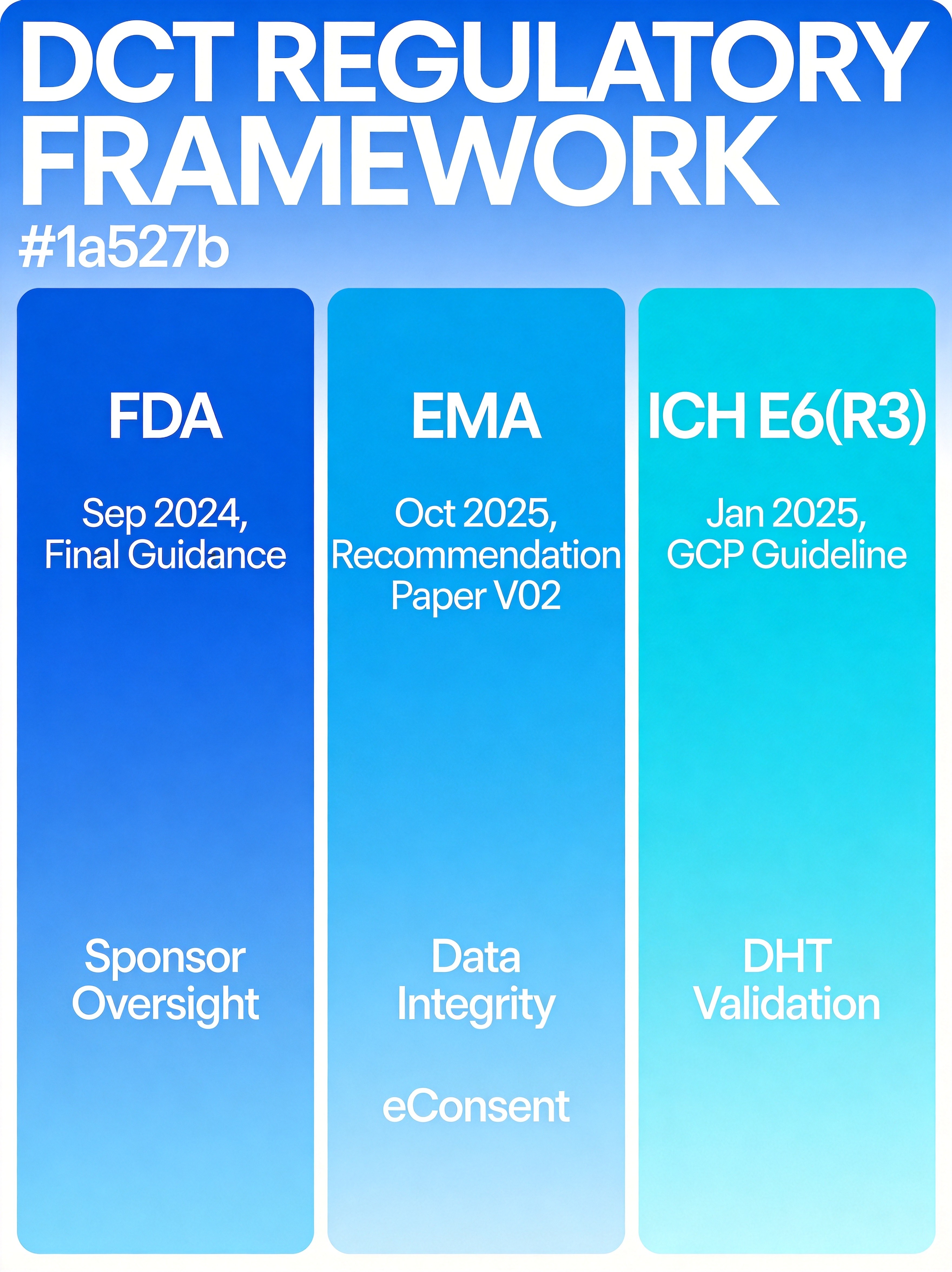
Figure 1: The three-pillar global regulatory framework for decentralized clinical trials — FDA Final Guidance (Sep 2024), ICH E6(R3) GCP (Jan 2025), and EMA/HMA Recommendation Paper V02 (Oct 2025).
The Financial Case: Quantifying DCT Cost Savings
The economic argument for DCT adoption has strengthened considerably as empirical data accumulates. The Tufts Center for the Study of Drug Development (CSDD), in partnership with the PACT Consortium, has published the most comprehensive analysis to date.
Per-Patient and Per-Trial Savings
A landmark study published in Nature Digital Medicine and validated by Tufts CSDD demonstrated that DCT methods applied to Phase II and Phase III trials yield substantial financial returns. The expected net present value (eNPV) increase was $8.8 million per drug for Phase II portfolios (5x ROI) and $41 million per drug for Phase III portfolios (13x ROI). When DCT methods are applied across both phases, the incremental value reaches $20 million per drug entering Phase II, with a 7x return on the DCT technology investment.
Cost reductions materialize across multiple operational categories:
| Cost Category | Traditional Trial | DCT/Hybrid | Savings |
|—|—|—|—|
| Site operations (per patient) | $8,000–$15,000 | $5,000–$10,000 | 30–40% |
| Patient travel reimbursement | $200–$500/visit | $50–$100/visit | 70–80% |
| Data management | $300K–$600K | $400K–$800K | +15–30% (offset by site savings) |
| Enrollment timeline | 12–18 months | 8–14 months | 25–35% faster |
| Patient retention rate | 70–80% | 80–90% | +10–15% |
Sources: IQVIA Clinical Trial Analytics, Tufts CSDD PACT Consortium (2025)
The U.S. Department of Health and Human Services (HHS) published an independent cost analysis confirming that mobile technologies in clinical trials can save approximately $0.4 million per Phase I study, $2.4 million per Phase II study, $6.1 million per Phase III study, and $6.7 million per Phase IV study. These figures align with industry estimates of $5,000–$10,000 in savings per enrolled patient when DCT elements replace traditional site visits. For deeper analysis on the broader financial impact of these connected health technologies, see our detailed breakdown of RPM economics and the ROI of remote patient monitoring. To maximize these operational efficiencies, sponsors are increasingly deploying standalone devices like the 4G LTE standalone monitoring watch, which utilizes medical-grade sensors to transmit continuous patient data directly to trial databases without requiring a paired smartphone. For a provider-focused perspective on scaling these technologies, see our comprehensive guide to the economics of remote patient monitoring, including ROI and reimbursement strategies.
The ROI Mechanism
DCT cost savings are not primarily driven by headcount reduction. Rather, the value accrues from three compounding factors: faster enrollment shortens the overall development timeline (each month of delay costs sponsors an estimated $600,000–$8 million in lost revenue, depending on the therapeutic area); lower dropout rates preserve statistical power and reduce the need for replacement enrollment; and more representative patient populations strengthen the regulatory submission package, potentially accelerating review timelines.
The DCT market itself reflects this economic logic. Valued at $9.29 billion in 2025, the global DCT market is projected to reach $34.82 billion by 2035, growing at a compound annual growth rate (CAGR) of 14.2%, according to Emergen Research. North America leads with 42.8% market share, followed by Europe (28.4%) and Asia-Pacific (19.4%).
Real-World Evidence and Wearable Data: FDA Acceptance
One of the most consequential regulatory developments for wearable technology manufacturers is the FDA’s growing acceptance of real-world evidence (RWE) derived from wearable devices. The agency’s framework for evaluating wearable-generated clinical evidence has matured significantly.
The Fit-for-Purpose Validation Framework
The FDA applies a three-tier validation model to wearable data used in clinical investigations:
Verification establishes that the sensor technology accurately measures the physiological parameter under intended-use conditions. For a wearable ECG monitor, this means demonstrating accuracy against a 12-lead gold standard across the range of heart rates, activity levels, and skin types expected in the target population.
Clinical Validation confirms that the wearable-derived measurement is clinically meaningful. A device that accurately measures step count is verified as a pedometer, but its validity as a measure of functional capacity in heart failure patients requires evidence of correlation with established clinical endpoints.
Usability Assessment ensures the device can be operated reliably by the intended user population in real-world settings — a critical consideration given that DCT participants may be elderly, have limited digital literacy, or have physical impairments.
Regulatory Precedents
The FDA’s 2023 guidance on Digital Health Technologies for Remote Data Acquisition in Clinical Investigations established the foundational expectations for wearable data quality. Subsequent guidance on Real-World Evidence for Medical Devices clarified the circumstances under which wearable-derived RWE can support regulatory decisions. The key requirements are that data must be relevant to the regulatory question, generated through methods that ensure adequate quality and reliability, and analyzed using appropriate statistical methods that account for real-world data characteristics.
The implications for DCTs are significant. A trial that uses medical-grade wearables with validated accuracy, complete audit trails, and documented data quality protocols can use the resulting data as primary or secondary endpoints in regulatory submissions. This is not theoretical — an increasing number of approved drugs now include wearable-derived endpoints in their labels.
Patient Recruitment: Eliminating Geography as a Barrier
The most immediate operational benefit of DCTs — and the one most directly enabled by wearable technology — is the dramatic improvement in patient recruitment efficiency.
The Geography Problem
Traditional clinical trials are concentrated at urban academic medical centers. A 2022 study in npj Digital Medicine found that DCTs enrolled participants from an average of 40 U.S. states, compared to just one state for traditional trials. Recruitment timelines contracted from a mean of 15.9 months to 4.0 months. A Swiss study of low-back-pain patients replicated these findings internationally, with DCT approaches achieving enrollment three times faster and five times more geographically representative than conventional methods.
Diversity Gains
The Tufts CSDD PACT Consortium’s analysis of 69 clinical trials, published in January 2025, provided the most rigorous evidence to date linking DCT approaches to improved participant diversity:
- Asian participation increased from 14.2% to 20.9% (+6.7 percentage points)
- American Indian/Alaska Native participation nearly quadrupled (1.9% vs. 0.5%)
- Female participation rose from 49.0% to 55.7%, aligning more closely with the total U.S. population
The PACT Consortium — backed by over 30 pharmaceutical organizations including AbbVie, Amgen, Gilead, GSK, Janssen, Novartis, Pfizer, and Roche Genentech, with oversight from the NIH, FDA, and National Cancer Institute — continues to generate evidence that strategic DCT implementation meaningfully shifts diversity metrics.
However, the data also reveals persistent challenges. Black or African American enrollment remained at just 7.3% even with DCT approaches, compared to 14.9% representation in the U.S. population. As Ken Getz, Tufts CSDD Executive Director, noted: “Increasing diversity requires a multifaceted approach rather than a monolithic one. Certain decentralized elements, like local labs, can dramatically boost enrollment among Black participants — so you must be intentional.”
The Wearable Technology Bridge
Wearable devices serve as the critical bridge between decentralized trial designs and diverse patient populations. By enabling continuous physiological monitoring from home, wearables eliminate the need for participants to travel to study sites for routine assessments. This is particularly impactful for patients with mobility limitations, those in rural areas, and individuals with caregiving responsibilities — groups disproportionately excluded from traditional trials.
Remote Monitoring and Risk-Based Quality Management
The FDA and EMA both endorse risk-based monitoring approaches in DCTs, where monitoring intensity is proportional to data criticality and participant safety risk. This framework, formalized in ICH E6(R3), transforms how sponsors oversee trial quality.
Key Principles
Centralized Monitoring. Statistical monitoring of data patterns across all sites — including remote data streams — detects anomalies that may indicate data quality issues, protocol deviations, or safety signals. Centralized monitoring complements, and in some cases reduces the need for, on-site monitoring visits.
Real-Time Safety Surveillance. Wearable devices with continuous monitoring capabilities generate safety data that can be reviewed in near real-time. Abnormal vital sign readings, arrhythmia detections, or significant changes in activity patterns can trigger automated alerts to investigators, enabling faster intervention than traditional periodic site visits.
Source Data Verification. DCT protocols must define how remote source data will be verified. For wearable-generated data, this typically involves maintaining raw sensor data alongside processed outputs, ensuring complete audit trails, and establishing data quality metrics that are reviewed at defined intervals.
The Compliance Infrastructure
Implementing risk-based monitoring in DCTs requires a technology stack that supports centralized data aggregation, automated quality checks, and secure investigator access. Xdun Medical’s cloud platform provides this infrastructure, with HIPAA/GDPR-compliant data management, real-time alerting, and integration with hospital information systems (HIS) and electronic medical records (EMR) via API — enabling the closed-loop data flow that regulators increasingly expect.
Xdun Medical: Enabling the DCT Ecosystem
Xdun Medical’s product portfolio is purpose-built for the operational demands of decentralized clinical trials. With 15+ years of OEM/ODM experience serving 30+ countries, Xdun Medical provides the hardware, software, and data infrastructure that sponsors and CROs need to implement DCT elements compliantly and efficiently.
Integrated Device Portfolio
The Xdun Health Ecosystem spans five product categories, each with specific DCT applications:
- ECG Monitoring Watches — Medical-grade electrocardiogram monitoring with real-time arrhythmia detection, suitable for cardiovascular safety endpoints and cardiac rehabilitation trials
- Health Monitoring Bands — Screenless designs optimized for continuous vital sign collection, ideal for long-duration studies requiring minimal participant burden
- Smart Rings — Sleep tracking, HRV monitoring, and continuous SpO2 measurement in a discreet form factor that maximizes compliance in longitudinal studies
- Heart Rate & Arm Bands — Chest-strap and arm-band monitors with ANT+/Bluetooth connectivity for precise heart rate data in exercise physiology and sports medicine trials
- Medical Devices — Pulse oximeters, ECG monitors, and blood pressure monitors designed for clinical-grade accuracy
The Xdun Cloud Platform
Data collected by Xdun Medical devices flows through a secure, validated cloud platform that provides:
- AI Health Engine — Automated signal quality assessment and anomaly detection
- HIS/EMR Integration — API-based connectivity with hospital and clinical data systems
- HIPAA/GDPR Compliance — End-to-end encryption, access controls, and audit trails meeting global data protection standards
- White-Label Customization — Full branding flexibility for CROs and sponsors deploying devices under their own identity
- Real-Time Alerts, Reports, and Insights — Configurable dashboards for investigators, clinical operations teams, and data monitoring committees
Certification Support
Xdun Medical devices carry CE, FCC, RoHS, FDA, and BIS certifications. For sponsors requiring additional regulatory clearances for specific trial applications, Xdun Medical’s regulatory team supports the certification process — ensuring devices meet the documentation requirements that regulators expect when wearables are used as clinical investigation tools.
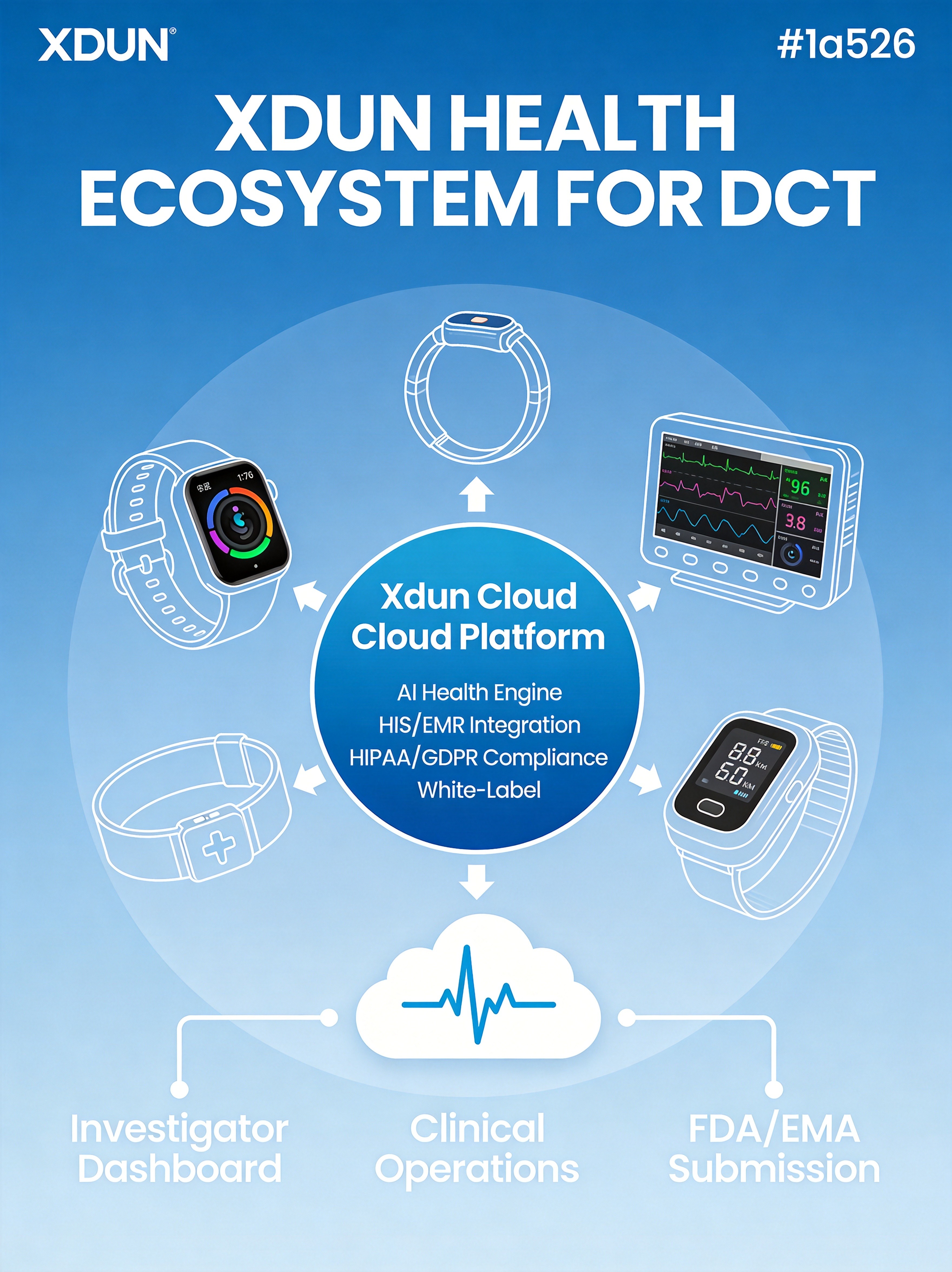
Figure 3: The Xdun Health Ecosystem — medical-grade wearable devices, cloud platform, and integrated data flow designed for decentralized clinical trial operations.
The Strategic Imperative
The convergence of regulatory clarity, proven cost savings, and technology maturity has created a window of competitive advantage for sponsors that adopt DCT methodologies early. The data is unambiguous: DCTs reduce enrollment timelines by 50–75%, cut per-patient costs by 30–40%, improve participant diversity, and generate regulatory-grade evidence that the FDA and EMA have explicitly endorsed.
For clinical operations leaders, the priority actions are clear: evaluate the DCT suitability of active and planned trials, engage with regulators early through scientific advice procedures, select and validate technology partners with demonstrated medical-grade accuracy, and build the standard operating procedures that will govern decentralized trial conduct.
As the DCT market accelerates toward $35 billion by 2035, the organizations that invest today in the regulatory knowledge, operational processes, and technology infrastructure — including validated wearable devices and secure data platforms — will be the ones that bring therapies to patients faster, at lower cost, and with stronger evidence.
For inquiries about Xdun Medical’s clinical trial wearable solutions, data collection platform, or OEM/ODM capabilities, contact our team at jine@xdunmedical.com or call +86-13544254314.
References
1. FDA. Conducting Clinical Trials with Decentralized Elements: Guidance for Industry, Investigators, and Other Interested Parties. September 2024.
2. ICH. E6(R3) Good Clinical Practice Guideline. January 2025.
3. EMA/HMA. Recommendation Paper on Decentralized Elements in Clinical Trials, V02. October 2025.
4. Tufts CSDD / Medable PACT Consortium. Assessing the Financial Value of Decentralized Clinical Trials. 2025.
5. U.S. Department of Health and Human Services. Cost Analysis of Mobile Technology Adoption in Clinical Trials.
6. DiMasi JA, et al. Innovation in the Pharmaceutical Industry: New Estimates of R&D Costs. Journal of Health Economics, 2016.
7. Opportunities and Counterintuitive Challenges for Decentralized Clinical Trials to Broaden Participant Inclusion. npj Digital Medicine, 2022.
8. Emergen Research. Decentralized Clinical Trials Market Size, Share, Trends Analysis 2025-2035.
9. Medable Inc. / Tufts CSDD. New Data Reveals DCTs Linked to Improved Diverse Participation. January 2025.