By Xdun Medical | June 2025
The Numbers That Demand a New Approach
The International Diabetes Federation’s 11th Edition Diabetes Atlas, released in April 2025, delivers a sobering message: approximately 589 million adults aged 20–79 are living with diabetes worldwide — that is 1 in every 9 adults. By 2050, the projection climbs to 853 million, a 46% increase driven by urbanization, aging populations, and rising obesity rates. More troubling still, an estimated 252 million people are unaware they have the condition, placing them at elevated risk of complications ranging from cardiovascular disease to kidney failure and vision loss (IDF Diabetes Atlas, 2025).
The economic toll matches the human one. Global diabetes-related health expenditure crossed the $1 trillion threshold for the first time in 2024, accounting for roughly 12% of all health spending worldwide. The World Health Organization reports that diabetes was directly responsible for 1.6 million deaths in 2021, with high blood glucose contributing to an additional 11% of cardiovascular deaths (WHO, 2024).
These figures explain why glucose monitoring has moved from the margins of chronic disease management to the center of global health procurement strategies. For B2B buyers — diabetes management platforms, telehealth providers, corporate wellness programs, and medical distributors — the question is no longer whether to invest in glucose monitoring solutions, but which technology generation to bet on. For deeper analysis on cardiovascular alternatives, see our technology guide on blood pressure monitoring wearables. For adjacent applications in blood health, see our B2B OEM guide on non-invasive anemia detection and blood disorder monitoring.
The Technology Arc: Three Generations of Glucose Monitoring
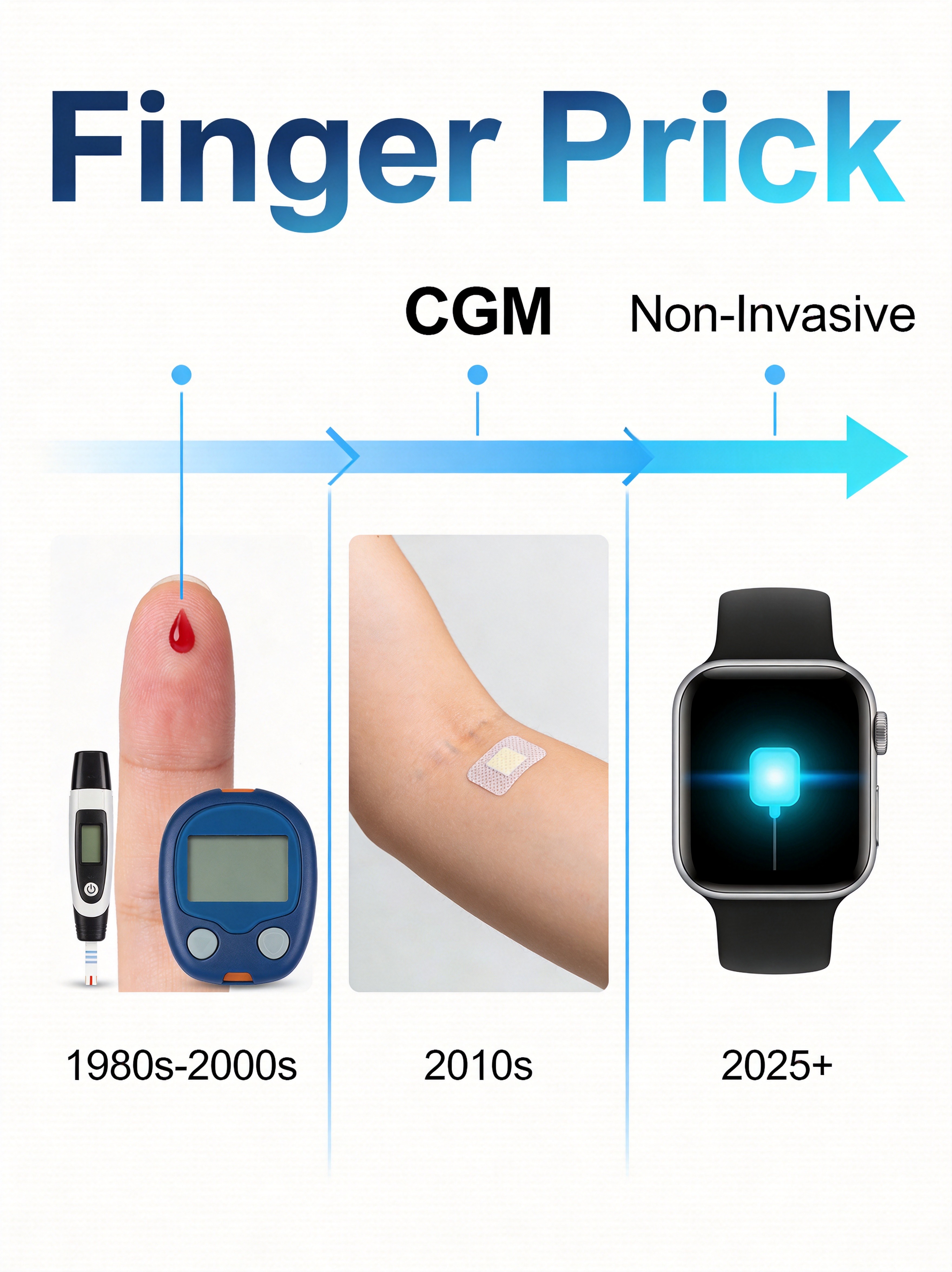
First Generation: Finger-Prick Glucometers (1980s–2000s)
The blood glucose meter (BGM) using capillary finger-prick sampling remains the most widely deployed technology globally, particularly in price-sensitive and low-resource markets. The workflow is familiar: lance the fingertip, draw a drop of blood onto a test strip, and receive a single-point reading within seconds. Devices in this category benefit from mature supply chains, established regulatory pathways, and unit economics that keep per-test costs low.
The limitation is structural. A single reading captures a moment in time — it cannot show whether glucose is rising, falling, or holding steady. Patients who test three to four times daily still miss the majority of glycemic excursions, including nocturnal hypoglycemic events that carry significant clinical risk. Adherence remains a persistent challenge; survey data consistently show that pain, inconvenience, and social stigma lead many patients to test less frequently than prescribed.
Second Generation: Continuous Glucose Monitors (2010s–Present)
Continuous glucose monitoring (CGM) systems addressed the data-gap problem by measuring interstitial fluid glucose at fixed intervals — typically every 1 to 5 minutes — via a subcutaneously inserted sensor filament. The two dominant players define the category.
Abbott’s FreeStyle Libre franchise generated approximately $6.2 billion in 2025 revenue, commanding an estimated 45% of the global CGM market with an installed base exceeding 5 million users. The Libre 3 sensor, roughly the size of two stacked U.S. pennies, delivers readings every minute over a 14-day wear period without requiring fingerstick calibration. Abbott’s strategy has been defined by accessibility — driving down per-sensor cost to expand the addressable market beyond type 1 diabetes into the far larger type 2 population.
Dexcom’s G7 system, contributing to Dexcom’s $3.9 billion in 2024 revenue across an installed base of over 2.3 million users, emphasizes sensor accuracy and connectivity. The G7 achieves a MARD (Mean Absolute Relative Difference) below 9%, supports direct-to-Apple Watch transmission, and integrates with the broadest ecosystem of insulin pumps and digital health platforms. The newly launched G7 15-Day variant extends sensor life while reducing monthly waste. Beyond proprietary ecosystems, B2B developers exploring independent remote patient monitoring can leverage devices like the 4G LTE health monitoring smartwatch to support direct cellular data transmission without smartphone bridging.
The global CGM market was estimated at approximately $10.8 billion in 2024 and is projected to grow at a compound annual rate of 12–16% through 2034, driven by expanding reimbursement coverage, growing type 2 adoption, and integration with automated insulin delivery systems.
Despite their clinical value, CGM systems retain a minimally invasive profile: a sensor filament penetrates the skin, and wearers must manage sensor insertion, adhesion, and replacement cycles. For large-scale deployments — corporate wellness programs covering thousands of employees, or population health initiatives in developing markets — the recurring consumable cost and user friction create meaningful barriers.
Third Generation: Non-Invasive Continuous Monitoring (Emerging)
The third generation aims to eliminate skin penetration entirely. Several technology pathways are converging toward commercially viable non-invasive glucose monitoring (NIGM) wearables, each with distinct trade-offs in accuracy, cost, form factor, and regulatory pathway.
The Science Layer: How Non-Invasive Sensing Actually Works
Procurement professionals evaluating NIGM solutions benefit from understanding the underlying measurement physics. Three principal approaches dominate current development pipelines.
Optical Spectroscopy: NIR and Raman
Near-infrared (NIR) spectroscopy illuminates tissue with wavelengths typically in the 750–2500 nm range and analyzes the absorption spectrum of reflected light. Glucose produces characteristic absorption signatures, but the challenge is formidable: glucose concentration in blood is roughly 100 times lower than water, and the NIR spectrum is dominated by water absorption, scattering from skin layers, and interference from other analytes. Signal processing — increasingly driven by deep learning models trained on large clinical datasets — is essential to extract the glucose signal from the noise.
Raman spectroscopy uses monochromatic laser excitation (commonly 830 nm) to detect the inelastic scattering signature unique to glucose molecular vibrations. A 2025 study published in Analytical Chemistry demonstrated a band-pass Raman spectroscopy (BRS) system achieving a MARD of 11.69% in human subjects — comparable to the Abbott FreeStyle Libre 3 (12.31%) and Dexcom G7 (11.45%) measured in the same trial (Bresci et al., 2025). The device eliminated bulky diffraction gratings and CCD cameras, bringing the form factor closer to portable wearable dimensions.
The key insight for B2B buyers: optical NIGM is transitioning from benchtop laboratory setups to miniaturized wearable architectures. Multi-wavelength sensor arrays, combined with AI-driven calibration, are closing the accuracy gap with needle-based CGM while removing the consumable supply chain entirely.
Electrochemical Sensing: Sweat, Tear, and ISF Analysis
Electrochemical glucose sensors — long the workhorse of finger-prick strips — are being re-engineered for non-invasive biofluids. Sweat-based platforms use flexible electrode arrays integrated into wristbands or patches, measuring glucose oxidase-catalyzed reactions in sweat at concentrations typically 10–200 μM (versus 3–8 mM in blood). Tear-based approaches embed sensors in contact lens platforms. Interstitial fluid (ISF) extraction via reverse iontophoresis avoids needles by using a mild electric current to draw glucose through the skin.
The sweat pathway faces calibration complexity: sweat rate, skin temperature, pH, and electrolyte composition all influence the glucose reading. Non-enzymatic sensors using noble metal nanoparticles (gold, platinum) and carbon nanomaterials address the enzyme degradation problem but require large-scale human validation before clinical deployment.
Microwave and Radio Frequency Sensing
Microwave dielectric spectroscopy operates on a fundamentally different principle: as blood glucose concentration changes, the dielectric properties of tissue shift in measurable ways across the 0.1–20 GHz frequency range. Unlike optical methods, microwave approaches are unaffected by skin pigmentation and do not require a clear optical path through tissue.
A 2024 study demonstrated a 2.4 GHz microwave sensor with detection error under 2% compared to invasive reference measurements (Chen & Lai, 2024). UK-based Afon Technology’s Glucowear™ embeds RF sensors beneath a wrist-worn device, transmitting glucose data without the time lag associated with ISF-based CGM systems. The approach won Junkosha’s Technology Innovator of the Year Award in 2024.
Microwave sensing holds particular appeal for wearable integration because the antenna structures can be fabricated on flexible substrates at relatively low cost, and the technology avoids the consumable business model entirely — a single device provides ongoing monitoring without replacement sensors.
Where the Demand Lives: Out-of-Hospital Glucose Management
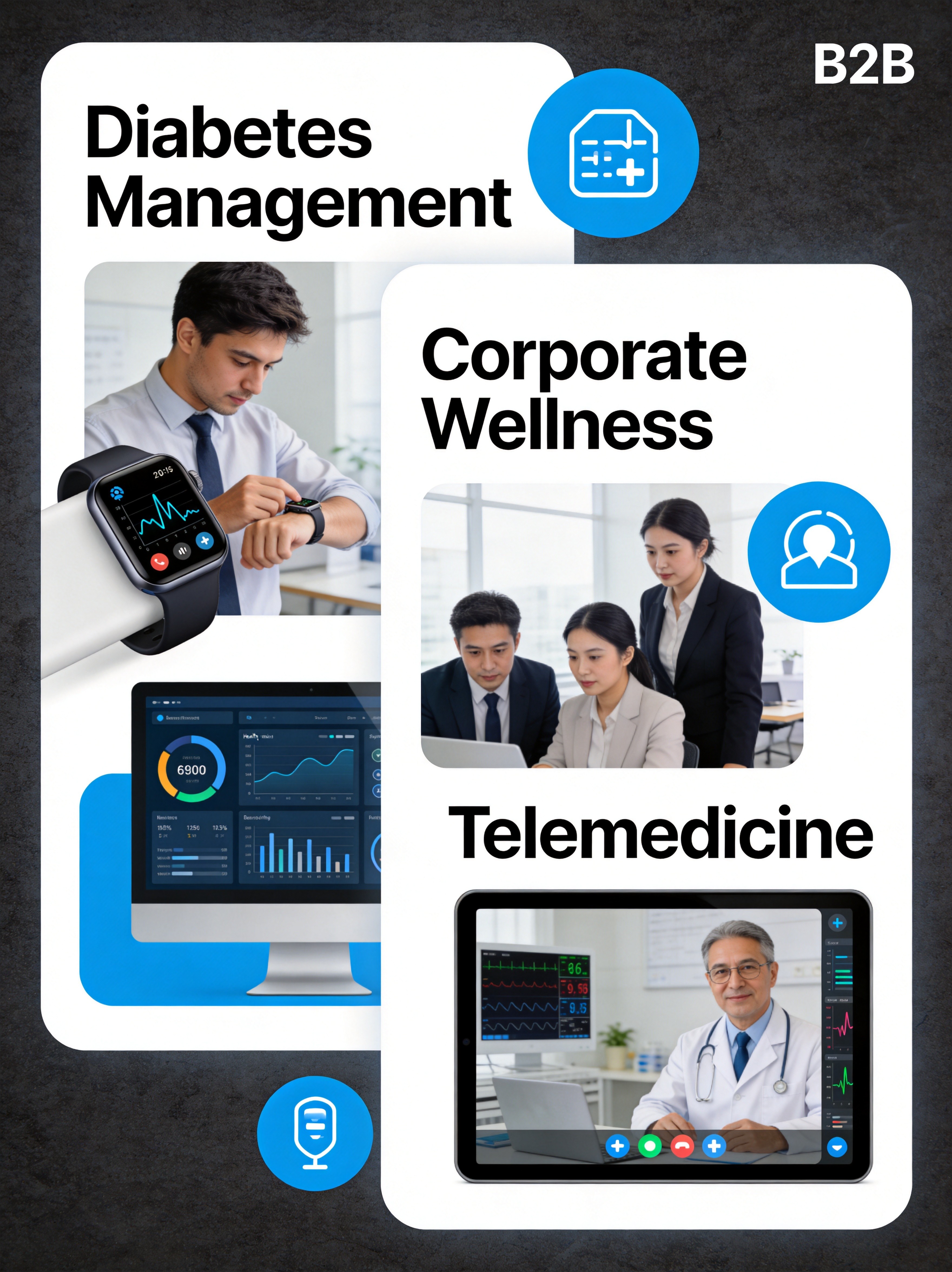
The commercial opportunity for non-invasive glucose wearables spans three distinct B2B verticals, each with different procurement requirements and deployment economics.
Diabetes Management Platforms
Digital diabetes management platforms aggregate CGM data, medication logs, nutrition tracking, and telehealth consultations into unified patient dashboards. These platforms serve payers, provider networks, and directly enrolled patients. The addition of a non-invasive monitoring wearable removes the sensor insertion barrier that limits CGM adoption among type 2 and pre-diabetic populations — the segments with the largest headroom for growth. For platform operators, a hardware component without recurring consumables dramatically simplifies logistics, reduces patient dropout from supply chain interruptions, and improves unit economics at scale.
Corporate Wellness and Employer Health Programs
Employer-sponsored wellness programs have evolved from step-counting challenges to comprehensive metabolic health initiatives. With diabetes and pre-diabetes affecting a growing share of the working-age population, self-insured employers face direct exposure to downstream treatment costs. Non-invasive glucose wearables offer a scalable screening and engagement tool: employees can track glucose trends without clinical procedures, and anonymized population-level data helps benefits managers target interventions. The wearable form factor — indistinguishable from a conventional smartwatch — addresses the participation barrier that medical-device aesthetics create in workplace settings.
Telemedicine and Remote Patient Monitoring
The expansion of remote patient monitoring (RPM) reimbursement codes across Medicare, European health systems, and private payers has created a structural incentive for providers to deploy connected monitoring devices. Glucose data ranks among the highest-value RPM data streams because of its direct link to medication adherence, diet, and acute event risk. Non-invasive wearables enable continuous data collection without requiring patients to manage sensor insertion, adhesion, or disposal — factors that disproportionately affect elderly populations and those with dexterity limitations.
The Competitive Landscape: Dexcom, Abbott, and the OEM Opportunity
The CGM market’s current structure is instructive for understanding where non-invasive OEM solutions fit.
Abbott and Dexcom are vertically integrated enterprises that design, manufacture, and distribute proprietary sensor systems. Their competitive moat rests on three pillars: extensive clinical data supporting regulatory approvals, reimbursement relationships with national payers, and installed bases that create switching costs through ecosystem lock-in (connected pumps, data platforms, clinician familiarity). For a new entrant to challenge them head-to-head on their own terms — building a branded, FDA/CE-marked sensor system with reimbursement coverage — requires $50–200 million in clinical costs and 3–5 years of development time.
The OEM model offers a different value proposition. Rather than competing for the end user’s wrist, OEM manufacturers provide the hardware, sensor technology, firmware, and cloud infrastructure that platforms and distributors brand as their own. This is the model that has proven successful across the broader wearable technology sector, where Shenzhen-based contract manufacturers supply the majority of smartwatches sold under Western brand names.
For diabetes management platforms, telemedicine providers, and wellness companies, the OEM pathway offers several structural advantages:
- Brand control: The platform owns the customer relationship and user experience, with hardware carrying the platform’s brand identity rather than a third-party manufacturer’s logo.
- Data integration: OEM partnerships typically include SDK access and cloud API integration, allowing seamless data flow into the platform’s existing analytics and clinical decision support tools.
- Regulatory pathway: Rather than pursuing standalone medical device clearance, the hardware can be positioned as a wellness or health-tracking device within the platform’s broader service offering, with the manufacturer supporting applicable certifications (CE, RoHS, FCC, ISO 13485).
- Supply chain simplicity: A single hardware unit with no recurring consumables eliminates the complex sensor logistics that characterize the CGM distribution model.
Xdun Medical: OEM Capability in Non-Invasive Glucose Monitoring
Xdun Medical brings focused engineering capability to the non-invasive glucose monitoring wearable space, serving B2B partners who need reliable hardware without building an in-house sensor R&D team.
The company’s development pipeline integrates multi-wavelength optical sensor arrays with AI-driven signal processing algorithms trained on clinical glucose datasets. The wearable form factor supports continuous trend monitoring alongside multi-parameter health tracking — heart rate, SpO₂, body temperature, sleep analysis — within a single wrist-worn device, eliminating the need for patients to manage multiple monitoring tools.
For OEM partners, Xdun Medical offers customization across multiple dimensions: industrial design and branding, firmware and application-layer software, cloud data architecture, and packaging. Manufacturing operations follow ISO 9001 quality management standards, with products designed to support CE, RoHS, and FCC certification pathways for target markets.
The company’s approach recognizes a market reality that pure-play technology companies sometimes miss: B2B buyers in healthcare procurement are not purchasing sensor specifications. They are purchasing reduced integration risk, predictable supply, and hardware that their clinical teams and end users will actually adopt. Xdun Medical’s engagement model — from initial technical consultation through prototyping, certification support, and mass production — is structured around that understanding.
What B2B Buyers Should Evaluate
When assessing non-invasive glucose monitoring OEM partners, procurement teams should examine several dimensions beyond the spec sheet:
Sensor validation methodology: How was accuracy measured, against what reference standard, across what population, and under what conditions? MARD figures without context — sample size, glycemic range, activity conditions — carry limited meaning.
Algorithm transparency: Is the signal processing model continuously improving with data, and does the partner provide visibility into update cadence and validation protocols?
Manufacturing quality infrastructure: ISO 13485 certification signals medical-device-grade quality management. ISO 9001 is the minimum baseline for health-related consumer electronics.
Customization depth: Can the partner modify not just the outer enclosure and logo, but the sensor configuration, firmware logic, and cloud API endpoints to match your platform architecture?
Regulatory support: Does the partner maintain technical documentation packages suitable for submission to notified bodies in your target markets?
The Road Ahead
The trajectory is clear. The diabetes population is growing faster than healthcare infrastructure can scale traditional clinic-based monitoring. Non-invasive wearable technology, combined with cloud analytics and AI-driven insights, offers a path to extend glucose monitoring beyond the diagnosed patient population into the much larger at-risk segment — the 635 million adults worldwide with impaired glucose tolerance who represent the next wave of demand (IDF, 2025).
For B2B organizations building the digital health platforms that will serve this population, the decision to integrate glucose monitoring hardware is increasingly a when-not-if proposition. The question is whether to build sensor technology in-house, license it from a CGM incumbent with competing brand interests, or partner with an OEM manufacturer that provides the hardware layer without inserting itself between the platform and its users.
The third path — OEM partnership — is gaining traction for reasons that have little to do with sensor physics and everything to do with business model alignment. In a market where platform differentiation comes from data analytics, clinical workflow integration, and user experience, ceding the hardware layer to a capable manufacturing partner frees resources for the activities that drive competitive advantage.
For OEM partnership inquiries regarding non-invasive glucose monitoring wearables, contact Xdun Medical:
Email: jine@xdunmedical.com
Phone/WhatsApp: +86-13544254314
References:
- International Diabetes Federation. IDF Diabetes Atlas, 11th Edition. Brussels: IDF; 2025.
- World Health Organization. Diabetes Fact Sheet. November 2024.
- Bresci A, Kim Y, Jue M, So PTC, Kang JW. Band-Pass Raman Spectroscopy Unlocks Compact Point-of-Care Noninvasive Continuous Glucose Monitoring. Analytical Chemistry. 2025.
- Chen JH, Lai KI. Cost-effective Noninvasive 2.4 GHz Microwave Blood Glucose Sensor. Sensors and Materials. 2024;36(5):1905–1917.
- Dexcom, Inc. 2024 Annual Financial Results. 2025.
- Abbott Laboratories. Q4 and Full-Year 2024 Results. January 2025.
- MegaResearch. Overview of the Global Market for Glucose Monitoring Systems. 2024.