Fall Detection in Medical Wearables: A B2B Guide for Senior Care and Hospital Safety
By Xdun Medical | June 2026
Introduction: Why Falls Demand a Technology-First Response
Every second of every day, an older adult somewhere falls. According to the U.S. Centers for Disease Control and Prevention (CDC), approximately 37 million falls occur annually among adults aged 65 and older in the United States alone — and roughly 37% of those who fall sustain an injury requiring medical treatment or activity restriction, translating to an estimated nine million fall injuries each year (CDC, 2026). Globally, the World Health Organization (WHO) reports that falls claim an estimated 684,000 lives annually, making them the second leading cause of unintentional injury death worldwide (WHO, 2021). Among older adults, falls are the leading cause of traumatic brain injury-related hospitalizations and deaths.
For senior care operators, hospital administrators, and home healthcare procurement teams, these numbers are not abstract public health statistics. They represent real operational risk: every unreported fall within a facility carries legal liability, regulatory exposure, and — most critically — a human cost that no retrospective incident report can undo. The question is no longer whether to invest in fall detection technology. The question is which technology architecture delivers measurable, auditable outcomes at scale. For deeper analysis, see our B2B procurement guide to deploying Edge-AI wearable fall detection in senior living.
This guide is written for B2B buyers — nursing home directors, hospital safety officers, OEM product managers, and home care procurement leads — who need to evaluate fall detection wearables not as consumer gadgets, but as enterprise-grade patient safety infrastructure.
1. The Scale of the Problem: Falls by the Numbers
Before evaluating any technology, procurement teams need to understand the clinical and economic burden they are solving for.
Global Prevalence. The WHO estimates that 37.3 million falls severe enough to require medical attention occur worldwide each year, resulting in over 38 million disability-adjusted life years (DALYs) lost — more than transport injuries, drowning, burns, and poisoning combined (WHO, 2021). Adults over 60 bear the highest proportion of fatal falls.
U.S. Burden. CDC data paints an even sharper picture for the American healthcare system. Among older adults, nearly one million hospitalizations per year are attributable to fall injuries, most commonly head injuries and hip fractures. Hip fractures alone account for 88% of emergency department visits and hospitalizations related to falls, and 83% of deaths linked to hip fractures are caused by falls (CDC, 2026). Fall death rates among older adults have risen over 35% in the past decade.
The Institutional Reality. In nursing homes and long-term care facilities, the challenge is compounded by staffing ratios. The sheer difficulty of continuous monitoring means residents may lie on the floor for minutes or hours before a fall is discovered. Research indicates that 62% of fall victims who do not receive help within the first hour — often called the “golden hour” — may lose their ability to live independently.
Financial Impact. Annual fall-related healthcare expenditures in the United States exceed $80 billion, including $53.3 billion in Medicare spending (Frontiers in Public Health, 2025). For a single nursing home, one unattended fall resulting in litigation can cost six to seven figures in settlement and reputation damage. The business case for automated detection is straightforward: the cost of prevention technology is a rounding error compared to the cost of one missed fall.
2. How Fall Detection Wearables Work: The Sensor Fusion Architecture
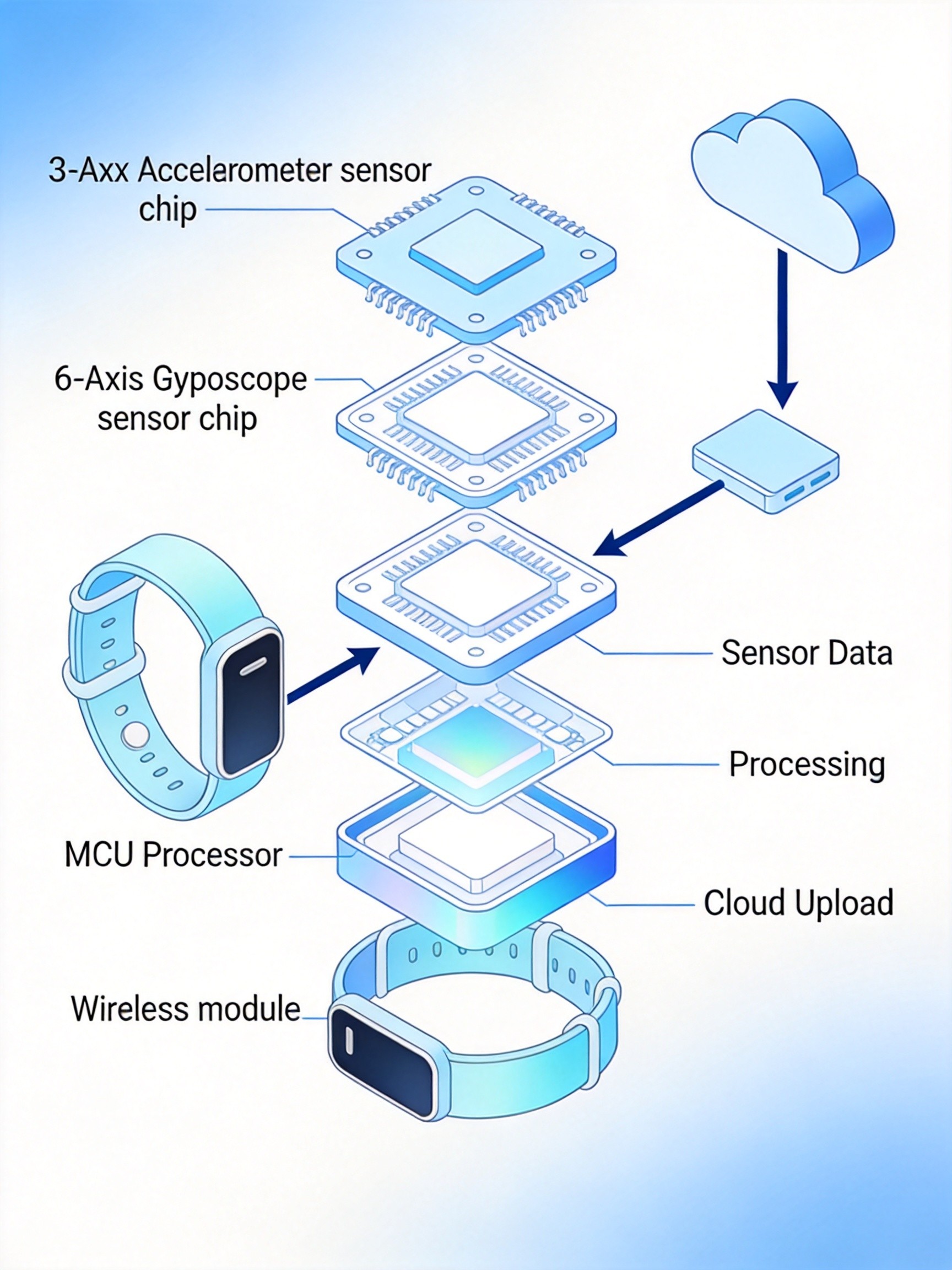
A credible fall detection wearable is not a single sensor with a threshold alarm. It is a sensor fusion system that combines multiple motion-sensing technologies with embedded algorithms to distinguish a genuine fall from the thousands of routine movements a person makes every day.
2.1 Accelerometer: Measuring Impact and Acceleration
The accelerometer is the foundational sensor in any fall detection system. It measures linear acceleration across three axes (X, Y, Z), capturing changes in velocity in real time. During a fall, the accelerometer detects a characteristic signature: a sharp acceleration spike (the body entering free-fall or rapid descent), followed by a sudden deceleration upon impact with the ground. This pattern is distinct from walking, sitting, or bending — activities that produce predictable, rhythmic acceleration profiles.
Modern medical-grade wearables use tri-axial MEMS (Micro-Electro-Mechanical Systems) accelerometers with sampling rates of 50–100 Hz and measurement ranges of ±8g to ±16g. Higher sampling rates capture more granular motion data, which directly improves the algorithm’s ability to distinguish between a hard fall and a vigorous arm swing.
2.2 Gyroscope: Tracking Orientation and Rotation
The gyroscope measures angular velocity — the rate of rotation around each axis. Where the accelerometer answers “how fast did the body move?”, the gyroscope answers “how did the body rotate during the event?” This is critical because a fall involves uncontrolled rotation of the torso, whereas deliberate movements (lying down, picking up an object) exhibit controlled, voluntary angular changes.
A high-quality six-axis gyroscope captures orientation changes across pitch, roll, and yaw. During a fall, the gyroscope records a rapid, unpredictable rotation pattern — the body tumbling — which is a strong differentiator from non-fall events like sitting down quickly or dropping the device.
2.3 Sensor Fusion: Combining Accelerometer and Gyroscope Data
Neither sensor alone is sufficient. An accelerometer might trigger on a sudden stop during a car ride; a gyroscope might register rotation when someone rolls over in bed. Sensor fusion — the real-time integration of accelerometer and gyroscope data streams — creates a multi-dimensional motion signature that dramatically reduces both false positives (non-falls misidentified as falls) and false negatives (actual falls missed).
In practice, the sensor fusion pipeline works as follows:
- Continuous Sampling: Both sensors sample at 50–100 Hz, generating a stream of acceleration and angular velocity vectors.
- Pre-Processing: Raw data passes through digital filters (low-pass, high-pass, or Kalman filters) to remove sensor noise and isolate the motion signal.
- Feature Extraction: The system computes derived metrics — signal magnitude vector (SMV), tilt angle, impact magnitude, post-impact stillness duration.
- Classification: The extracted features feed into the fall detection algorithm, which classifies the event as “fall” or “non-fall.”
3. AI Algorithms: From Threshold Detection to Intelligent Classification
The quality of the algorithm determines whether a fall detection system is a clinical tool or a nuisance device. Three generations of algorithms have emerged.
3.1 Threshold-Based Detection (First Generation)
Early fall detection systems used simple threshold rules: if acceleration exceeds 2.5g and tilt angle exceeds 45 degrees, classify as a fall. These systems are computationally lightweight but produce high false-alarm rates — typically 15–40% — because many everyday activities cross these thresholds. Threshold-based systems are now considered inadequate for clinical or institutional deployment.
3.2 Machine Learning Classifiers (Second Generation)
The second generation applies supervised machine learning models — Support Vector Machines (SVM), k-Nearest Neighbors (KNN), Decision Trees, and Random Forests — trained on labeled datasets of fall and non-fall events. These models learn to recognize the multi-dimensional pattern of a fall rather than relying on rigid thresholds. A systematic review of 80 studies found that ML-based wearable fall detection systems using accelerometer and gyroscope data achieved sensitivity rates above 90% in controlled environments (PMC, 2025).
3.3 Deep Learning and Edge AI (Third Generation)
The current state of the art employs deep learning architectures — Convolutional Neural Networks (CNN) and Long Short-Term Memory (LSTM) networks — that process raw sensor data as time-series inputs. CNNs excel at extracting spatial features from the multi-channel sensor stream, while LSTMs capture temporal dependencies, learning the sequential pattern of pre-impact, impact, and post-impact phases.
Critically, these models are increasingly deployed at the edge — running directly on the wearable device’s microcontroller — rather than requiring cloud connectivity for inference. This approach, often called TinyML, addresses three enterprise concerns: latency (decisions happen in milliseconds, not seconds), privacy (sensitive motion data never leaves the device), and reliability (the system works even without network connectivity).
AI-driven fall detection systems incorporating multi-modal sensor fusion have achieved recognition accuracy exceeding 98% while compressing false-alarm rates below 1% — a threshold that makes large-scale institutional deployment operationally viable.
4. The Automatic Alert Workflow: What Happens When a Fall Is Detected
A fall detection wearable’s value is measured not by the sensor data it collects, but by the care response it triggers. The alert workflow must be fast, reliable, and integrated into existing clinical communication channels.
Phase 1: Detection (0–2 seconds). The sensor fusion system identifies a fall event based on acceleration spike, rotation pattern, and impact signature. The algorithm confirms the event classification at the edge.
Phase 2: Verification (2–15 seconds). The device enters a brief verification window. If the wearer is conscious and the event was a false alarm (e.g., the device was dropped), they can cancel the alert with a button press or gesture. This reduces unnecessary escalations.
Phase 3: Alert Transmission (15–30 seconds). If no cancellation occurs, the device transmits an alert via the configured communication channel — cellular (4G/NB-IoT), Wi-Fi, or Bluetooth-to-gateway — to the monitoring platform. The alert packet includes: device ID, timestamp, GPS/indoor location coordinates, and fall event classification confidence score.
Phase 4: Notification Dispatch (30–60 seconds). The cloud platform or on-premises server routes the alert to designated responders. Depending on the deployment configuration, this may include: push notifications to nursing station dashboards, SMS/phone calls to on-call caregivers, integration with nurse call systems (via HL7 or proprietary APIs), and automatic logging in the electronic health record (EHR).
Phase 5: Response and Resolution. Care staff respond to the location. The event is logged with timestamps for compliance auditing. Post-event analysis data — including the motion signature leading up to the fall — can inform individualized fall risk assessments and preventive interventions.
The entire chain, from impact to caregiver notification, should complete in under 60 seconds. In comparison, traditional pull-cord or button-based call systems depend entirely on the fallen resident being conscious and able to reach the call point — a dependency that fails precisely when it matters most.
5. Wearable Fall Detection vs. Traditional Call Systems: A Comparison for Procurement Teams
| Criterion | Traditional Call Button / Pull Cord | Wearable Fall Detection |
|---|---|---|
| Activation | Manual — requires resident consciousness and reach | Automatic — triggers on detected fall event |
| Coverage | Fixed points (bedside, bathroom) — blind spots everywhere else | 24/7 anywhere the resident goes |
| False Negatives | 100% when resident is unconscious or cannot reach button | <5% with modern AI algorithms |
| Response Time | Variable — depends on when fall is discovered | <60 seconds from impact to notification |
| Data Logging | None or minimal | Full event timeline with motion data for audit |
| Staff Burden | High — requires constant vigilance and manual rounds | Reduced — exception-based alerting |
| Integration | Standalone or basic nurse call | API integration with EHR, nurse call, and monitoring platforms |
| Compliance | Incident-dependent reporting | Automated, timestamped, auditable records |
| Scalability | Per-room installation, high infrastructure cost | Per-resident deployment, incremental scaling |
The fundamental shift is from reactive discovery to proactive detection. A pull cord cannot help a resident who has lost consciousness. A wearable can — and does.
6. Deployment Scenarios: Matching Technology to Care Settings
6.1 Nursing Homes and Assisted Living Facilities
In a 120-bed skilled nursing facility, staffing ratios typically range from 1:8 to 1:15 per shift, depending on jurisdiction and shift type. Continuous visual monitoring of every resident is physically impossible. Wearable fall detection fills this gap by providing exception-based alerting: staff are notified only when an event occurs, freeing them to focus on proactive care rather than constant surveillance.
Deployment model: Each resident wears a device (wrist-worn or pendant). Alerts route to nursing station dashboards and mobile devices carried by CNAs and charge nurses. Integration with the facility’s existing nurse call system ensures alerts appear in the same interface staff already use. Fall event data feeds into monthly quality assurance reports and supports regulatory compliance documentation.
Key procurement consideration: Devices must withstand daily wear in a healthcare environment — water resistance for showering, durable bands resistant to picking and removal by residents with cognitive impairment, and battery life exceeding 24 hours with rapid recharge or hot-swap capability.
6.2 Hospitals and Post-Acute Care
In hospital settings, fall risk is concentrated in specific populations: post-surgical patients, patients on sedating medications, and geriatric psychiatry patients. The Joint Commission identifies falls as a National Patient Safety Goal, and CMS classifies certain fall-related injuries as “never events” — meaning hospitals are not reimbursed for the associated costs of care.
Deployment model: Targeted deployment to high-risk patients identified through Morse Fall Scale or Hendrich II assessments. Devices integrate with the hospital’s real-time location system (RTLS) to provide room-level location data alongside fall alerts. Data streams into the hospital’s clinical decision support system and patient safety dashboard.
Key procurement consideration: Hospital-grade devices must support rapid disinfection protocols (alcohol-based wipes, UV-C compatible), integrate with existing RTLS/Wi-Fi infrastructure, and comply with IEC 60601-1 medical electrical equipment safety standards.
6.3 Home Care and Aging-in-Place
The home care market is the fastest-growing segment, driven by demographic trends and payer preference for community-based care over institutional placement. In the United States, over 14 million seniors live alone (U.S. Census Bureau), and home care agencies are increasingly expected to provide technology-enabled monitoring as part of their service package.
Deployment model: The wearable connects via cellular (4G/NB-IoT) or home Wi-Fi to a cloud monitoring platform. Alerts route to family caregivers, agency care coordinators, or third-party monitoring centers. GPS location tracking is critical for active seniors who may fall outside the home.
Key procurement consideration: The device must function as a standalone system — no smartphone required for setup or operation, no dependency on the senior’s own technology. SIM card connectivity with multi-carrier fallback ensures reliability across coverage areas.
7. OEM Selection Criteria: What to Evaluate in a Fall Detection Module
For medical device brands and solution integrators looking to embed fall detection into their own products, selecting the right sensor module and algorithm partner is a multi-dimensional engineering and commercial decision.
7.1 Sensor Specifications
- Accelerometer range: ±8g minimum; ±16g preferred for capturing high-impact events
- Gyroscope range: ±2000°/s minimum for capturing rotational dynamics of a fall
- Sampling rate: ≥50 Hz for both sensors; 100 Hz recommended for clinical-grade accuracy
- Sensor fusion: On-chip sensor fusion (6-axis IMU) preferred over discrete components for reduced latency and power consumption
7.2 Algorithm Performance
- Sensitivity (true positive rate): >95% in real-world testing, not just laboratory conditions
- Specificity (true negative rate): >98% to ensure manageable false-alarm rates at scale
- Soft fall detection: The algorithm must recognize slow, sliding falls — common among frail elderly users — not just hard impacts
- Edge inference capability: Algorithm should run on-device (TinyML) for privacy, latency, and offline operation
7.3 Communication and Integration
- Cellular: Integrated 4G Cat-M1 / NB-IoT module for standalone connectivity
- Wi-Fi / Bluetooth: For in-facility deployment with gateway infrastructure
- API: RESTful API with webhook support for integration with nurse call systems, EHR platforms, and monitoring dashboards
- Protocols: Support for HL7/FHIR for hospital integration; MQTT for IoT platforms
7.4 Power and Form Factor
- Battery life: Minimum 24 hours active monitoring; 48–72 hours preferred for nursing home deployment
- Charging: Contact charging or hot-swappable battery; wireless charging for waterproof integrity
- Form factor: Wrist-worn (watch form factor) for compliance and comfort; pendant option for users who cannot wear wrist devices
- Weight: Under 50g for all-day wear compliance
7.5 Regulatory and Quality
- Medical device certification: Support for FDA 510(k) clearance pathway or CE Mark (MDR Class I/IIa)
- Manufacturing: ISO 13485 certified production
- Water resistance: IP67 minimum; IP68 preferred for shower and bathing scenarios
- Biocompatibility: ISO 10993 for skin-contact materials
8. The Xdun Medical Approach to Fall Detection
Xdun Medical develops wearable health monitoring solutions designed for B2B integration — serving nursing home chains, hospital systems, home care agencies, and OEM partners who need reliable, customizable fall detection technology.
Our fall detection platform combines tri-axial accelerometer and six-axis gyroscope sensor fusion with an AI-driven classification engine that runs at the edge — meaning fall events are identified on-device within milliseconds, without depending on cloud connectivity. The algorithm is trained on a diverse motion dataset encompassing hard falls, soft falls, near-falls, and activities of daily living, achieving high sensitivity while maintaining a low false-alarm rate suitable for institutional-scale deployment.
For OEM partners, Xdun Medical provides flexible integration options: the fall detection module can be delivered as a licensable firmware package for integration into existing wearable hardware, or as a complete reference design including sensor selection, PCB layout, and algorithm calibration support. Our engineering team works directly with partner R&D groups to tune detection parameters for specific use cases — whether that is a nursing home wristband optimized for dementia residents who may attempt to remove the device, or a hospital pendant designed for rapid disinfection between patients. To accelerate time-to-market for these specialized applications, our screenless health band serves as a prime example of this hardware capability, utilizing medical-grade sensors and AI to deliver continuous health tracking without a display.
Certification support: Xdun Medical assists partners with documentation and testing for FDA 510(k) clearance, CE Mark (EU MDR), and other regional regulatory pathways. All manufacturing is conducted under ISO 13485 quality management systems.
9. Implementation Roadmap for B2B Buyers
Deploying fall detection across a facility or product line is not a simple purchase decision — it requires a structured implementation plan.
Phase 1: Needs Assessment (Weeks 1–2). Map fall incident data from the past 12–24 months. Identify high-risk zones (bathrooms, corridors, specific resident cohorts). Define integration requirements with existing nurse call, EHR, and RTLS systems.
Phase 2: Pilot Deployment (Weeks 3–6). Deploy 10–20 devices on a single unit or floor. Measure: false-alarm rate, missed-fall rate, staff response time, user compliance (wear time), and device durability. Compare against baseline incident data.
Phase 3: Full Rollout (Weeks 7–12). Scale to facility-wide or multi-facility deployment. Establish standard operating procedures for alert response. Train all clinical staff on device management, alert handling, and data interpretation.
Phase 4: Optimization (Ongoing). Use aggregated fall event data to identify patterns — time-of-day clustering, environmental factors, resident-specific risk profiles. Feed insights into fall prevention programs, staffing models, and environmental modifications.
10. The Future: What’s Next for Medical Wearable Fall Detection
The fall detection technology landscape is evolving rapidly. Several trends will shape procurement decisions over the next three to five years:
- Multi-modal sensor fusion: Combining IMU data with photoplethysmography (PPG) for heart rate and blood oxygen, enabling pre-fall risk detection based on physiological precursors such as sudden hypotension or arrhythmia.
- Predictive analytics: Moving from “detect the fall” to “predict the fall” — using longitudinal motion and gait data to identify deteriorating balance before an incident occurs.
- Federated learning: Training AI models across multiple institutions without sharing raw patient data, addressing privacy regulations while improving algorithm robustness across diverse populations.
- Integration with ambient sensors: Combining wearable data with room-based radar or LiDAR sensors for redundant fall detection in high-risk areas like bathrooms, where wearables may be removed.
Conclusion
Falls are not an inevitability of aging — they are a patient safety challenge that technology can meaningfully address. For B2B buyers in senior care, hospital safety, and home health, the decision to invest in fall detection wearables should be evaluated against a clear set of criteria: detection accuracy, alert speed, integration capability, regulatory readiness, and total cost of ownership. For deeper analysis on optimizing these specific metrics, see our guide on strategic deployment of AI-enhanced fall detection wearables to balance hardware responsiveness and reduce alert fatigue.
The data is unambiguous. Every year, 37 million older adults fall. Nearly one million are hospitalized. Over 41,000 die. Behind each statistic is a care team that wishes they had known sooner, responded faster, and documented better. Automated fall detection wearables make that possible — not as a replacement for human care, but as a force multiplier that lets caregivers be in the right place at the right time.
Ready to evaluate fall detection technology for your facility or product line?
Contact the Xdun Medical engineering team for a technical consultation, product specifications, or OEM partnership discussion.
References:
1. World Health Organization. (2021). Falls Fact Sheet. https://www.who.int/news-room/fact-sheets/detail/falls
2. Centers for Disease Control and Prevention. (2026). Common Injuries as We Age. https://www.cdc.gov/still-going-strong/about/common-injuries-as-we-age.html
3. Frontiers in Public Health. (2025). Global, Regional, and National Burden of Hip Fractures Attributable to Falls in Older Adults.
4. Yon, Y., Mikton, C.R., Gassoumis, Z.D., & Wilber, K.H. (2017). Elder abuse prevalence in community settings. The Lancet Global Health, 5(2), e147–e156.
5. PMC / NIH. (2025). Fall Detection in Elderly People: A Systematic Review of Ambient Assisted Living Technology Performance.