Pulse Oximetry Wearable Technology: The 2025 OEM Selection Guide for Medical Device Brands
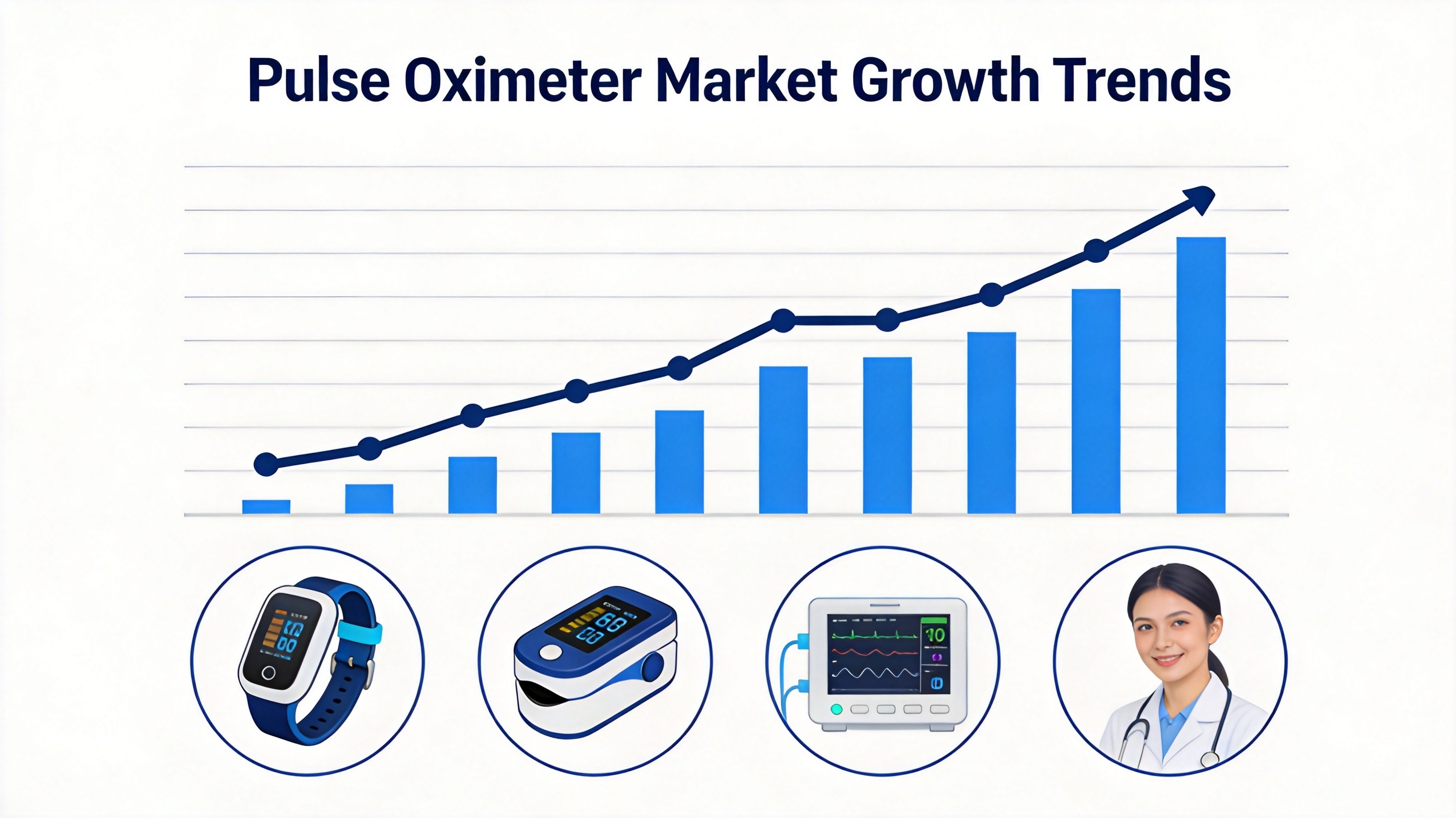
Blood oxygen saturation monitoring has moved out of the ICU and onto the wrist. What was once a hospital-bound diagnostic parameter is now a consumer expectation—Apple Watch users track SpO2 during sleep, Garmin athletes monitor oxygen at altitude, and chronic respiratory patients rely on fingertip oximeters for daily spot-checks. The global pulse oximeter market, valued at approximately $2.5 billion in 2024, is projected to cross $5.1 billion by 2032, driven by an aging population, rising COPD prevalence, and the normalization of remote patient monitoring (RPM) post-pandemic. For deeper analysis on the emerging smart ring form factor, see our technical guide on reflective pulse oximetry technology for continuous blood oxygen tracking.
For brands entering this space—whether a consumer electronics company adding health sensors to a smartwatch, or a med-tech distributor building a clinical-grade line—the OEM partner you choose defines your product’s ceiling. This guide breaks down the technology, the regulatory terrain, and a practical framework for evaluating pulse oximetry manufacturing partners.
The Pulse Oximetry Market: Hard Numbers Behind the Hype
The demand trajectory is not speculative. Grand View Research estimates the global pulse oximeter market will grow at a CAGR of approximately 8–10% through 2032. Several structural forces are converging:
- Aging demographics. The WHO reports that by 2030, 1 in 6 people globally will be aged 60 or older. Age-related conditions—COPD, congestive heart failure, sleep apnea—all require regular oxygen saturation monitoring.
- Chronic respiratory disease burden. According to the Global Burden of Disease Study, COPD affects over 200 million people worldwide. SpO2 monitoring is a cornerstone of COPD management protocols, and guidelines from the Global Initiative for Chronic Obstructive Lung Disease (GOLD) recommend pulse oximetry for exacerbation detection.
- RPM reimbursement expansion. The U.S. Centers for Medicare & Medicaid Services (CMS) now covers remote physiologic monitoring under CPT codes 99453 and 99454, creating a reimbursement pathway that makes clinical-grade wearable oximeters economically viable for healthcare providers.
- Consumer health awareness. The wearables market is no longer about step counting. As of 2025, smart wristband devices with SpO2 sensors exceeded 71 million units in annual sales in China alone, per industry data.
Market Segmentation at a Glance
| Segment | 2024 Market Share | Growth Driver | Key OEM Consideration | |———|——————|—————|———————-| | Fingertip Pulse Oximeters | ~48% | Home care, post-COVID awareness | High-volume, cost-sensitive manufacturing | | Wrist-Worn / Wearable | ~22% | Smartwatch integration, RPM | Miniaturization, multi-sensor fusion | | Handheld / Portable | ~18% | Clinical settings, ambulatory surgery | Display quality, battery life | | Tabletop / Bedside | ~12% | Hospital ICUs, ORs | Alarm accuracy, wired connectivity |
Sources: Grand View Research, industry reports, 2024–2025 analyst consolidations.
The takeaway: the fastest-growing segment is wearable—but it’s also the most technically demanding. OEM partners that cut their teeth on fingertip devices may not have the engineering depth for wrist-based or ring-form-factor SpO2 sensing.
How PPG-Based SpO2 Sensing Works: A Technical Primer
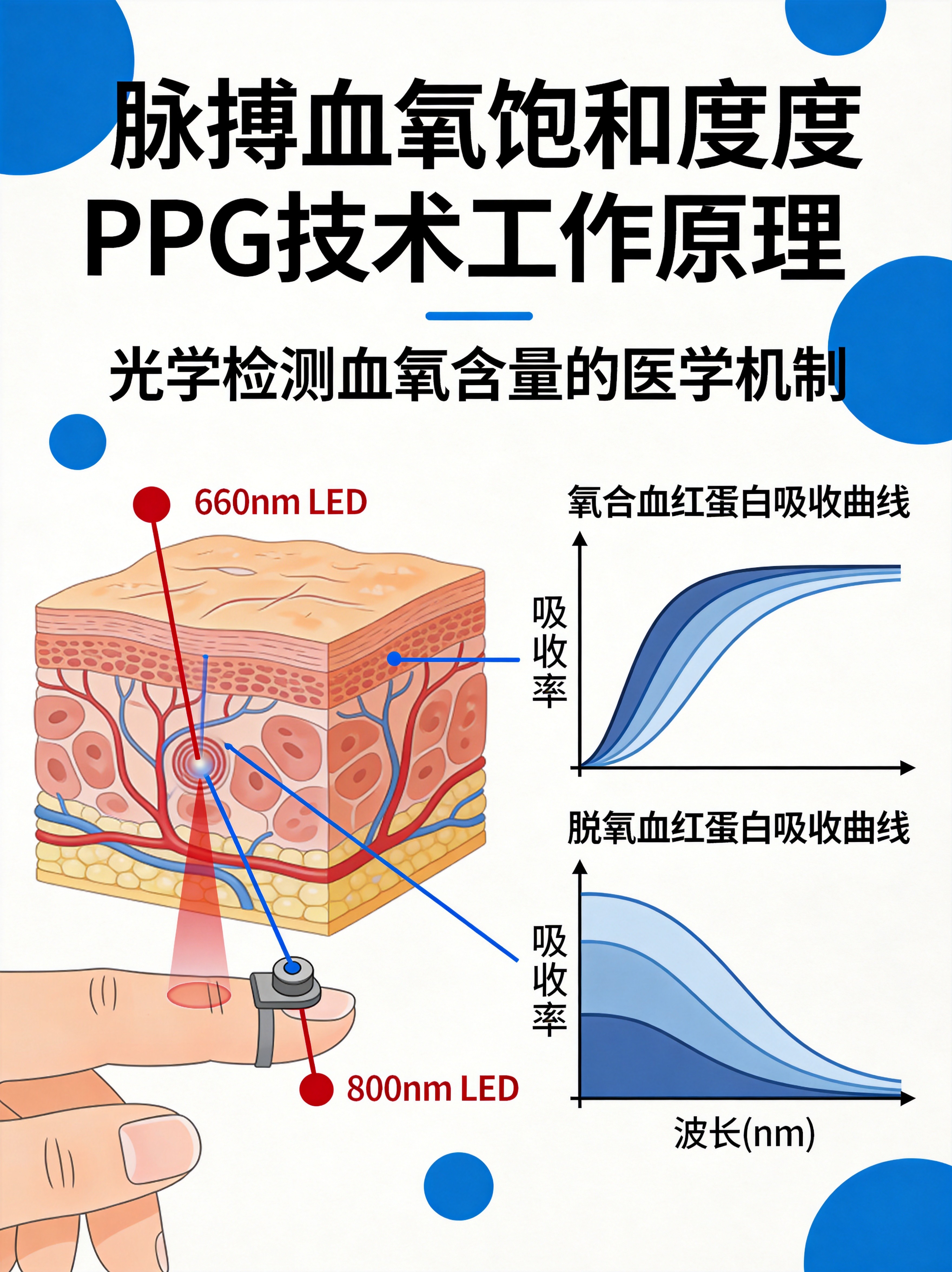
Pulse oximetry relies on photoplethysmography (PPG)—an optical technique that measures blood volume changes in the microvascular bed of tissue. Here is what matters for product development:
The Dual-Wavelength Principle
A standard transmission-mode pulse oximeter uses two LEDs:
- Red LED (660 nm): Deoxygenated hemoglobin (Hb) absorbs significantly more red light than oxygenated hemoglobin (HbO₂).
- Infrared LED (880–940 nm): HbO₂ absorbs more IR light than Hb.
A photodiode on the opposite side captures the transmitted light. The ratio of pulsatile (AC) to non-pulsatile (DC) components at each wavelength yields the R-value, which is mapped to SpO₂ via an empirically derived calibration curve:
“ R = (AC_red / DC_red) / (AC_ir / DC_ir) SpO₂ ≈ 104 - 17R - 11R² (Maxim AN6409 reference)
“
Reflectance vs. Transmission: The Wearable Design Decision
Fingertip oximeters use transmission-mode PPG—light passes through the finger. Wearables (wristbands, rings, earbuds) use reflectance-mode PPG, where the LED and photodiode sit on the same side of the skin. Reflectance PPG introduces signal-to-noise challenges:
- Motion artifact. Wrist movement generates noise orders of magnitude larger than the PPG signal. Accelerometer-assisted adaptive filtering is non-negotiable.
- Low perfusion. Cold extremities, dark skin tones, and peripheral vascular disease reduce signal amplitude. This is where FDA’s January 2025 draft guidance on pulse oximeter performance across skin pigmentation becomes critical.
- Ambient light interference. Sunlight contains IR components that saturate photodiodes. Optical isolation and modulated LED driving are baseline requirements.
A competent OEM partner should be able to discuss their signal processing chain—analog front-end (AFE) selection (e.g., TI AFE4950, Maxim MAX86178), sampling rate, motion compensation algorithm, and calibration methodology. If they default to “we use the chip manufacturer’s reference design,” probe deeper. To illustrate this level of optimization, the 4G ECG monitoring watch integrates medical-grade sensors with custom-tuned signal processing to support continuous cardiac monitoring, moving well beyond basic reference implementations. For a broader look at physical form factor and material customization, see our guide on smart ring customization and full ODM design for healthcare brands.
Accuracy Specifications That Matter
- ARMS (Accuracy Root Mean Square): The industry standard metric. Clinical-grade devices target ≤ 3.0% ARMS across 70–100% SpO₂ range.
- Perfusion Index (PI): The ratio of pulsatile to non-pulsatile signal. A PI below 0.3% indicates poor perfusion and unreliable readings. Devices should display PI or flag low-perfusion conditions.
- Bias across skin tones: FDA’s 2025 draft guidance recommends testing on at least 15 subjects per Fitzpatrick skin type category (I–VI), with a minimum of 30% of subjects having dark skin pigmentation.
Regulatory Landscape: The Paperwork That Separates Serious OEMs from Garage Shops
Medical device regulation is jurisdiction-specific, but three frameworks dominate:
FDA 510(k) (United States)
Pulse oximeters are Class II devices under 21 CFR 870.2700. The 510(k) premarket notification pathway requires demonstrating substantial equivalence to a predicate device. The FDA’s 2025 draft guidance raised the bar: manufacturers must now include skin pigmentation analysis in clinical validation studies, and the agency recommends a minimum of 150 subjects across diverse demographics.
For OEM buyers: confirm whether your partner has supported 510(k) submissions for clients. A factory that has never contributed to a technical file or design history file (DHF) is a liability, not a partner.
CE Marking / EU MDR (European Union)
The transition from MDD to MDR (EU 2017/745) elevated clinical evidence requirements. Pulse oximeters classified as Class IIa under MDR need a notified body audit covering ISO 13485 QMS, technical documentation, and clinical evaluation reports (CER). Key requirements:
- UDI (Unique Device Identification) assignment
- Post-market surveillance (PMS) plan
- Periodic safety update reports (PSUR)
ISO 13485:2016
The global quality management system standard for medical devices. An OEM’s ISO 13485 certificate should explicitly cover the product category—verify the scope includes “design and manufacture of pulse oximeters” or “patient monitoring devices,” not a generic “medical devices” umbrella.
OEM Selection Framework: 5 Criteria You Cannot Skip
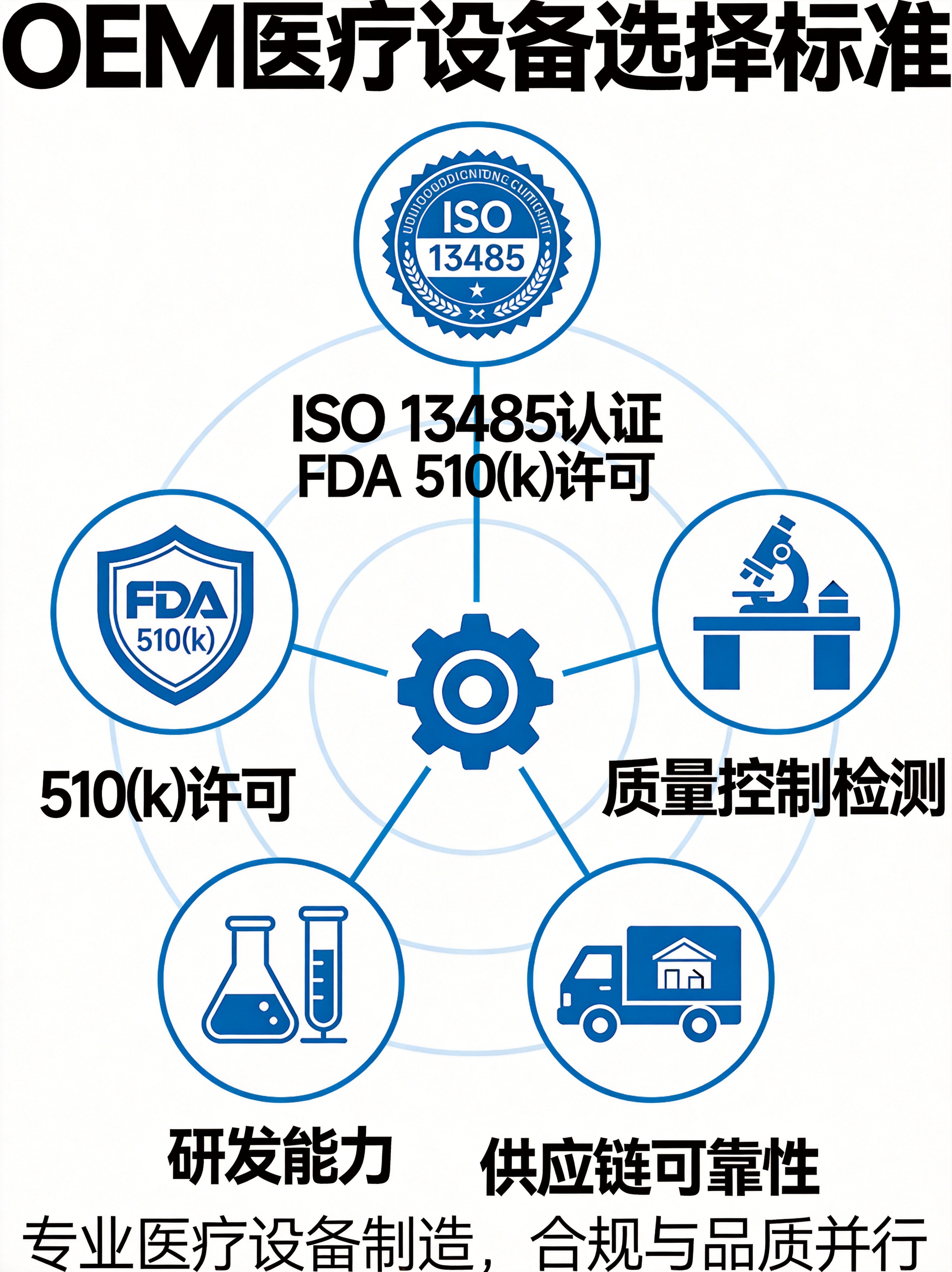
After auditing dozens of manufacturing facilities in the Pearl River Delta and Yangtze River Delta regions, here is the evaluation framework that consistently separates professional OEMs from commodity assemblers:
1. Regulatory Track Record
Ask for redacted examples of 510(k) clearance letters or CE certificates where the OEM contributed to the technical file. A factory that can produce a DHF index, risk management file per ISO 14971, and software validation records per IEC 62304 demonstrates regulatory maturity.
2. Signal Processing & Algorithm Capability
The calibration curve—the mathematical mapping from R-value to SpO₂—is the core IP. An OEM that relies entirely on the sensor manufacturer’s default calibration cannot differentiate your product. Probe for:
- In-house clinical calibration data across SpO₂ ranges
- Motion artifact reduction algorithm performance (tested on treadmill protocols)
- Low-perfusion performance (PI < 0.3%)
3. Component Sourcing & Supply Chain
The optical sensor stack—LEDs, photodiodes, AFE chip—is the bill-of-materials bottleneck. Ask about:
- Second-source qualification for critical components
- Lead times and minimum order quantities (MOQs)
- Traceability systems (UDI-compliant serialization)
4. Testing & Validation Infrastructure
A legitimate OEM should have:
- SpO₂ simulators (Fluke Index 2, Datrend AccuSim) for production-line testing
- Environmental chambers for temperature/humidity cycling
- Clinical trial partnerships with local hospitals for human subject validation
- EMC pre-compliance testing capability (IEC 60601-1-2)
5. Scalability & After-Sales
From pilot runs of 500 units to mass production of 50,000+ units per month—the OEM’s production line should scale without quality regression. Beyond manufacturing, evaluate:
- RMA handling process and defect rate targets
- Firmware OTA update infrastructure
- Regulatory change notification protocols
Technology Trends Shaping the Next 3 Years
Multi-Wavelength Oximetry
Traditional 2-wavelength SpO₂ is limited. Next-generation sensors add 4–8 wavelengths (e.g., green 530 nm, near-IR 940 nm) to measure methemoglobin, carboxyhemoglobin, and even hemoglobin concentration—parameters previously reserved for co-oximeters costing $5,000+. OEMs investing in multi-wavelength sensor fusion are positioning for the clinical-grade wearable segment.
AI-Driven Signal Processing
Convolutional neural networks trained on raw PPG waveforms can suppress motion artifacts more effectively than traditional adaptive filtering. Several research groups have demonstrated SpO₂ estimation from PPG alone using deep learning, with ARMS approaching 2.0% in ambulatory conditions. The catch: FDA’s guidance on AI/ML-enabled medical devices requires change control plans and ongoing performance monitoring—adding regulatory complexity.
Chip-Scale Integration
The trend from discrete AFE + MCU architectures toward system-on-chip (SoC) solutions (e.g., Maxim MAX32664, TI AFE4950 with integrated Cortex-M) reduces BOM cost, PCB footprint, and power consumption. This is critical for ring-form-factor oximeters, where battery capacity is measured in tens of milliampere-hours.
Skin Tone Equity
The FDA’s 2025 draft guidance is a regulatory inflection point. Pulse oximeters cleared before 2025 were predominantly tested on lighter-skinned subjects. New devices must demonstrate accuracy across Fitzpatrick types I–VI. The Open Oximetry Project at UCSF is building a public database of device accuracy across skin tones—a resource every OEM buyer should consult.
FAQ
Q1: What is the difference between FDA 510(k) clearance and FDA registration?
FDA registration is a facility listing—it means the FDA knows the factory exists. FDA 510(k) clearance means the FDA has reviewed the device’s clinical data and determined it is substantially equivalent to a legally marketed predicate device. For a pulse oximeter intended for clinical decision-making, 510(k) clearance is the baseline. A factory that conflates registration with clearance is either uninformed or misleading you.
Q2: Can a pulse oximeter be accurate on dark skin tones?
Historically, many pulse oximeters showed positive bias (overestimated SpO₂) on darker skin tones due to melanin absorbing light at the measurement wavelengths. The FDA’s 2025 draft guidance mandates diverse-subject testing. When evaluating an OEM, ask for their skin-tone calibration data and whether they test across Fitzpatrick types I–VI.
Q3: What is the minimum clinical data required for a wearable pulse oximeter?
For a 510(k) submission, the FDA recommends a minimum of 150 subjects with arterial blood gas (ABG) reference measurements. The SpO₂ range should span 70–100%, with at least 200 data points below 80%. For CE MDR, the notified body will expect a clinical evaluation report (CER) based on literature review and/or clinical investigation.
Q4: What is the typical lead time from prototype to mass production for a wearable pulse oximeter?
A realistic timeline: 3–4 months for engineering validation (EVT), 2–3 months for design validation (DVT), and 2–3 months for process validation (PVT). Add 4–6 months for regulatory submission review. Total: 12–16 months from frozen design to market, assuming the OEM has existing tooling and calibration infrastructure.
Q5: What certifications should an OEM have before I consider them?
At minimum: ISO 13485:2016 (with scope covering pulse oximeter or patient monitoring), ISO 14971 risk management compliance, and IEC 60601-1 electrical safety. If targeting the EU, confirm MDR-compliant technical documentation capability. If targeting the U.S., confirm the OEM has supported client 510(k) submissions with DHF documentation.
Partner with a Manufacturer That Understands the Technology
The pulse oximetry market rewards speed-to-market—but a poorly calibrated device, a regulatory miss, or a supply chain failure can set a brand back 12–18 months. Xdun Medical brings two decades of patient monitoring OEM experience to your product development cycle, from sensor selection and algorithm tuning to regulatory documentation support.
We support ISO 13485-compliant manufacturing, FDA 510(k) submission preparation, and CE MDR technical file assembly. Our engineering team works directly with your product managers—not through layers of sales intermediaries.
Ready to discuss your pulse oximetry product requirements?
- 📧 Email: jine@xdunmedical.com
- 📞 Phone/WhatsApp: +86-13544254314
- 🌐 Visit: [xdunmedical.com](https://xdunmedical.com)
This article is for informational purposes only and does not constitute regulatory advice. Consult qualified regulatory professionals for your specific device classification and market access strategy.