Choosing the right medical wearable manufacturer is one of the most consequential decisions a B2B buyer will make. The wrong partner can mean regulatory delays, quality failures, missed launch windows, and six-figure losses. The right partner accelerates time-to-market, ensures compliance, and becomes a long-term competitive advantage. For deeper analysis on evaluating a partner’s quality and compliance frameworks, see our ISO 13485 vs ISO 9001 vs FDA QMSR quality standards comparison. As covered in our Medical Device QSR (21 CFR 820) OEM audit checklist for wearable buyers, verifying these specific compliance frameworks is a critical step in the vendor selection process.
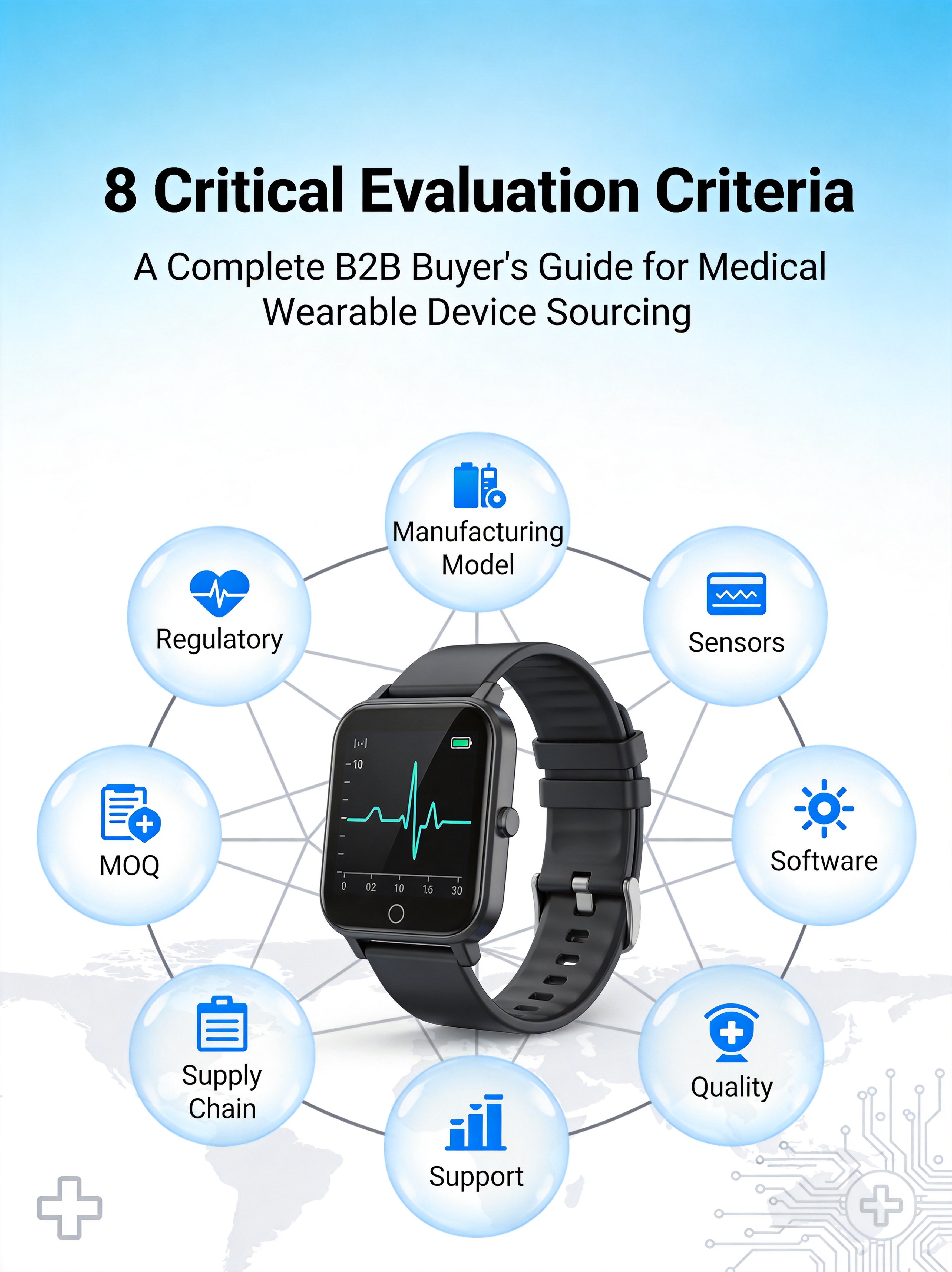
This guide breaks down the 8 critical evaluation criteria, red flags to watch for, and a practical checklist you can use during vendor selection — whether you’re sourcing ECG smartwatches for a telehealth program, blood pressure monitors for RPM, or fitness bands for a corporate wellness initiative. For instance, when evaluating devices for continuous cardiac monitoring, the 4G ECG monitoring watch utilizes medical-grade sensors to support reliable remote patient tracking.
Why Manufacturer Selection Matters More Than Price
Medical wearables occupy a unique intersection of consumer electronics and regulated medical devices. A $5 savings per unit means nothing if the device fails FDA submission, if the firmware has a data security vulnerability, or if the factory can’t scale from prototype to 50,000 units without quality degradation.
The total cost of working with the wrong manufacturer includes:
- Regulatory re-submission costs: $50,000–$200,000 per failed 510(k) cycle
- Recall costs: $2–$10 per unit for software fixes, $10–$50+ per unit for hardware recalls
- Launch delays: 6–18 months of lost market opportunity
- Reputational damage: Particularly damaging in healthcare, where trust is the product
8 Critical Evaluation Criteria
1. Regulatory Certifications & Compliance Experience
This is the single most important factor. A manufacturer without regulatory experience cannot guide you through the certification process — they can only build hardware and hope it passes.
What to look for:
| Certification | What It Proves | Why It Matters |
|---|---|---|
| ISO 13485 | Quality Management System for medical devices | The foundation. No ISO 13485 = no serious medical device manufacturer. |
| FDA 510(k) experience | Has navigated US regulatory submissions | The US is the largest medical wearable market. Your manufacturer should have devices that have cleared 510(k). |
| CE MDR (EU 2017/745) | EU medical device compliance | Required for European market access. MDR is stricter than the old MDD. |
| ISO 9001 | General quality management | Good baseline, but ISO 13485 supersedes it for medical devices. |
| MDSAP | Medical Device Single Audit Program | Single audit satisfies US, Canada, Brazil, Japan, Australia. Sign of a mature manufacturer. |
Questions to ask:
- How many 510(k) submissions have you supported? What were the outcomes?
- Can you provide a Declaration of Conformity for CE MDR?
- Do you have an MDSAP certificate? When does it expire?
- What’s your process for managing design controls and risk management files (ISO 14971)?
2. Manufacturing Capabilities: OEM vs ODM vs White-Label
Understanding the manufacturing model determines your customization options, IP ownership, and unit economics.
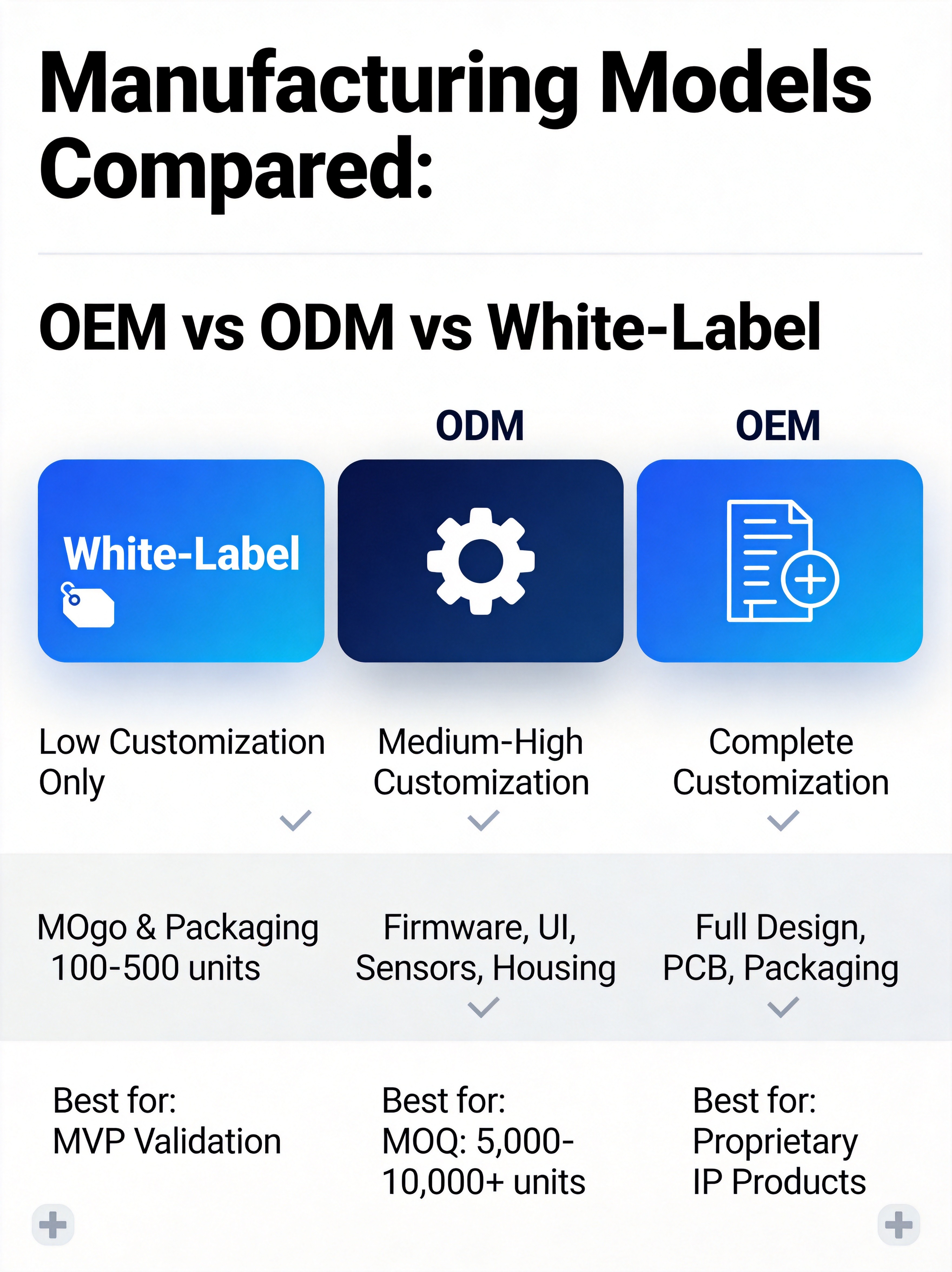
| Model | What You Get | Customization Level | Typical MOQ | Best For |
|---|---|---|---|---|
| White-Label | Existing product with your logo | Low (logo, packaging) | 100–500 units | Quick launches, MVP validation |
| ODM (Original Design Manufacturer) | Manufacturer’s existing platform, heavily customized | Medium–High (firmware, UI, sensors, housing) | 1,000–5,000 units | Differentiated products without R&D from scratch |
| OEM (Original Equipment Manufacturer) | Fully custom design built to your spec | Complete (everything from PCB to packaging) | 5,000–10,000+ units | Proprietary products, unique form factors, IP ownership |
Key consideration: If you need FDA 510(k) clearance, the manufacturer’s name appears on the submission. Their regulatory track record directly affects your approval odds.
3. Technology & Sensor Expertise
Medical wearables live or die by sensor accuracy. Your manufacturer should have deep expertise in the specific sensor technologies your product requires.
Core sensor technologies and what to verify:
ECG (Electrocardiogram)
- Single-lead vs multi-lead capability
- Sampling rate (250Hz minimum for clinical-grade)
- AFib detection algorithm performance (sensitivity/specificity)
- FDA-cleared ECG module references
PPG (Photoplethysmography)
- Green LED vs infrared vs multi-wavelength
- Heart rate accuracy: ±2 BPM resting, ±5 BPM during exercise
- SpO2 accuracy: ±2% in the 70–100% range
- Motion artifact rejection algorithms
Blood Pressure (Oscillometric)
- Cuff-based (air pump) vs PPG estimation
- ISO 81060-2 clinical validation data
- FDA 510(k) clearance status
- Calibration requirements
Additional sensors to consider:
- Temperature (skin and body core estimation)
- Accelerometer/gyroscope (fall detection, activity tracking)
- GPS (location tracking for elderly care, pediatric devices)
- Bioimpedance (body composition, hydration)
Questions to ask:
- Can you share clinical validation data for your ECG/PPG/BP sensors?
- What’s your firmware development capability? Can you customize algorithms?
- Do you have reference designs for [specific sensor combination]?
- How do you handle sensor calibration in mass production?
4. Software & Firmware Development
Hardware is half the product. Firmware, companion apps, and cloud infrastructure determine the user experience — and the regulatory classification.
What to evaluate:
- Firmware customization: Can they modify the firmware for your specific use case? (Custom alerts, data protocols, BLE GATT profiles)
- Companion app development: iOS and Android app development capability. Do they have in-house developers or outsource?
- Cloud backend: Do they offer a cloud platform for device management, or do you bring your own?
- API/SDK availability: Can your team integrate the device data into your existing systems?
- Data security: HIPAA compliance for US health data, GDPR for EU. Encryption at rest and in transit. BLE pairing security.
- OTA (Over-The-Air) updates: Critical for post-launch bug fixes and feature additions. Can they push firmware updates remotely?
Red flag: If the manufacturer can only provide a white-label app with no customization, you’ll be stuck with their UI/UX — which may not meet your brand or regulatory requirements.
5. Quality Management System (QMS)
ISO 13485 is the minimum bar. But the real question is whether the QMS is actually followed in daily operations.
What to verify:
- Design controls: Design input → output → verification → validation → transfer. Are these documented and traceable?
- Risk management: ISO 14971 compliance. FMEA (Failure Mode and Effects Analysis) documentation.
- CAPA (Corrective and Preventive Action): How do they handle quality issues? What’s their process for root cause analysis?
- Incoming inspection: What percentage of incoming components are inspected? What are the AQL (Acceptable Quality Limit) levels?
- Production testing: 100% functional testing or sampling? What test parameters?
- Traceability: Can they trace any shipped unit back to its component lots, production date, and test results?
Audit tip: Ask for a copy of their most recent ISO 13485 audit report. Any non-conformities should have been addressed with CAPA records.
6. Minimum Order Quantity (MOQ) & Pricing Structure
MOQ and pricing structures vary dramatically between manufacturers. Understanding the full cost picture prevents budget surprises.
Typical MOQ ranges:
| Product Type | White-Label MOQ | ODM MOQ | OEM MOQ |
|---|---|---|---|
| Fitness band | 100–500 | 1,000–3,000 | 5,000–10,000 |
| ECG smartwatch | 200–500 | 1,000–3,000 | 5,000–10,000 |
| Blood pressure watch | 200–500 | 1,000–3,000 | 5,000–10,000 |
| Smart ring | 300–1,000 | 2,000–5,000 | 10,000+ |
Pricing structure questions:
- What’s included in the unit price? (Firmware, packaging, accessories, certification support?)
- Are there NRE (Non-Recurring Engineering) fees for customization? How much?
- What are the tooling costs for custom housings? ($5,000–$50,000 depending on complexity)
- Is there a price break at higher volumes? At what thresholds?
- What are the payment terms? (Typically 30% deposit, 70% before shipment)
Hidden costs to watch:
- Certification support fees ($10,000–$50,000 for 510(k) support)
- Firmware customization ($5,000–$30,000)
- App development ($10,000–$50,000)
- Packaging design ($2,000–$10,000)
- Shipping and customs (15–25% of unit cost for air freight)
7. Supply Chain & Lead Times
Lead times can make or break a product launch. Medical wearable supply chains involve specialized components (medical-grade sensors, biocompatible materials) that have longer procurement cycles.
Typical lead times:
| Stage | White-Label | ODM | OEM |
|---|---|---|---|
| Sample (1–10 units) | 3–7 days | 7–14 days | 30–60 days |
| Pilot run (100–500 units) | 2–3 weeks | 3–4 weeks | 6–8 weeks |
| Mass production (5,000+) | 3–4 weeks | 4–6 weeks | 8–12 weeks |
Supply chain questions:
- Do you have dual-source suppliers for critical components (sensors, MCUs)?
- What’s your component inventory strategy? Do you stock long-lead-time parts?
- How do you handle component obsolescence? (End-of-life notifications, last-time-buy)
- What’s your capacity utilization? (If they’re at 95%+, your order may be delayed)
- Can you handle sudden demand spikes? What’s your maximum monthly capacity?
8. After-Sales Support & Warranty
The relationship doesn’t end at shipment. Post-launch support is where good manufacturers differentiate from average ones.
What to expect:
- Warranty period: 12–24 months is standard for medical wearables
- Defect rate commitment: <1% for medical-grade, <2% for consumer-grade
- RMA process: How quickly do they process returns? Do they cover shipping?
- Firmware support: Bug fixes, security patches, and feature updates for how long?
- Technical support: Response time SLAs (24–48 hours for critical issues)
- On-site support: Available for large-scale deployments?
Red Flags That Should Stop You Immediately
- “We can do everything” — No manufacturer excels at everything. A manufacturer claiming expertise in every sensor technology, every certification, and every form factor is likely overstating.
- No ISO 13485 — This is non-negotiable for medical devices. If they don’t have it, they’re a consumer electronics factory, not a medical device manufacturer.
- Unwilling to share references — A good manufacturer has satisfied clients who are willing to vouch for them. If every reference is “confidential,” that’s a red flag.
- No quality documentation — If they can’t show you their QMS documents, design control records, or CAPA history, their quality system exists only on paper (if at all).
- Prices 30%+ below market — Medical-grade components have real costs. If the price is dramatically lower than competitors, something is being cut — usually quality control, component grade, or regulatory compliance.
- No clinical validation data — “Our ECG is very accurate” without validation data is meaningless. Ask for the clinical study report.
- Poor communication during evaluation — If they’re slow to respond, vague in answers, or miss deadlines during the sales process, expect worse after you’ve paid.
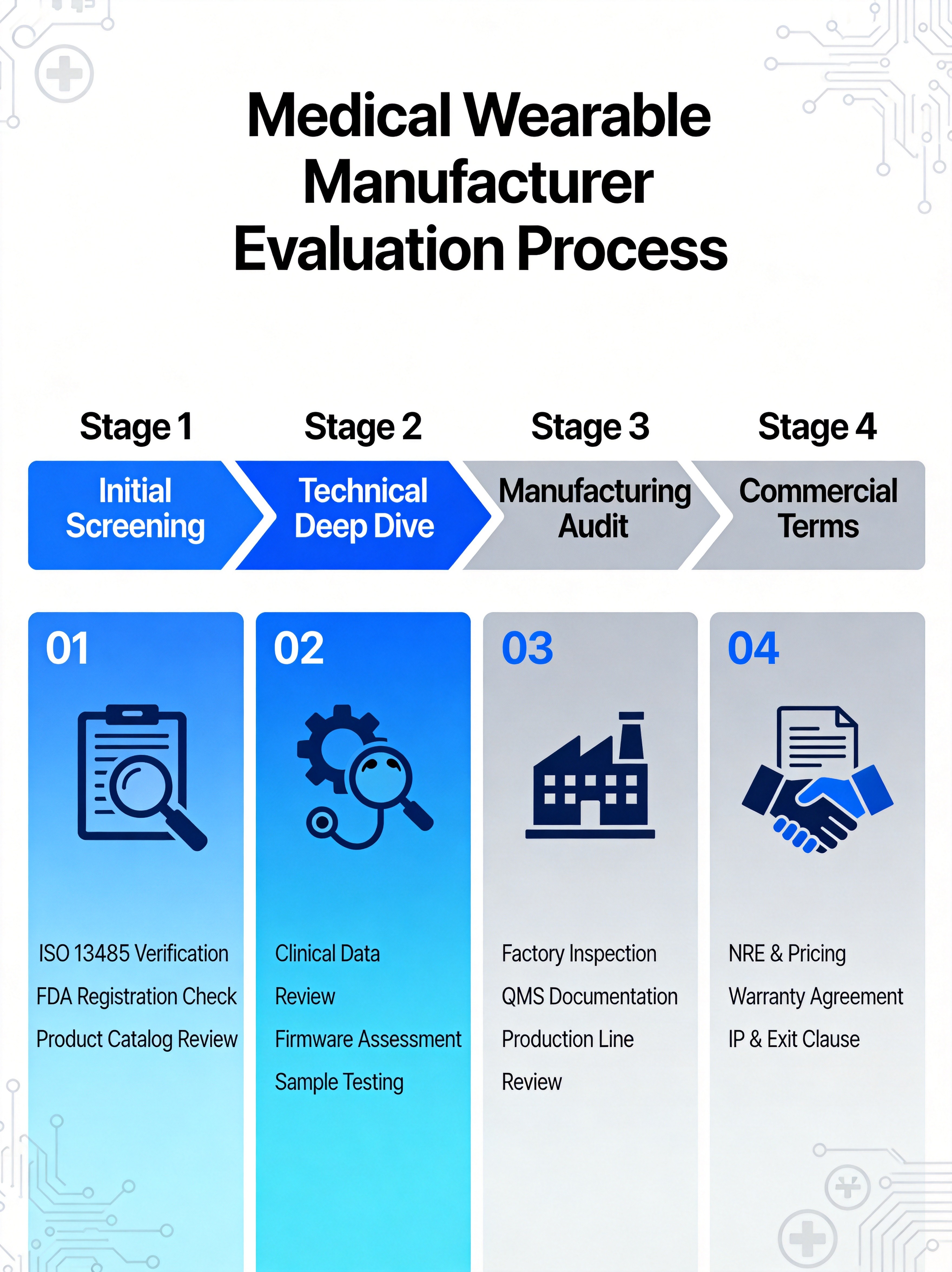
Practical Evaluation Checklist
Use this checklist during your manufacturer evaluation process:
Phase 1: Initial Screening (Before First Call)
- ✅ ISO 13485 certificate verified (check issuing body, validity date)
- ✅ FDA Establishment Registration verified (accessdata.fda.gov)
- ✅ Website shows specific medical wearable products (not just generic electronics)
- ✅ At least 3 years of medical device manufacturing history
- ✅ Clear product catalog with specifications
Phase 2: Technical Deep Dive (First 2–3 Calls)
- ✅ Clinical validation data provided for relevant sensors
- ✅ Regulatory pathway discussion (they ask about your target markets and intended use)
- ✅ Firmware customization capabilities confirmed
- ✅ Companion app development capability confirmed
- ✅ Sample devices received and tested (order 2–5 samples)
- ✅ Sample quality meets expectations (build quality, sensor accuracy, UI)
Phase 3: Manufacturing Audit (Before Signing)
- ✅ Factory audit completed (in-person or third-party)
- ✅ QMS documentation reviewed (design controls, CAPA, risk management)
- ✅ Production line inspection (cleanliness, organization, testing stations)
- ✅ Incoming inspection process verified
- ✅ Outgoing QC process verified (functional testing, visual inspection)
- ✅ Traceability system confirmed (batch records, component lot tracking)
Phase 4: Commercial Terms
- ✅ NRE fees clearly documented
- ✅ Unit pricing at multiple volume tiers
- ✅ Lead time commitments in writing
- ✅ Warranty terms agreed (period, defect rate, RMA process)
- ✅ IP ownership clearly defined in contract
- ✅ Exit clause (what happens if you want to switch manufacturers)
Why Xdun Medical
Xdun Medical has been manufacturing medical wearable devices for healthcare providers, telehealth companies, and corporate wellness programs worldwide. Our manufacturing capabilities include:
Regulatory foundation:
- ISO 13485 compliance support for medical device QMS
- FDA Establishment Registration support
- CE MDR compliance support for European market
- Experience supporting 510(k) submissions for ECG and blood pressure devices
Product portfolio (30+ models):
- ECG smartwatches (single-lead, clinical-grade AFib detection)
- Air pump blood pressure watches (ISO 81060-2 oscillometric measurement)
- PPG health monitors (heart rate, SpO2, sleep tracking)
- Smart rings (compact form factor, sleep + heart rate monitoring)
- Fitness bands (corporate wellness, high-volume deployments)
- Specialized devices (elderly care, pediatric, sports medicine)
Manufacturing capabilities:
- OEM/ODM/White-label models with flexible MOQ (starting from 100 units for white-label)
- In-house firmware development team (custom BLE protocols, data encryption, OTA updates)
- Companion app development (iOS, Android, cloud backend)
- Custom PCB design and housing tooling
- 100% functional testing on production line
- Full traceability (batch records, component lot tracking)
Support:
- Regulatory submission support (510(k), CE MDR technical documentation)
- 24-month warranty with <1% defect rate commitment
- 24-hour technical support response for critical issues
- Dedicated project manager for each client
Contact Xdun Medical at jine@xdunmedical.com or +86-13544254314 to discuss your medical wearable manufacturing requirements. Our team will help you evaluate the right product platform, customization options, and regulatory pathway for your specific application.
Frequently Asked Questions
What is the difference between OEM and ODM for medical wearables?
OEM means the manufacturer builds a completely custom device to your specifications — you own the design and IP. ODM means the manufacturer has an existing product platform that they customize for you (firmware, UI, sensors, housing), but the base design is theirs. ODM has lower NRE costs and faster time-to-market; OEM gives you full control and IP ownership but requires higher investment and longer development cycles.
How long does it take to manufacture a custom medical wearable?
For white-label products: 2–4 weeks for mass production after sample approval. For ODM projects: 4–8 weeks for mass production after firmware customization and sample approval. For full OEM projects: 3–6 months from design freeze to mass production, including tooling, prototyping, and design verification.
What MOQ do I need for a medical wearable?
White-label products typically start at 100–500 units. ODM customization usually requires 1,000–3,000 units minimum. Full OEM development typically requires 5,000–10,000 units to justify tooling and NRE costs. Some manufacturers offer pilot runs at lower MOQs for an additional fee.
Do I need FDA 510(k) clearance for my wearable?
If your device makes medical claims (diagnosis, treatment, monitoring of a disease), yes. General wellness devices (fitness tracking, step counting) are typically FDA-exempt. Devices with ECG, blood pressure, or SpO2 measurements that are intended for medical use require 510(k) clearance. Consult with your manufacturer’s regulatory team early in the process.
How do I verify a manufacturer’s ISO 13485 certification?
Ask for the certificate and verify it with the issuing certification body (BSI, TÜV SÜD, SGS, etc.). Check the scope of certification — it should specifically include medical device manufacturing. Verify the validity dates and any surveillance audit schedule. You can also check the ISO 13485 registry on the certification body’s website.
What should I budget for a medical wearable manufacturing project?
For ODM projects: $15,000–$50,000 NRE (customization, firmware, app) + $25–$80 per unit. For OEM projects: $50,000–$200,000 NRE (design, tooling, prototyping, regulatory support) + $20–$60 per unit. Regulatory submission support is typically $10,000–$50,000 on top of NRE. These are rough ranges — actual costs depend on complexity, sensors, and volume.
Can a manufacturer help with FDA 510(k) submission?
A manufacturer cannot submit a 510(k) on your behalf (you are the sponsor), but they should provide substantial support: technical documentation, performance testing data, biocompatibility data, software documentation (IEC 62304), and design control records. Ask specifically what regulatory documentation they provide and whether they have experience with predicate device comparisons.
What happens if the defect rate is higher than expected?
Your contract should specify a maximum acceptable defect rate (typically <1% for medical-grade). If exceeded, the manufacturer should replace defective units at no cost and conduct root cause analysis (CAPA). For systemic quality issues, you should have the right to a third-party audit and, in extreme cases, contract termination with tooling transfer to a new manufacturer.