In an era where medical wearables are transforming healthcare delivery, data privacy and regulatory compliance have become non-negotiable imperatives for manufacturers, healthcare providers, and technology partners. As these devices—ranging from continuous glucose monitors to cardiac rhythm trackers to remote patient monitoring systems—collect, process, and store highly sensitive health data, they attract rigorous scrutiny from regulatory bodies worldwide. For example, advanced solutions like the 4G ECG monitoring watch utilize medical-grade sensors to support continuous cardiac monitoring, necessitating robust encryption and secure data pipelines to protect patient information. As covered in our guide on how AI transforms raw sensor data into clinical decision support, the transition from basic data collection to advanced algorithmic processing introduces additional layers of compliance complexity that manufacturers must navigate. For deeper analysis on the hardware reliability required to maintain these secure data pipelines, see our guide on the reliability validation matrix covering ORT, burn-in, and accelerated life testing gates before mass production.
For B2B stakeholders including hospitals, senior care facilities, corporate wellness programs, and US/European distributors, understanding the complex landscape of HIPAA (Health Insurance Portability and Accountability Act), GDPR (General Data Protection Regulation), and FDA (U.S. Food and Drug Administration) compliance is not merely a legal requirement—it is a competitive advantage and a fundamental trust-builder.
This comprehensive guide explores the critical intersection of medical wearable technology, data privacy, and regulatory compliance, providing actionable insights for businesses navigating this complex ecosystem.

The Growing Importance of Medical Wearables Market
The global medical wearables market is experiencing unprecedented growth. According to recent industry reports project the market to reach $135 billion by 2030, growing at a CAGR of 26.4%. This surge is driven by:
- Aging populations worldwide
- Rising prevalence of chronic diseases
- Shift toward value-based care models
- Advancements in sensor technology and AI
- Increasing patient demand for remote monitoring solutions
However, this rapid growth brings significant data security challenges that cannot be overlooked. Medical wearables differ from consumer fitness trackers in that they handle Protected Health Information (PHI), making them subject to stringent regulatory requirements.
1. Data Security Challenges in Medical Wearables
Medical wearables present unique data security challenges that set them apart from other digital health tools:
1.1 Sensitivity of Health Data
Unlike consumer wearables that track steps or sleep patterns, medical wearables collect clinical-grade health data including:
- Cardiac rhythms and ECG data
- Blood glucose levels
- Blood pressure measurements
- Oxygen saturation levels
- Medication adherence patterns
- Patient location data
This data, when compromised, can lead to identity theft, insurance discrimination, and significant patient harm. The sensitivity of this data requires multi-layered security approaches that go beyond standard consumer data protection.
1.2 Continuous Data Monitoring
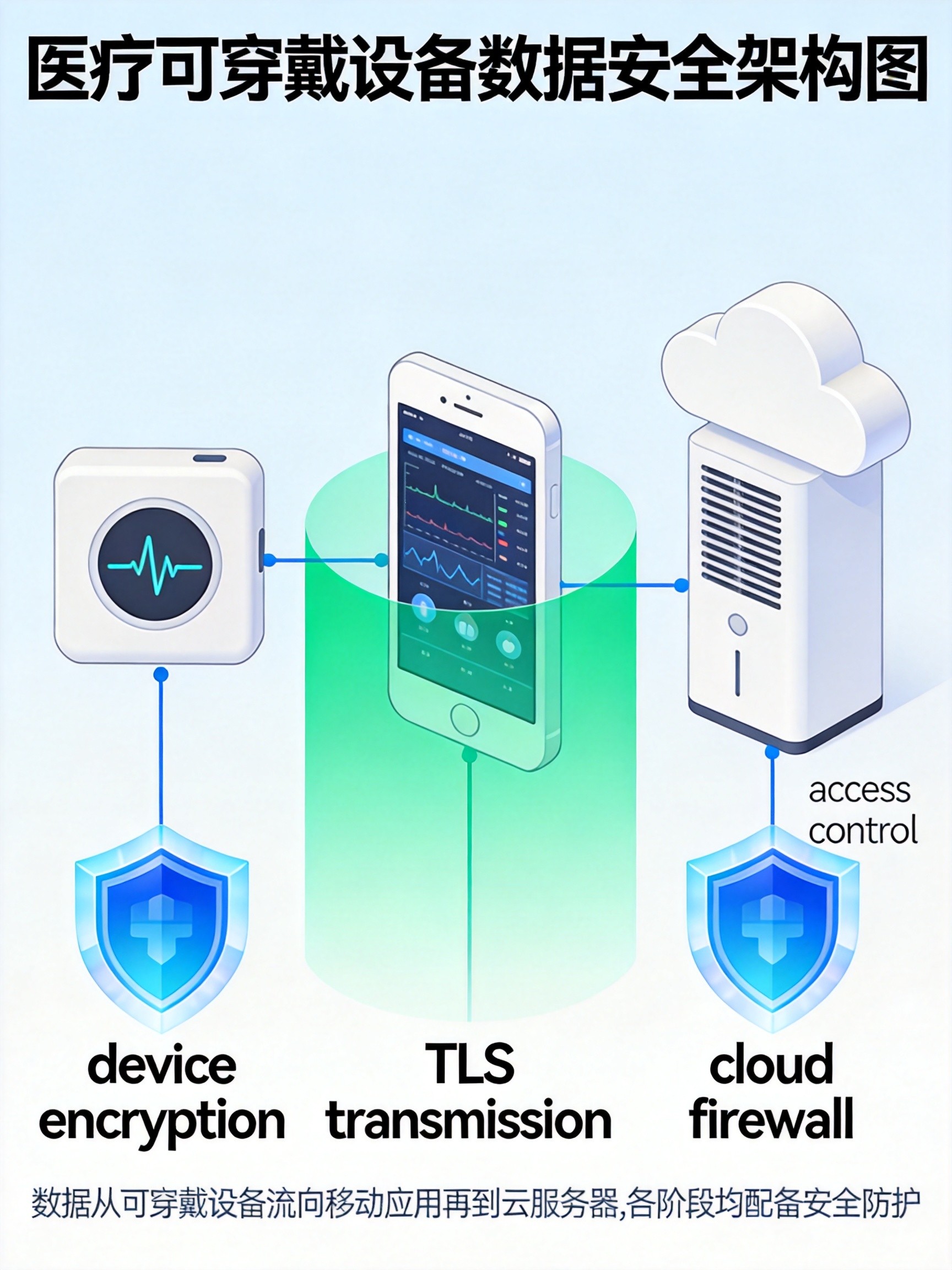
Medical wearables operate 24/7, generating continuous streams of health data that must be secured at every stage:
- Data collection on the device itself
- Data transmission via Bluetooth, Wi-Fi, or cellular networks
- Data processing in cloud platforms
- Data storage in electronic health records (EHRs)
Each transmission point represents a potential vulnerability that bad actors can exploit.
1.3 Cloud Storage and Accessibility
Most medical wearable ecosystems rely on cloud infrastructure for data storage, processing, and accessibility across multiple stakeholders. While cloud solutions offer scalability and accessibility, they also introduce:
- Multi-tenant environment risks
- API vulnerabilities
- Insider threat vectors
- Cross-border data transfer complications
- Third-party vendor risks
1.4 Device-Level Vulnerabilities
Medical wearables themselves can be points of vulnerability:
- Limited processing power constraints limit on-device encryption capabilities
- Bluetooth Low Energy (BLE) connectivity risks
- Lost or stolen devices containing patient data
- Outdated firmware with security patches
- Lack of standardization across device platforms
2. Major Regulatory Frameworks
Understanding the regulatory landscape is essential for any medical wearable manufacturer or distributor. Below is a comprehensive breakdown of the three most influential regulatory frameworks.
2.1 HIPAA (United States)
The Health Insurance Portability and Accountability Act of 1996 (HIPAA) establishes national standards to protect individuals’ medical records and other personal health information.
Applicability
HIPAA applies to covered entities and business associates:
- Covered Entities: Health plans, healthcare clearinghouses, and healthcare providers who electronically transmit health information
- Business Associates: Persons or entities that perform functions on behalf of a covered entity that involve access to PHI
For medical wearables, HIPAA compliance is required when:
- Devices are used by healthcare providers for clinical decision-making
- Data is shared with covered entities
- Device manufacturers handle PHI on behalf of covered entities
Technical Requirements
HIPAA’s Security Rule mandates specific technical safeguards:
- Access Control: Implement technical policies and procedures for electronic information systems that allow access only to authorized personnel
- Audit Controls: Implement hardware, software, and/or procedural mechanisms that record and examine activity in information systems
- Integrity Controls: Implement policies and procedures to ensure that electronic PHI is not improperly altered or destroyed
- Authentication: Implement procedures to verify that a person or entity seeking access is the one claimed
- Transmission Security: Implement technical security measures to guard against unauthorized access to electronic PHI being transmitted over an electronic communications network
Breach Notification and Penalties
HIPAA violations carry severe penalties based on the level of negligence:
| Violation Type | Minimum Penalty | Maximum Penalty |
|---|---|---|
| Unknowing | $100 per violation | $50,000 per violation |
| Reasonable Cause | $1,000 per violation | $50,000 per violation |
| Willful Neglect (Corrected) | $10,000 per violation | $50,000 per violation |
| Willful Neglect (Uncorrected) | $50,000 per violation | $1.5 million per year |
The HITECH Act (Health Information Technology for Economic and Clinical Health Act) strengthens HIPAA enforcement and increases penalties for violations.
2.2 GDPR (European Union)
The General Data Protection Regulation (GDPR) is the EU’s comprehensive data protection law that applies to any organization processing personal data of EU residents, regardless of where the organization is based.
Key Principles for Medical Wearables
GDPR introduces several principles that are particularly relevant for medical wearables:
- Lawfulness, Fairness, and Transparency: Personal data must be processed lawfully, fairly, and transparently
- Purpose Limitation: Data collected for specified, explicit, and legitimate purposes only
- Data Minimization: Only collect data necessary for the specified purpose
- Accuracy: Keep data accurate and up-to-date
- Storage Limitation: Store data only as long as necessary
- Integrity and Confidentiality: Ensure appropriate security measures
Data Subject Rights
GDPR grants EU residents significant rights over their health data:
- Right of Access: Individuals can access their personal data
- Right to Rectification: Individuals can correct inaccurate data
- Right to Erasure (“Right to be Forgotten”): Individuals can request deletion of data
- Right to Restriction of Processing: Individuals can restrict how their data is used
- Right to Data Portability: Individuals can receive their data in a usable format
- Right to Object: Individuals can object to data processing
DPIA Requirements
For medical wearables processing health data typically require a Data Protection Impact Assessment (DPIA):
- Systematic and extensive evaluation of personal data processing
- Assessment of necessity and proportionality
- Risk management measures
- Consultation with supervisory authorities when high risks remain
Cross-Border Data Transfers
GDPR regulates the transfer of personal data outside the EU/EEA:
- Adequacy decisions
- Standard Contractual Clauses (SCCs)
- Binding Corporate Rules (BCRs)
- Other appropriate safeguards
Penalties
GDPR violations can result in fines of up to:
4% of annual global turnover or €20 million, whichever is higher
2.3 FDA (United States)
The U.S. Food and Drug Administration (FDA) regulates medical devices, including software as a medical device (SaMD), through its Center for Devices and Radiological Health (CDRH).
Software as a Medical Device (SaMD) Classification
The FDA classifies medical devices into three classes based on risk:
| Class | Risk Level | Examples | Regulatory Path |
|---|---|---|---|
| Class I | Low Risk | General wellness devices, low-risk monitoring | 510(k) or De Novo if novel, exempt if Class I exempt |
| Class II | Moderate Risk | ECG monitors, pulse oximeters, CGMs | 510(k) clearance |
| Class III | High Risk | Life-sustaining or life-supporting devices | Premarket Approval (PMA) |
Medical wearables fall into different classes depending on their intended use and risk level.
FDA Cybersecurity Requirements
The FDA has issued specific cybersecurity guidelines for medical devices:
- Premarket Considerations:
- Design cybersecurity into devices
- Provide evidence of cybersecurity controls
- Labeling with cybersecurity information
- Software Bill of Materials (SBOM)
- Postmarket Cybersecurity:
- Monitor for vulnerabilities
- Timely disclosures
- Patch management processes
- Coordinated vulnerability disclosure
FDA Software as a Medical Device (SaMD) Action Plan
The FDA’s SaMD Action Plan outlines the agency’s approach to regulating digital health software, with key focus areas:
- Real-world evidence
- AI/ML-based SaMD
- Cybersecurity
- Digital health technology
- Patient-centered outcomes
2.4 Additional Important Standards and Regulations
Beyond the “big three” frameworks, several additional standards are critical for medical wearable compliance:
ISO 27001
- International standard for information security management systems (ISMS)
- Provides a systematic approach to managing sensitive company information
- Includes people, processes, and technology controls
ISO 13485
- Quality management system for medical devices
- Focuses on regulatory compliance and risk management
- Essential for medical device manufacturers
- Required for FDA QSR and CE marking compliance
HITECH Act
- Strengthens HIPAA enforcement
- Promotes adoption of health information technology
- Incentivizes EHR adoption
- Increases penalties for HIPAA violations
NIST Cybersecurity Framework
- Voluntary framework for reducing cybersecurity risks
- Five core functions: Identify, Protect, Detect, Respond, Recover
- Widely referenced in healthcare cybersecurity
3. Compliance Requirements for Medical Wearables: A Comparative Analysis
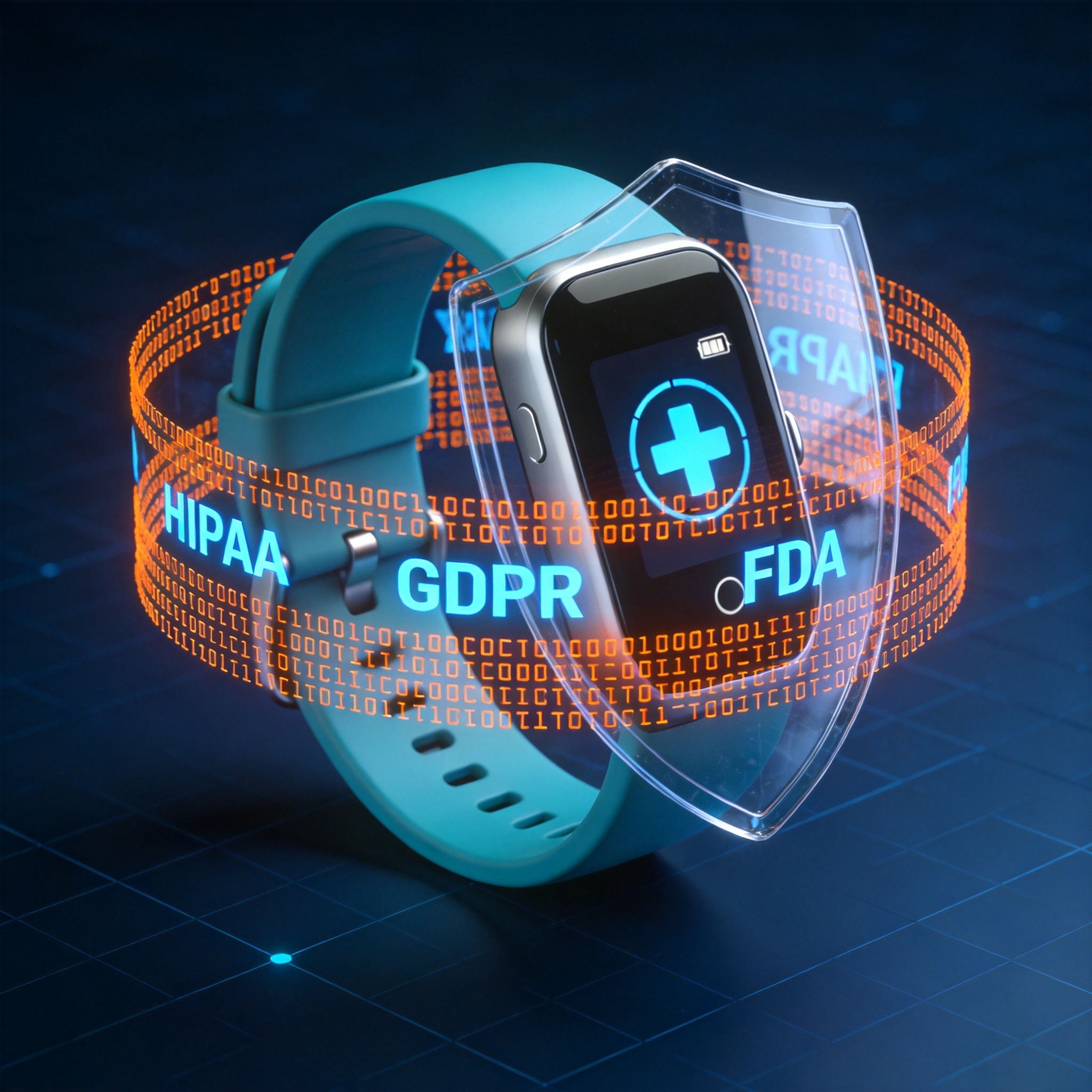
Understanding how HIPAA, GDPR, and FDA regulations intersect is crucial for medical wearable manufacturers serving global markets. Below is a comprehensive comparison table.
3.1 Regulatory Comparison Table
| Requirement Category | HIPAA (US) | GDPR (EU) | FDA (US) |
|---|---|---|---|
| Primary Focus | Protected Health Information (PHI) protection and portability | Personal data protection and privacy rights | Medical device safety, effectiveness, and cybersecurity |
| Applicable Data | PHI held by covered entities and business associates | All personal data of EU residents | Medical device software and data |
| Consent Requirement | Not explicitly required, but notice of privacy practices | Explicit, specific, informed consent for sensitive data | Informed consent for clinical studies; labeling for OTC |
| Data Minimization | Implied through minimum necessary standard | Explicit principle required | Related to intended use |
| Encryption Requirement | Addressable (must be implemented if reasonable and appropriate) | Required as appropriate technical measure | Recommended in cybersecurity guidelines |
| Breach Notification | 60 days following discovery | 72 hours to supervisory authority; without undue delay to individuals | MedWatch program; 10 days for certain cybersecurity incidents |
| Penalty Structure | Tiered based on negligence; up to $1.5M/year | Up to 4% global turnover or €20M | Warning letters, fines, product seizures, injunctions |
| Cross-Border Transfer Rules | No specific rules; covered entities must ensure protections | Adequacy decisions, SCCs, BCRs required | No specific data transfer rules; focuses on device safety |
| Risk Assessment | Required (security management process) | DPIA for high-risk processing | Required as part of QMS and cybersecurity |
| Third-Party Oversight | Business Associate Agreements (BAAs) | Data Processing Agreements (DPAs), controller-processor relationships | Supplier control over design, supplier quality agreements |
| Right to Access Data | Right to access and amend PHI | Comprehensive data subject rights (access, rectification, erasure, portability) | Patient access to device data through labeling requirements |
3.2 Key Compliance Requirements for Medical Wearables
Medical wearables must implement specific technical and organizational measures to meet these regulatory requirements:
Data Encryption
At every stage of the data lifecycle:
- At Rest: AES-256 encryption for stored data on devices and in cloud servers
- In Transit: TLS 1.3 for data transmission between devices, mobile apps, and cloud platforms
- End-to-End Encryption: For sensitive patient data from device to healthcare provider
Access Control
Implement robust access management ensures only authorized personnel can access sensitive data:
- Role-based access control (RBAC)
- Multi-factor authentication (MFA)
- Least privilege principle
- Regular access reviews and audits
Data Minimization
Collect only what is necessary:
- Purpose-specific data collection
- Anonymization and pseudonymization where possible
- Regular data purging schedules
- Granular data collection options for users
User Consent Management
Transparent and informed consent processes:
- Clear privacy notices in plain language
- Granular consent options
- Easy opt-out mechanisms
- Consent withdrawal processes
- Documentation of consent
Audit Logging
Comprehensive audit trails for all data access and modifications:
- Timestamped activity logs
- User identification
- Action performed
- Data accessed
- Regular log reviews
Data Breach Response
Preparedness is critical:
- Incident response plans
- Breach notification procedures
- Regular testing and drills
- Post-incident reviews
4. OEM/ODM Partner Compliance Responsibilities
In the medical wearable ecosystem, OEM/ODM partners play a critical role in ensuring regulatory compliance. The supply chain complexity means compliance extends beyond the final product manufacturer.
4.1 Supply Chain Security
Medical device manufacturers must ensure security throughout the supply chain:
- Vendor Risk Assessments: Evaluate potential partners’ security posture
- Security by Design: Integrate security into product development lifecycle
- Component Security: Ensure components and components don’t introduce vulnerabilities
- Software Supply Chain: Manage software components and dependencies
4.2 Data Processing Agreements (DPA)
When working with OEM/ODM partners, comprehensive data processing agreements are essential:
- Clearly defined data processing purposes and limitations
- Security measures requirements
- Data subject rights assistance
- Breach notification obligations
- Audit rights
- Data return or deletion at end of contract
- Sub-processor management
4.3 Compliance Certifications
Working with certified partners demonstrates commitment to security and quality:
- ISO 13485:2016 certification
- ISO 27001 certification
- ISO 14001 environmental management
- ISO 9001 quality management
- FDA QSR compliance
- CE marking for EU market
4.4 Shared Responsibility Model
Compliance in medical wearables is a shared responsibility:
| Party | Responsibilities |
|---|---|
| Device Manufacturer | Product safety, effectiveness, cybersecurity design, labeling, regulatory submissions |
| Healthcare Provider | HIPAA compliance, patient consent, data access controls |
| Cloud Provider | Infrastructure security, data center operations |
| Distributor | Proper handling, distribution controls, reporting adverse events |
| OEM/ODM Partner | Manufacturing quality, component security, process compliance |
5. Xdun Medical: Your Trusted Compliance Partner
As a leading OEM/ODM manufacturer of medical wearables, Xdun Medical understands that regulatory compliance is not an afterthought—it’s a core competency. Our commitment to data privacy and regulatory excellence sets us apart in the medical device manufacturing landscape.
5.1 Our Compliance Advantages
Design for Compliance (Security by Design) Philosophy
We integrate compliance and security into every stage of product development:
- Secure Development Lifecycle (SDLC): Our development processes incorporate security and compliance requirements from concept to commercialization
- Privacy by Design: Privacy considerations are built into system architecture
- Risk Management: Proactive risk assessment and mitigation throughout development
- Testing and Validation: Rigorous testing ensures compliance validation before product release
Comprehensive Certifications
Xdun Medical maintains critical certifications that demonstrate our commitment to quality and security:
- ISO 13485:2016: Quality management system for medical devices
- ISO 27001: Information security management system
- ISO 9001: Quality management system
- FDA QSR Compliance: Aligned with FDA quality system regulation
- CE Marking Capabilities: Support for EU market access
Expert Team
Our multidisciplinary team brings deep regulatory expertise:
- Regulatory affairs specialists with FDA and CE experience
- Cybersecurity engineers with healthcare security expertise
- Quality assurance professionals
- Clinical affairs professionals
- Data protection officers
5.2 How We Support Your Compliance Journey
Partnering with Xdun Medical means you gain a compliance partner, not just a manufacturer:
Regulatory Strategy Development
- Market entry strategy for US and EU markets
- Classification determination and pathway identification
- Regulatory submission support
- Post-market surveillance planning
Documentation Support
- Technical documentation preparation
- DHF (Design History File) maintenance
- DMR (Device Master Record) development
- Risk management files
Testing and Validation
- Biocompatibility testing
- Electrical safety testing
- EMC testing
- Software validation
- Cybersecurity testing
Post-Market Support
- Post-market surveillance
- Complaint handling
- Field safety corrective actions
- Software updates and patch management
6. Best Practices for Medical Wearable Compliance
Achieving and maintaining compliance requires a comprehensive, ongoing commitment across the organization. Here are best practices for medical wearable companies:
6.1 Implement a Compliance Framework
Establish a robust compliance program:
- Appoint a Chief Information Security Officer (CISO) or Data Protection Officer (DPO)
- Develop policies and procedures aligned with regulatory requirements
- Conduct regular risk assessments
- Implement compliance training for all employees
- Maintain up-to-date documentation
6.2 Security by Design
Integrate security into product development:
- Threat modeling during design phase
- Secure coding practices
- Regular vulnerability assessments and penetration testing
- Security patches and update mechanisms
- SBOM (Software Bill of Materials)
6.3 Vendor Management
Manage third-party risks:
- Conduct thorough vendor due diligence
- Execute appropriate agreements (BAAs, DPAs)
- Regular vendor security assessments
- Incident response coordination
- Exit strategies for vendor relationships
6.4 Incident Response Preparedness
Be prepared for security incidents:
- Develop and test incident response plans
- Conduct regular tabletop exercises
- Establish breach notification procedures
- Maintain cyber insurance coverage
- Conduct post-incident reviews and remediation
6.5 Continuous Monitoring and Improvement
Compliance is not a one-time achievement:
- Continuous monitoring systems and continuous monitoring
- Regular internal and external audits
- Stay current with regulatory changes
- Continuous improvement processes
- Customer feedback incorporation
7. Future Trends in Medical Wearable Compliance
The regulatory landscape for medical wearables continues to evolve. Key trends shaping the future include:
7.1 AI and Machine Learning
AI-powered medical wearables present new regulatory challenges:
- FDA’s AI/ML Action Plan for SaMD
- Predetermined Change Control Plans (PCCPs)
- Algorithmic bias considerations
- Transparency and explainability requirements
- Real-world evidence requirements
7.2 Global Regulatory Convergence
Increasing alignment between regulatory bodies:
- IMDRF (International Medical Device Regulators Forum) initiatives
- Convergence on cybersecurity requirements
- Mutual recognition agreements
- Harmonized standards
7.3 Enhanced Cybersecurity Focus
Regulators are placing greater emphasis on cybersecurity:
- More stringent premarket cybersecurity requirements
- Postmarket cybersecurity surveillance
- SBOM requirements
- Vulnerability disclosure programs
- Cyber resilience expectations
7.4 Patient-Centric Data Rights
Growing emphasis on patient control and access:
- Patient access to their health data
- Interoperability requirements
- Patient-generated health data (PGHD) integration
- Consumer-directed data portability
Frequently Asked Questions (FAQ)
Q1: Are all medical wearables subject to HIPAA?
No, not all medical wearables are subject to HIPAA. HIPAA applies only when the device or its data is used by a HIPAA-covered entity or business associate. Consumer wellness wearables used for general health and wellness are not typically subject to HIPAA. However, if the same device data is shared with a healthcare provider for clinical purposes, HIPAA requirements may apply.
Q2: What is the difference between HIPAA and GDPR for medical wearables?
HIPAA is a US law focused on healthcare data protection, while GDPR is an EU regulation covering all personal data including health data. Key differences include: GDPR applies extraterritorially, grants stronger data subject rights, and has higher maximum penalties. HIPAA specifically targets healthcare entities and their business associates, while GDPR applies to any organization processing EU residents’ data.
Q3: How does FDA regulate wearable medical devices?
FDA classifies medical devices based on risk (Class I, II, III) and requires different regulatory pathways accordingly. For software as a medical device (SaMD), FDA provides guidance on cybersecurity, clinical evaluation, and quality systems. Medical wearables may require 510(k) clearance, De Novo classification, or Premarket Approval depending on their intended use and risk level.
Q4: What certifications should I look for in an OEM/ODM partner for medical wearables?
Key certifications and capabilities to look for include: ISO 13485 certification for medical device quality management, ISO 27001 for information security, FDA QSR compliance capabilities, regulatory affairs expertise, cybersecurity capabilities, and a track record of successful regulatory submissions.
Q5: How can medical wearables comply with both HIPAA and GDPR?
Yes, medical wearables can comply with both frameworks. While there is significant overlap in technical requirements (encryption, access controls, risk assessments). The key is implementing a comprehensive compliance program that addresses both sets of requirements, including appropriate consent mechanisms, data subject rights processes, and cross-border data transfer mechanisms for GDPR, and business associate agreements for HIPAA.
Conclusion
Navigating the complex landscape of data privacy and compliance in medical wearables is essential for success in today’s regulatory environment. As HIPAA, GDPR, and FDA requirements continue to evolve, partnering with an experienced OEM/ODM manufacturer like Xdun Medical ensures your products meet the highest standards of data security and regulatory compliance.
Our commitment to security by design, comprehensive certifications, and expert regulatory team makes us the ideal partner for hospitals, senior care facilities, corporate wellness programs, and distributors looking to bring safe, secure, and compliant medical wearables to market.
Ready to bring your medical wearable vision to life with confidence? Contact Xdun Medical today to discuss how our compliance expertise and manufacturing capabilities can support your project. Our team is ready to guide you through every stage of product development, from concept to commercialization.
For more information about our medical wearable solutions and compliance capabilities, contact our team or explore our capabilities.