Skin Safety and Biocompatibility in Medical Wearables: Materials, Testing, and ISO 10993 Compliance
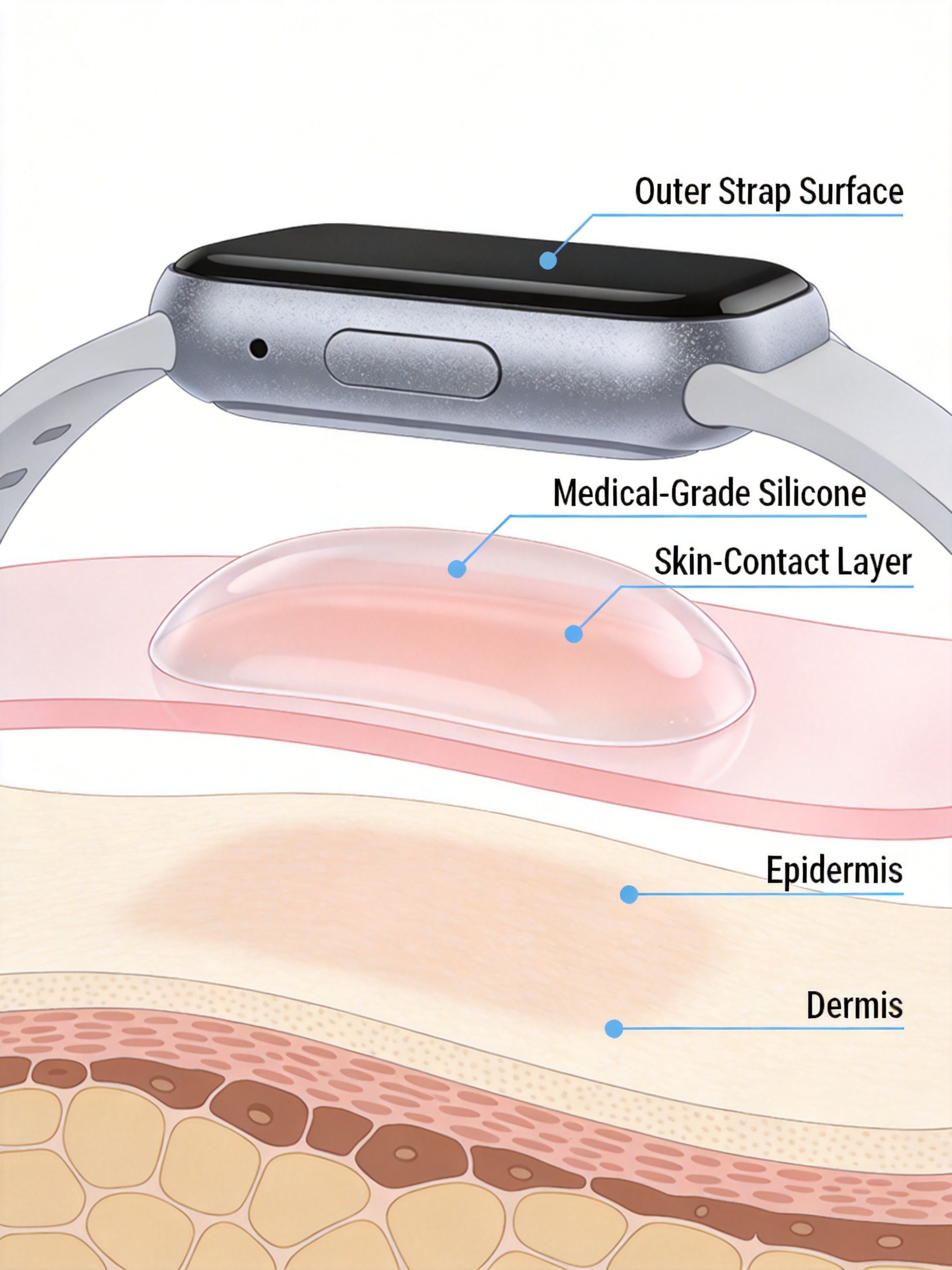
Medical wearables have moved far beyond fitness tracking. Today’s devices monitor cardiac rhythms, deliver continuous glucose readings, and track oxygen saturation in neonatal care—all while maintaining prolonged skin contact. Advanced platforms like the 4G ECG monitoring watch utilize medical-grade sensors to support continuous cardiac tracking, requiring rigorous material evaluation to ensure the device housing does not cause adverse skin reactions during extended use. For product managers, quality engineers, and regulatory affairs specialists, navigating material science, biocompatibility standards, and regulatory expectations is the foundation of a defensible submission and, more importantly, patient safety.
The Regulatory Landscape: ISO 10993 and FDA Expectations
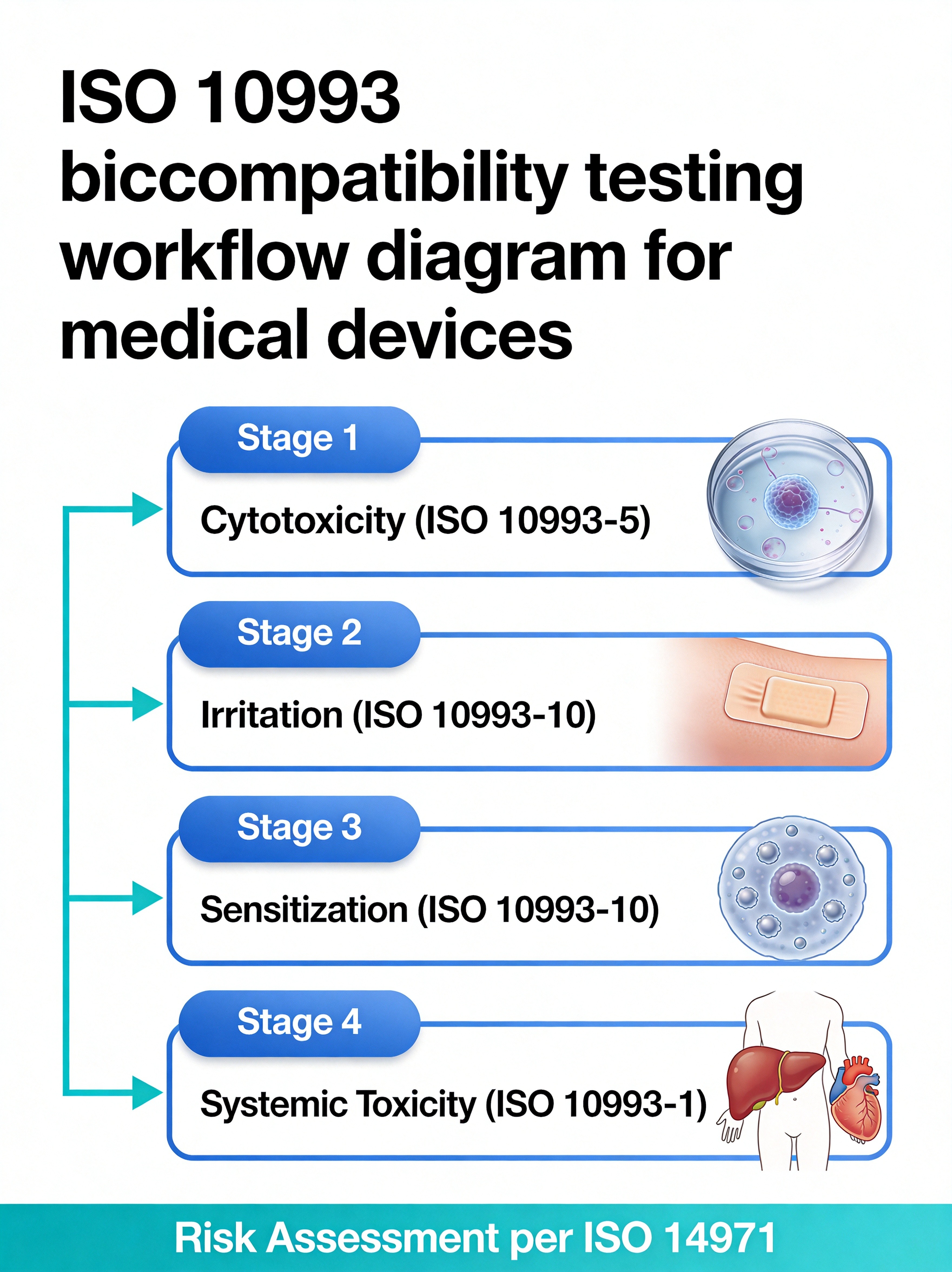
The ISO 10993 series governs biocompatibility evaluation for medical devices. The 2025 revision of ISO 10993-1 (sixth edition) represents a paradigm shift away from the traditional checklist approach toward a risk-management-driven methodology anchored in ISO 14971. Instead of selecting test endpoints from a static table, manufacturers must now conduct a formal biological risk assessment before determining which tests are necessary.
For skin-contact medical wearables, the relevant classification under ISO 10993-1:2025 falls under “intact skin contact only.” Depending on cumulative wear duration, devices are categorized as limited contact (≤24 hours), prolonged contact (24 hours to 30 days), or long-term contact (>30 days). Many wearables—continuous glucose monitors, Holter patches, and smartwatch-based SpO₂ sensors—fall into prolonged or long-term categories, triggering broader biological evaluation requirements.
The FDA’s guidance on ISO 10993-1, updated in September 2023 with Appendix G, provides recommendations for devices contacting only intact skin. For devices made from common polymers (silicone, certain plastics) and fabrics, the Agency may accept a streamlined biocompatibility assessment relying on material characterization, established safety records, and robust post-market surveillance—rather than every test panel. The 2025 revision also mandates chemical characterization under ISO 10993-18 as a prerequisite for biological testing. For multi-component wearables, each material must be characterized individually, and interaction effects evaluated. For deeper analysis, see the full ISO 10993 biocompatibility testing cost and timeline breakdown for wearables.
Materials in Skin-Contact Medical Wearables: A Comparative Analysis
Medical-Grade Silicone
Silicone remains the gold standard for prolonged skin contact. Its silicon-oxygen backbone with organic side groups provides inherent flexibility, thermal stability, and low surface energy that resists bacterial adhesion. Medical-grade silicone (platinum-cured LSR or HCR) is virtually free of leachable plasticizers, eliminating a major source of skin irritation. Its hypoallergenic profile makes it the material of choice for neonatal monitoring, wound care interfaces, and wearable infusion pump bases. Limitations include higher per-unit cost, limited resistance to certain hospital-grade disinfectants, and the need for post-curing to remove residual volatile siloxanes.
Thermoplastic Polyurethane (TPU)
TPU’s segmented block copolymer structure enables tunable hardness from Shore 60A to 75D. Medical-grade TPU formulations (Covestro’s Desmopan®, Lubrizol’s Pellethane®) meet USP Class VI and ISO 10993 requirements. TPU’s key advantage is processability: it can be injection-molded, extruded, or blow-molded into complex geometries at high throughput. Its abrasion resistance and tensile strength surpass silicone. However, TPU is more susceptible to hydrolysis in humid environments, and some formulations contain aromatic isocyanates that may raise sensitization concerns. For long-term wearables exposed to sweat, ether-based TPU offers better hydrolytic stability than ester-based variants.
Fluoroelastomer (FKM/FPM)
Fluoroelastomers are niche materials reserved for applications requiring exceptional chemical resistance—devices exposed to aggressive cleaning agents, transdermal patches with permeation enhancers, or seals in reusable sensor housings. Their highly fluorinated backbone delivers outstanding oxidation and chemical resistance. For skin-contact applications, biocompatibility depends heavily on the curing system: peroxide-cured grades offer a cleaner toxicological profile than bisphenol-cured variants. Higher density and stiffness limit use in flexible skin-contact surfaces, but they excel in sealing gaskets where chemical barrier performance is critical.
Stainless Steel (316L)
316L stainless steel is ubiquitous in electrodes, sensor housings, and structural frames. Its biocompatibility is well-established with decades of implant and skin-contact data. The primary concern is nickel leaching: 316L contains approximately 10–14% nickel. While the chromium oxide passivation layer effectively minimizes ion release in intact components, compromised surfaces—through machining scratches, prolonged exposure to acidic sweat (pH 4.5–5.5 during exercise), or repeated sterilization—can increase nickel release. For the estimated 10–20% of the population with nickel sensitivity, even trace amounts can trigger contact dermatitis. Passivation (per ASTM A967) and electropolishing significantly reduce surface nickel availability.
Titanium and Titanium Alloys
Titanium offers excellent strength-to-weight ratio, complete chloride-corrosion resistance, and—crucially—a nickel-free composition that eliminates the sensitization risk of stainless steel. Grade 2 commercially pure titanium is the most common variant for skin contact; Ti-6Al-4V (Grade 5) serves structural components. The spontaneously forming TiO₂ passive layer is exceptionally stable across the full physiological pH range. Titanium is also non-magnetic, suitable for MRI-conditional devices. The trade-off is cost: approximately 5–10 times more expensive than stainless steel, with specialized machining requirements.
Technical Ceramics (Zirconia and Alumina)
Zirconia (ZrO₂) and alumina (Al₂O₃) ceramics occupy a growing niche in optical sensor windows, capacitive touch surfaces, and thermal management components. Their chemical inertness is nearly absolute—they do not leach, corrode, or degrade in contact with any bodily fluid. From a biocompatibility perspective, ceramics are among the lowest-risk materials, completely free of organic additives, plasticizers, and metal ions. The primary consideration is surface finish: diamond-polished or glazed surfaces prevent bacterial entrapment and mechanical skin irritation. The limiting factor remains cost and brittleness that constrains design geometries.
Material Comparison Summary
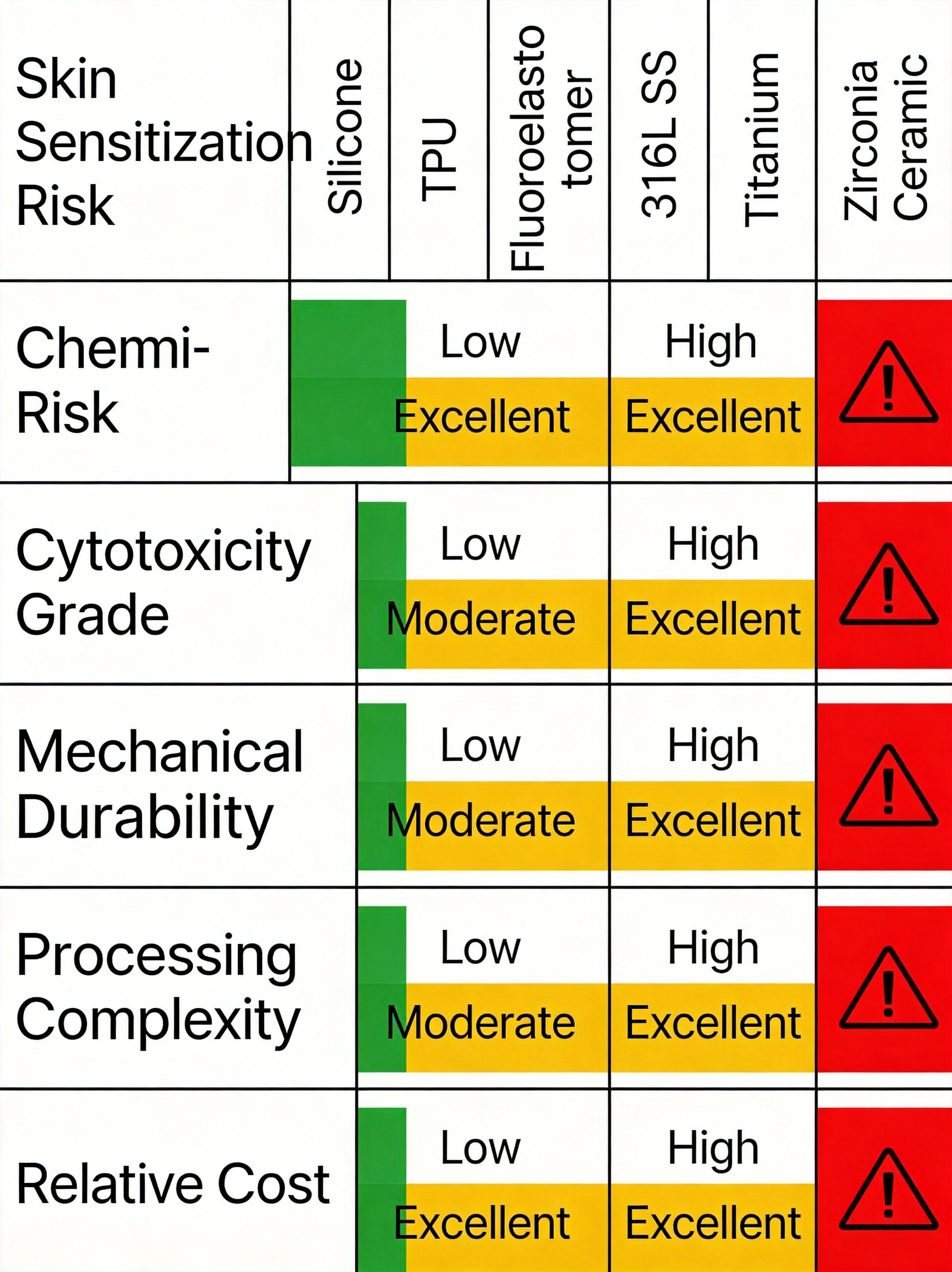
| Material | Skin Sensitization Risk | Cytotoxicity Profile | Chemical Resistance | Mechanical Durability | Processing Complexity | Relative Cost |
|---|---|---|---|---|---|---|
| Medical Silicone | Very Low | Grade 0–1 | Moderate | Moderate | Medium | $$ |
| Medical TPU | Low–Moderate | Grade 0–1 | Moderate | High | Low | $ |
| Fluoroelastomer | Low | Grade 0–1 | Excellent | High | High | $$$ |
| 316L Stainless Steel | Moderate (Ni) | Grade 0 | Good | Excellent | Medium | $$ |
| Titanium (Grade 2) | Very Low | Grade 0 | Excellent | Excellent | High | $$$ |
| Zirconia/Alumina Ceramic | Very Low | Grade 0 | Excellent | Moderate (Brittle) | Very High | $$$$ |
ISO 10993-5: Cytotoxicity Testing as the First Line of Defense
Cytotoxicity testing per ISO 10993-5 evaluates whether a material or its extractables cause cell death, inhibit proliferation, or disrupt cellular metabolism. Testing uses mammalian cell lines (typically L-929 mouse fibroblasts) exposed to material extracts prepared under standardized conditions simulating clinical use. The three standard methodologies—agar diffusion, direct contact, and MEM elution—offer different sensitivity profiles. The MEM elution method is most widely used for wearables, as it accommodates diverse geometries and is compatible with quantitative MTT assay readouts. The acceptance criterion: cell viability must exceed 70% of the negative control (cytotoxicity grade 0 or 1).
For wearable manufacturers, cytotoxicity testing serves as both a material selection gate and a quality control tool. A batch of silicone strap material that passes in its raw state may fail after a specific pigment or processing aid is introduced—underscoring why “medical-grade” raw material certification is never a substitute for finished-device testing. Under the 2025 revision, cytotoxicity and skin sensitization remain foundational screening tests, though the standard now permits exemption through comprehensive chemical characterization data demonstrating negligible extractables.
ISO 10993-10: Skin Irritation and Sensitization Testing
While cytotoxicity asks “is this material toxic to cells?”, ISO 10993-10 addresses the immunologically more nuanced question: “will this material trigger an inflammatory or allergic response in the skin?”
Skin Irritation Testing
Skin irritation is a localized, non-immunological inflammatory reaction. The standard in vivo test uses New Zealand White rabbits, with the material or its extract applied to shaved dorsal skin under occlusive patches for a minimum of four hours. Erythema and edema are scored at 1, 24, 48, and 72 hours post-removal. A Primary Irritation Index (PII) below 1.0 is generally acceptable. For wearable devices, physical design factors—edge geometry, ventilation, moisture accumulation—can contribute to mechanical irritation that exacerbates chemical irritation. Some manufacturers conduct supplementary human repeat-insult patch testing (HRIPT) on finished devices for 24/7 wear applications.
Skin Sensitization Testing
Unlike irritation, sensitization is an immunological response. A sensitized individual may tolerate the device for days before developing a delayed-type hypersensitivity reaction (Type IV). The standard in vivo method is the Guinea Pig Maximization Test (GPMT), with an induction phase followed by a challenge phase. A sensitization rate below 10% is the typical acceptance criterion. The Local Lymph Node Assay (LLNA) is increasingly preferred, offering a quantitative endpoint that reduces animal use. In vitro methods—KeratinoSens™ and h-CLAT—are gaining traction as screening tools during material selection, though not yet accepted as standalone replacements for regulatory submissions.
Systemic Toxicity: The Overlooked Dimension
When a wearable maintains skin contact 24/7, cumulative exposure to any leachable substances can be substantial. Systemic toxicity testing evaluates whether extractable compounds, once absorbed through the skin or incidentally ingested, cause adverse effects in distant organs. Under the 2025 revision of ISO 10993-1, the traditional tiered approach has been consolidated into a unified “systemic toxicity evaluation” customized to the device’s exposure profile. For a wearable with cumulative contact exceeding 30 days, the evaluating toxicologist must account for total extractable dose, dermal absorption rate, intended user population, and material degradation products forming over the device’s service life.
Designing for Sensitive Populations
Medical wearables are not worn exclusively by healthy adults. The intended-use population often includes neonates with immature stratum corneum, elderly patients with age-related epidermal thinning, diabetic patients with compromised skin integrity, and individuals with atopic dermatitis or known nickel allergies. Designing for these populations demands more than passing a standard battery of biocompatibility tests—it requires a material selection philosophy that defaults to the lowest-risk option. When Xdun Medical develops skin-contact components for wearable devices, the process starts with medical-grade silicone or titanium as the baseline—materials with decades of demonstrated safety in sensitive populations—and only departs when a specific performance requirement (such as injection-molded complex geometries at scale) necessitates an alternative. Even then, the departure is accompanied by rigorous extractables profiling, cytotoxicity screening, and supplementary sensitization testing on the finished assembly. For deeper analysis on how these principles apply to compact form factors, see our guide on smart ring skin contact materials and hypoallergenic coatings.
Long-Term Wear: The Cumulative Exposure Challenge
Most published biocompatibility data is derived from tests simulating acute or subacute exposure. A 72-hour cytotoxicity test or a 4-hour skin irritation patch does not fully model the reality of a continuous glucose monitor worn for 14 days or a cardiac monitoring patch used for years. Several degradation mechanisms become relevant over extended wear: hydrolytic degradation of ester-based TPU in sweat, oxidative degradation accelerated by skin lipids and UV exposure, mechanical fatigue creating micro-cracks that harbor bacteria, and pH cycling destabilizing metallic passivation layers. For devices targeting long-term wear, accelerated aging studies (per ASTM F1980) should be integrated with biocompatibility re-evaluation at multiple time points. Xdun Medical incorporates accelerated aging as a standard component of the biocompatibility evaluation package, ensuring material safety is demonstrated for the device at the end of its service life.
Practical Steps for Your Biocompatibility Strategy
- Define the contact scenario precisely. Under ISO 10993-1:2025, identify not just the intended contact duration but the cumulative lifetime exposure. A device worn 12 hours daily, replaced monthly, over a 5-year use period, requires a different evaluation than a single-use 24-hour patch.
- Complete chemical characterization first. Per the 2025 revision, ISO 10993-18 extractables and leachables analysis is the prerequisite for all subsequent biological testing—and enables potential test exemptions through toxicological risk assessment.
- Select materials with established safety records. Medical-grade silicone, 316L stainless steel, and Grade 2 titanium have extensive published biocompatibility data. Novel materials or proprietary formulations may require more extensive testing programs.
- Test the finished device, not just the raw materials. Processing aids, mold release agents, adhesive residues, and sterilization byproducts can introduce unexpected biological reactivity that raw material certificates will not capture.
- Plan for post-market surveillance. Biocompatibility is not a one-time gate. Real-world data—complaint analysis, MDR review, published literature monitoring—should feed back into your risk management file and trigger re-evaluation when patterns emerge.
Conclusion
Skin safety in medical wearables is not a single test or a certificate—it is a systems-level discipline spanning material selection, chemical characterization, biological testing, design engineering, and post-market vigilance. The ISO 10993 framework, particularly in its strengthened 2025 edition, provides the structure for demonstrating that your device does not cause unacceptable biological risk. But the standard is a floor, not a ceiling. Devices that earn the trust of clinicians and patients do so because their manufacturers invested in understanding the full picture of material-skin interaction, not just in checking regulatory boxes.
Selecting the right material partner matters. Xdun Medical supports medical device OEMs with medical-grade silicone, TPU, and metal components engineered for skin-contact applications, backed by comprehensive biocompatibility testing documentation aligned with ISO 10993-5, ISO 10993-10, and ISO 10993-1:2025. Whether you are developing a next-generation wearable monitor, a transdermal drug delivery patch, or a long-term rehabilitation sensor, the conversation about materials should start early—and it should start with safety.
Contact Xdun Medical to discuss your wearable device material requirements:
📧 jine@xdunmedical.com
📞 +86-13544254314
Disclaimer: This article provides general information for educational purposes and does not constitute regulatory or legal advice. Medical device manufacturers should consult qualified regulatory professionals for guidance specific to their product and target markets.