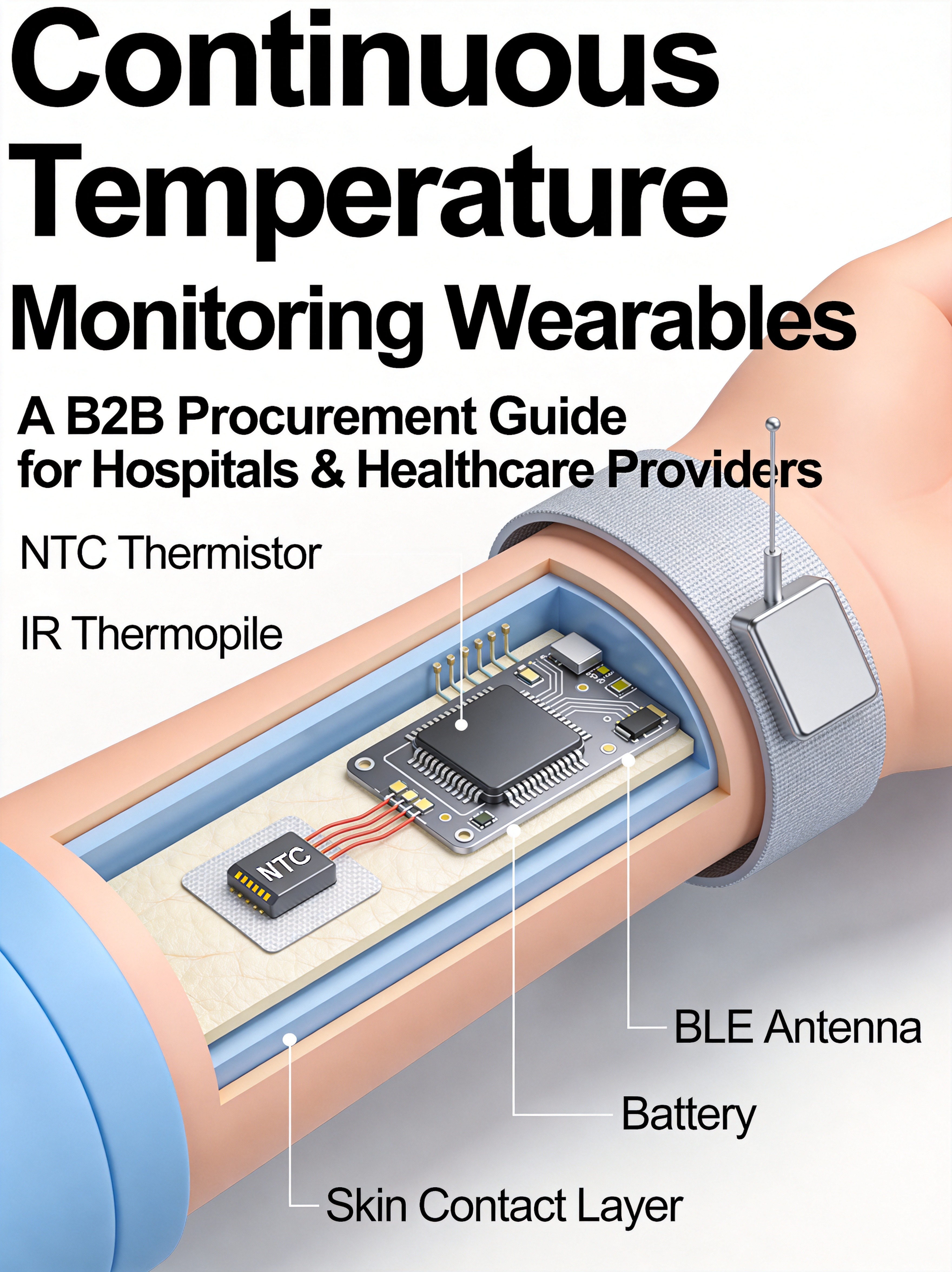
Continuous Temperature Monitoring Wearables: A B2B Procurement Guide for Hospitals and Healthcare Providers
By Xdun Medical | B2B OEM/ODM Medical Wearable Solutions
Body temperature is one of the oldest vital signs in medicine—yet the way most hospitals measure it hasn’t changed in decades. Spot-checking with a handheld thermometer every four to six hours remains the standard protocol across thousands of facilities worldwide. A patient can spike a fever at minute 10, and no one will know until minute 240. That gap represents a clinical blind spot with measurable consequences: delayed antibiotic administration, missed early signs of surgical site infection, and prolonged length of stay.
Continuous temperature monitoring wearables close this gap. This guide examines the technology, clinical evidence, procurement considerations, and supplier selection criteria that hospital buyers and healthcare procurement teams need to evaluate these devices for their institutions. For healthcare teams expanding their continuous vital signs capabilities, our procurement guide details the technological differences in blood pressure monitoring wearables, from PPG estimation to air pump measurement.
1. Why Spot-Checking Is No Longer Enough
The World Health Organization identifies temperature monitoring as a core component of clinical assessment across multiple care pathways, including perioperative care, infectious disease management, and vaccine cold-chain integrity. Yet the dominant method—manual spot-checking—suffers from structural limitations:
Detection latency. A study published in *Sensors* (2024) demonstrated that continuous temperature telemonitoring detected fever episodes up to seven hours earlier than conventional four-hour spot measurements in patients with COVID-19 and other infectious diseases. Another investigation found the iThermonitor WT705 wearable patch identified fever an average of 4.35 hours earlier than mercury thermometers.
Inconsistent technique. The Society of Critical Care Medicine and Infectious Diseases Society of America (2023) note that measurement site, device type, and operator technique introduce significant variability. Axillary measurements—still common in many wards—correlate poorly with core temperature, while oral readings are affected by recent fluid intake, respiratory rate, and probe placement.
Documentation gaps. Manual logging creates opportunities for omission, transcription error, and delayed clinical response. A 2022 perioperative feasibility study published in *Patient Safety in Surgery* found that without continuous monitoring, adherence to guideline-recommended 15-minute temperature checks in post-anesthesia care units was effectively zero.
Staff workload. Each spot-check consumes 3–5 minutes of nursing time per patient. Across a 30-bed ward running four checks daily, that translates to roughly six hours of nursing labor per day dedicated solely to temperature measurement—time that could be redirected to higher-acuity tasks.
The CDC’s infection prevention guidelines for healthcare facilities emphasize early detection and isolation of febrile patients as a cornerstone of outbreak containment. Continuous monitoring transforms temperature surveillance from an intermittent, reactive process into a continuous, proactive one.
2. Sensor Technologies: NTC Thermistors vs. Infrared Thermopiles
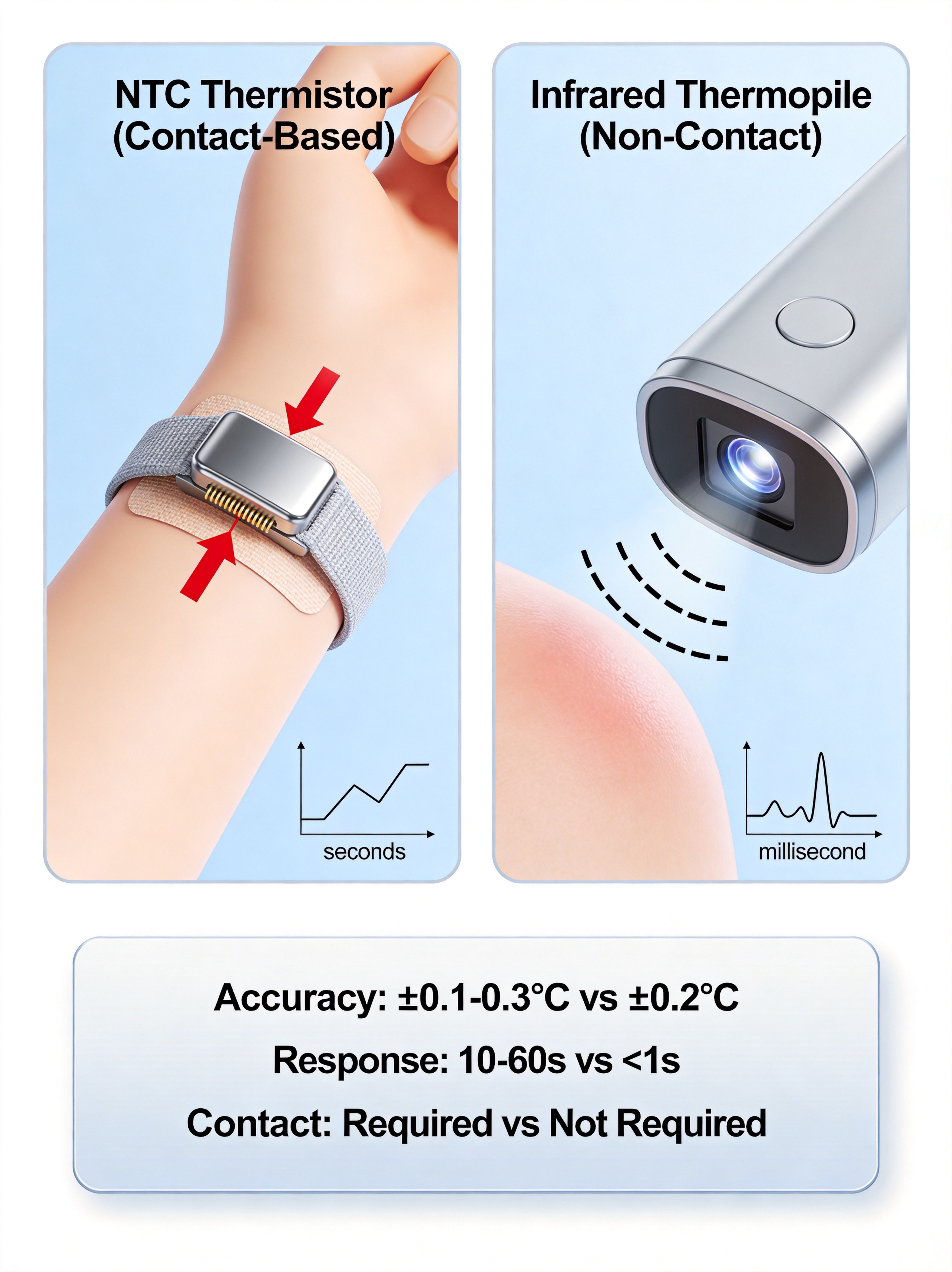
Continuous temperature wearables rely on one of two sensor architectures. Understanding their differences is essential for procurement decisions, because the choice of sensor directly affects accuracy, power consumption, response time, and clinical suitability.
2.1 NTC Thermistors (Contact-Based)
Negative Temperature Coefficient (NTC) thermistors are semiconductor ceramic elements whose electrical resistance decreases predictably as temperature rises. Temperature is calculated using the Steinhart-Hart equation, which maps resistance to temperature with high precision.
How they work in wearables: The thermistor is embedded in the device housing or strap, positioned to maintain direct skin contact—typically at the wrist, upper arm, or axilla. Heat from the skin conducts through the housing material into the sensor. The device’s microcontroller reads the resistance value, applies calibration coefficients, and outputs a temperature reading.
Performance characteristics:
| Parameter | Typical Value |
| Clinical accuracy (with proper contact) | ±0.1°C to ±0.3°C |
|---|---|
| Response time to equilibrium | 10–60 seconds |
| Power consumption | < 1 mW (passive sensing) |
| Calibration requirement | R-T curve matching per batch |
| Long-term drift | Gradual aging drift over 2–5 years |
Advantages: Low cost, minimal power draw, well-established manufacturing chain, simple integration with existing MCU platforms. When the device maintains consistent, firm skin contact under stable ambient conditions, NTC thermistors deliver clinically useful accuracy.
Limitations: Performance degrades significantly under variable contact conditions. Sweat alters thermal conductivity at the skin-sensor interface. Loose band fit introduces air gaps that act as thermal insulators. Ambient airflow—common in air-conditioned wards—can pull readings downward by 1–2°C. These factors make NTC-based wrist wearables less reliable during patient movement or in environments with fluctuating ambient temperature.
A 2015 study in *PLOS ONE* comparing conductive (thermistor) and infrared devices for skin temperature measurement found that thermistors maintained superior agreement with reference measurements under resting conditions (mean bias ±0.01°C vs. iButton reference). However, agreement deteriorated during exercise and recovery phases, underscoring the contact-quality dependency.
2.2 Infrared Thermopiles (Non-Contact)
Infrared thermopile sensors operate on the principle of thermal radiation detection. All objects above absolute zero emit infrared energy proportional to their temperature (Stefan-Boltzmann law). A thermopile sensor captures this radiation through an optical window, converts it to a voltage via the Seebeck effect across multiple thermocouple junctions, and calculates the target temperature.
How they work in wearables: The sensor is mounted facing the skin surface, typically behind an optical window with a bandpass filter tuned to the human body’s peak emission wavelength (~9–10 μm). Unlike contact sensors, the thermopile does not require direct pressure against the skin—only a stable optical path within a defined distance and angle.
Performance characteristics:
| Parameter | Typical Value |
| Clinical accuracy (factory-calibrated) | ±0.2°C |
|---|---|
| Response time | Milliseconds |
| Power consumption | 1–5 mW (including ambient compensation) |
| Calibration requirement | Factory calibration; ambient drift compensation algorithm |
| Long-term stability | Stable optical elements; window contamination risk |
Advantages: Sub-second response enables detection of rapid temperature fluctuations. No thermal equilibrium wait time. Non-contact operation eliminates skin irritation from prolonged pressure. Less sensitive to sweat and movement artifacts compared to contact sensors when proper algorithms are in place.
Limitations: Accuracy depends on maintaining consistent sensor-to-skin distance and angle. Optical window contamination (skin oils, dust) degrades signal quality over time. Ambient temperature changes require algorithmic compensation—sensors can drift briefly when moving between environments (e.g., air-conditioned room to hallway). Higher component cost compared to basic NTC solutions.
2.3 Head-to-Head Comparison for Clinical Procurement
| Criterion | NTC Thermistor | Infrared Thermopile |
| Accuracy (ideal conditions) | ±0.1–0.3°C | ±0.2°C |
|---|---|---|
| Accuracy (real-world, variable contact) | Degrades significantly | Moderate degradation |
| Response speed | Slow (seconds to minutes) | Fast (milliseconds) |
| Motion artifact sensitivity | High | Low–Moderate |
| Skin contact requirement | Must maintain firm contact | No contact required |
| Power consumption | Very low | Low |
| Unit cost (sensor only) | Lower | Higher |
| Best clinical scenario | Static monitoring (sleep, bed-bound) | Dynamic monitoring (ambulatory, active patients) |
| Algorithm complexity | R-T table lookup | Requires ambient compensation |
Neither technology is universally superior. The optimal choice depends on the intended clinical use case, patient population, and care environment. Many advanced wearable platforms—including those developed by Xdun Medical—employ sensor fusion architectures that combine both technologies, using thermistor data for baseline tracking and infrared for rapid transient detection.
3. Clinical Applications and Evidence
3.1 Postoperative Temperature Surveillance
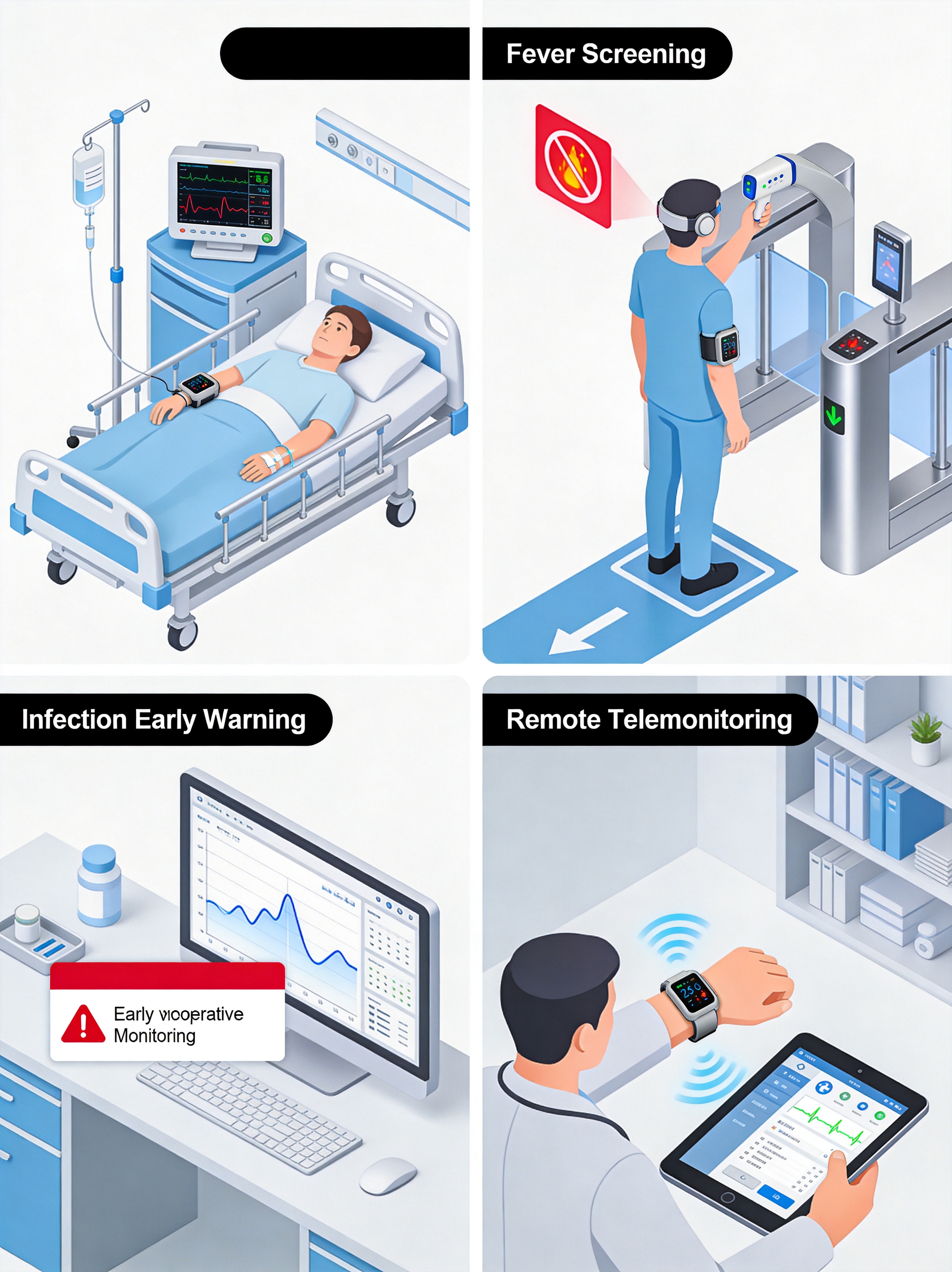
Postoperative hypothermia and fever are among the most common complications following surgery. The 2023 Chinese Expert Consensus on Perioperative Hypothermia Prevention recommends continuous temperature monitoring from preoperative assessment through post-anesthesia care unit (PACU) discharge, with measurements every 15–30 minutes.
A 2022 feasibility study published in *Patient Safety in Surgery* evaluated zero-heat-flux continuous temperature monitoring across the perioperative pathway. Key findings:
– Without continuous monitoring, zero percent of patients received guideline-adherent 15-minute temperature checks in the PACU.
– With continuous monitoring, adherence rose to 46% in the PACU.
– On PACU admission, 37% of patients in the usual-care group exhibited mild hypothermia (35.0–35.9°C), compared to 43% in the continuous-monitoring group—but the continuous group received faster warming intervention because the decline was detected in real time rather than at a single admission measurement.
The clinical stakes are well-documented: intraoperative hypothermia increases surgical site infection rates, impairs coagulation, prolongs anesthetic recovery, and extends hospital stays.
Wearable patches offer a practical alternative to invasive core-temperature probes (esophageal, bladder) for ward-level postoperative monitoring, where invasive methods are neither appropriate nor feasible.
3.2 Fever Screening and Infection Surveillance
Hospital-acquired infections (HAIs) affect an estimated 7–10% of hospitalized patients in developed countries, according to WHO data. Early fever detection is the first line of clinical response.
A 2021 study in *IEEE Journal of Translational Engineering in Health and Medicine* evaluated a novel wearable device for continuous temperature monitoring and fever detection. The device demonstrated the ability to identify febrile events hours before scheduled spot-checks would have captured them.
The CDC’s infection control guidelines for healthcare facilities mandate “rapid triage and isolation of patients who might have [infectious disease] infection.” Continuous temperature wearables enable automated screening without staff intervention—a capability that proved transformative during COVID-19 and remains relevant for seasonal influenza, RSV, and emerging pathogens.
In skilled nursing facilities and long-term care settings—where residents are often unable to articulate symptoms and staff-to-patient ratios are lower than in acute-care hospitals—automated fever alerts provide an essential safety net. Wearable devices can push notifications to nursing stations or mobile devices when a resident’s temperature crosses a configurable threshold, enabling early intervention before infection spreads through the facility. For environments where Wi-Fi coverage is inconsistent, the 4G LTE temperature monitoring watch assists care teams by using standalone cellular connectivity and medical-grade sensors to ensure these critical alerts are transmitted without interruption.
3.3 Remote Patient Monitoring and Telemedicine
The expansion of hospital-at-home and remote patient monitoring programs has created demand for wearable devices that transmit temperature data to clinical dashboards outside hospital walls.
A 2024 *Sensors* study on the Viture® system validated continuous temperature telemonitoring for COVID-19 patients in hospital-at-home settings, demonstrating that wearable data streams could be integrated into clinical workflows with actionable alert thresholds.
For healthcare systems building or expanding telemedicine infrastructure, temperature wearables serve as one component of a multi-parameter remote monitoring platform—typically alongside heart rate, SpO₂, and respiratory rate. The value proposition extends beyond individual patient care to population health management: aggregated temperature trends across a monitored cohort can provide early warning of infectious disease outbreaks within a facility or community. For deeper analysis, see the complete OEM/ODM procurement guide for remote patient monitoring wearables, which details the technical specifications and vendor evaluation criteria for multi-parameter devices.
3.4 Infection Warning Systems
Beyond simple threshold alerts, advanced temperature monitoring platforms are incorporating trend-analysis algorithms that identify patterns predictive of infection before fever crosses the clinical threshold. These systems analyze circadian rhythm disruption, rate of temperature change, and deviation from individual baselines.
Research indicates that continuous temperature monitoring can detect infectious complications up to 14 hours earlier than standard nursing chart review. For immunocompromised patients—such as those undergoing chemotherapy or post-transplant care—this early warning window can be the difference between outpatient oral antibiotics and an ICU admission.
4. Traditional Thermometry vs. Continuous Wearables
| Feature | Manual Spot-Check | Continuous Wearable |
| Measurement frequency | Every 4–6 hours (typical) | Every 1–10 minutes |
|---|---|---|
| Fever detection latency | Hours | Minutes |
| Trend data | None (discrete readings) | Continuous time-series |
| Staff labor per patient/day | 12–20 minutes | 0 minutes (automated) |
| Documentation | Manual logging | Automated data capture |
| Nighttime monitoring | Disrupts patient sleep | Passive, non-disruptive |
| Alarm capability | None | Configurable thresholds |
| Data integration | Paper chart or manual EHR entry | API/HL7 integration with HIS/EMR |
| Hypothermia detection | Often missed between checks | Continuous surveillance |
| Patient mobility | Tethered to nursing schedule | Ambulatory, unrestricted |
The economic case extends beyond labor savings. Earlier detection of postoperative infections reduces average length of stay. For a hospital with 200 surgical beds and a baseline SSI rate of 2%, preventing even a fraction of infections through earlier detection can offset device procurement costs within the first year of deployment.
5. OEM Procurement: Key Selection Criteria
For hospitals, healthcare systems, and distributors sourcing continuous temperature monitoring wearables from OEM partners, the following criteria should guide supplier evaluation:
5.1 Sensor Architecture and Accuracy Validation
– Request the sensor specification sheet: thermistor type (NTC precision grade), thermopile model, or hybrid architecture.
– Ask for accuracy validation data across the device’s operating temperature range (typically 34–42°C for clinical use).
– Evaluate whether the manufacturer conducts per-unit factory calibration or batch-level calibration.
– For thermopile-based devices, confirm the presence of ambient temperature compensation algorithms.
5.2 Form Factor and Wearability
– Wrist-worn (watch/band): Familiar form factor, high patient acceptance. Accuracy depends on band tightness and ambient conditions.
– Upper-arm patch: Superior thermal stability, closer to core temperature. Adhesive-based, single-use or limited-reuse.
– Chest patch/strap: Multi-parameter capability (temperature + ECG + respiratory rate). Best for comprehensive monitoring but higher per-unit cost.
– Ring: Minimal footprint, good for sleep monitoring and long-term trend tracking.
The optimal form factor depends on the clinical application. Postoperative wards may prefer disposable patches; long-term care facilities may favor rechargeable wristbands; telemedicine programs may require a mix of form factors for different patient cohorts.
5.3 Connectivity and Data Infrastructure
– Bluetooth Low Energy (BLE): Standard for short-range connectivity to a bedside hub, tablet, or patient smartphone.
– Wi-Fi: Enables direct-to-cloud data transmission without an intermediary device. Higher power consumption.
– Cellular (LTE-M/NB-IoT): For truly untethered remote monitoring, particularly in home-health settings.
– Gateway architecture: In hospital deployments, BLE-to-WiFi gateways per ward reduce per-device cost and simplify network management.
Confirm that the manufacturer’s data platform supports HL7 FHIR or equivalent API standards for integration with existing hospital information systems (HIS) and electronic medical records (EMR).
5.4 Battery Life and Charging Logistics
– For rechargeable devices: minimum 24-hour continuous monitoring on a single charge. Seven-day battery life enables weekly charging cycles that align with nursing workflows.
– For disposable patches: minimum 72-hour continuous operation to cover the critical postoperative window.
– Evaluate charging infrastructure: individual USB chargers vs. multi-device charging docks. A 30-bed ward requires a manageable charging workflow.
5.5 Regulatory and Quality Documentation
– FDA 510(k) clearance or registration: For US market entry. Temperature monitoring wearables typically fall under Class II (with predicates) or may pursue De Novo classification for novel architectures.
– CE marking (EU MDR): Required for European market access. Temperature monitoring devices are typically Class IIa under Rule 10 (devices for monitoring physiological processes).
– ISO 13485 certification: Demonstrates quality management system compliance for medical device manufacturing.
– Biocompatibility (ISO 10993): Required for skin-contacting components.
– IEC 60601 series: Electrical safety and electromagnetic compatibility for medical electrical equipment.
– Data security: HIPAA compliance for US deployments; GDPR for EU. Confirm encryption standards for data at rest and in transit.
A credible OEM partner should provide a regulatory documentation package that supports the buyer’s own certification or registration process in the target market.
5.6 Customization Capabilities
For distributors and healthcare brands, evaluate:
– Industrial design customization: Enclosure color, material, logo placement, packaging.
– Firmware customization: Measurement intervals, alert thresholds, device behavior.
– Application white-labeling: Branded mobile app and web dashboard.
– Cloud platform branding: Custom domain, logo, color scheme on the data platform.
– Minimum order quantity (MOQ): Typically ranges from 500–3,000 units for custom SKUs depending on the scope of modification.
5.7 Quality Control and Production Scale
– Factory certifications: ISO 13485, ISO 9001.
– Production capacity: can the supplier scale to your projected volumes?
– Quality control: in-line testing protocols, batch sampling rates, calibration verification.
– Lead times: from PO confirmation to delivery, including customization cycles.
– After-sales support: warranty terms, defect rate commitments, replacement logistics.
6. Xdun Medical: Continuous Temperature Monitoring Solutions
Xdun Medical brings over 15 years of OEM/ODM manufacturing experience to the wearable health monitoring market, serving healthcare providers and distributors across 30+ countries. The company’s temperature monitoring portfolio spans multiple form factors designed for different clinical and care settings.
Wrist-Worn Temperature Monitoring: Xdun’s smart watch and smart band platforms integrate precision temperature sensors alongside multi-parameter health monitoring—including heart rate, SpO₂, blood pressure, and ECG. These devices support 24-hour continuous temperature tracking with configurable alert thresholds and cloud-based data dashboards. The wrist form factor offers high patient compliance for general ward monitoring, elderly care, and workplace health programs.
Clinical-Grade Sensor Architecture: Xdun platforms employ calibrated sensor modules with factory-level accuracy validation. The devices support real-time data transmission via BLE to the Xdun Cloud Platform, which provides analytics, trend visualization, and integration APIs for hospital information systems. The platform is designed to support HIPAA and GDPR compliance requirements.
OEM/ODM Flexibility: Every Xdun product is available for full customization—from industrial design and firmware to mobile applications and cloud dashboards. This enables healthcare distributors, telehealth platforms, and hospital groups to deploy temperature monitoring solutions under their own brand identity with tailored feature sets.
Certification Support: Xdun products carry CE, FCC, RoHS, FDA registration, and BIS certifications. The company’s regulatory team supports clients through the documentation and testing requirements for target-market certification.
Production Scale: With daily production capacity exceeding 50,000 units and ISO-certified manufacturing facilities, Xdun Medical can support deployments ranging from pilot programs to system-wide rollouts.
7. Implementation Roadmap for Hospital Buyers
Phase 1: Needs Assessment (2–4 weeks)
– Define clinical use cases: postoperative monitoring, infection surveillance, elderly care, telemedicine.
– Map patient volume and device quantity requirements.
– Assess existing IT infrastructure: WiFi coverage, EMR integration readiness, data security requirements.
– Identify stakeholder departments: nursing, IT, infection control, biomedical engineering, procurement.
Phase 2: Vendor Evaluation (4–8 weeks)
– Issue RFI/RFP to shortlisted OEM partners.
– Request accuracy validation data, regulatory certificates, and reference accounts.
– Conduct on-site or virtual factory audits.
– Request evaluation units for clinical pilot.
Phase 3: Pilot Deployment (4–12 weeks)
– Deploy 20–50 devices in a single ward or unit.
– Define success metrics: alert response time, staff satisfaction, device uptime, data completeness.
– Integrate with existing nursing workflows; identify friction points.
– Collect clinician feedback and adjust configurations.
Phase 4: System-Wide Rollout (8–24 weeks)
– Finalize device configuration and branding.
– Develop training materials for nursing and IT staff.
– Deploy gateway infrastructure and cloud platform integration.
– Establish ongoing support and replenishment logistics.
8. Looking Ahead
Continuous temperature monitoring is one component of a broader shift toward continuous, multi-parameter patient surveillance. The convergence of wearable sensors, edge computing, and AI-driven analytics is reshaping how hospitals detect clinical deterioration.
The FDA has cleared over 1,000 AI/ML-enabled medical devices as of early 2025, many incorporating data from wearable sensors. Temperature trend analysis algorithms that learn individual patient baselines and detect subtle deviations are in active development. When integrated with heart rate variability, respiratory rate, and SpO₂ trends, temperature data becomes part of an early warning score that can predict clinical deterioration hours before conventional vital sign changes become apparent.
For hospital procurement teams, the question is not whether continuous temperature monitoring will become standard practice—but when, and with which technology partner.
Contact Xdun Medical
Xdun Medical partners with hospitals, nursing homes, telehealth providers, and healthcare distributors worldwide to deliver customized continuous temperature monitoring solutions. Our OEM/ODM team supports every stage of deployment—from initial concept and prototyping through clinical validation, regulatory documentation, and scaled production.
Email: jine@xdunmedical.com
Website: https://xdunmedical.com
What to include in your inquiry:
– Target clinical application and patient population
– Estimated device quantity and deployment timeline
– Form factor preference (watch, band, patch, ring)
– Required certifications for your target market
– Customization requirements (branding, firmware, app, cloud platform)
Our team responds to B2B inquiries within one business day.
*Disclaimer: This article is for informational purposes only and does not constitute medical advice. Product specifications, certifications, and capabilities should be confirmed directly with the manufacturer. Regulatory requirements vary by jurisdiction; buyers are responsible for verifying compliance in their target market.*